
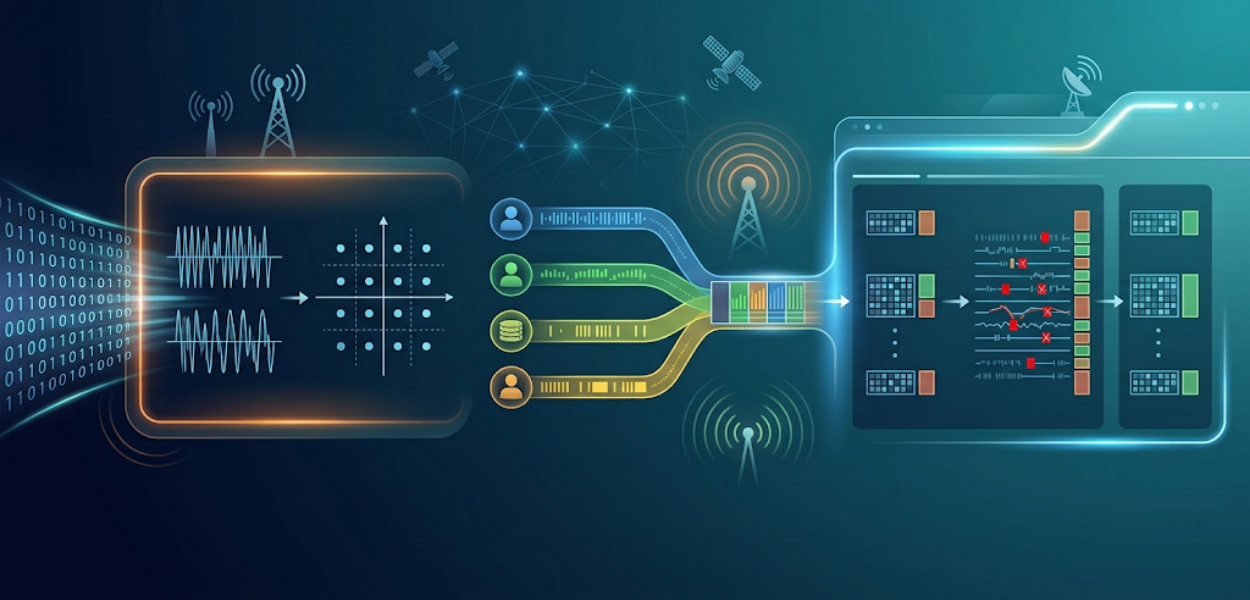
Wireless communication systems move data through open air using controlled radio waves. Every signal faces noise, interference and bandwidth limits. Engineers who understand modulation, multiplexing and channel coding solve these constraints with precision rather than guesswork.
Organisations building RF and telecom capability often start with foundational concepts before moving to applied skills. Essential Wireless Communication Systems Concepts and Standards Training Courses introduce the terminology, mathematics and system architecture that underpin every wireless network deployed today. This foundation matters because misapplied modulation choices or weak coding schemes cause measurable signal loss, dropped calls and failed data transmissions in commercial networks.
Workforce skill gaps in RF engineering remain a persistent HR concern. Telecom operators report that entry-level engineers frequently lack hands-on exposure to modulation trade-offs and channel coding design. This gap widens as 5G and satellite communication systems demand faster, more reliable data links. Training investment closes this gap only when it targets the specific technical layers that determine network performance.
What is essential wireless communication systems training and why does it matter for engineering teams?
Essential wireless communication systems training teaches engineers how signals are encoded, transmitted and recovered across noisy channels, covering modulation, multiplexing, duplexing and channel coding as core technical building blocks for network design. These four elements determine how much data a system carries, how many users it serves simultaneously and how well it resists interference.
Telecom and RF teams rely on these concepts daily. A network engineer configuring a base station applies modulation theory to set data rates. A systems architect designing a satellite link applies channel coding to guarantee error-free transmission across long distances with weak signal strength. Without structured training, engineers often learn these concepts through fragmented on-the-job exposure, which slows project delivery and increases design errors.
Measurable business outcomes follow from structured technical training. Teams with formal RF training complete network design reviews faster because engineers share a common technical vocabulary. Fewer design iterations reduce project costs and shorten deployment timelines. HR and L&D teams increasingly track these outcomes as part of workforce development ROI, linking training completion to reduced project rework rates.
How do modulation schemes affect signal reliability and data throughput?
Modulation schemes convert digital information into radio waves by varying amplitude, frequency or phase, and the chosen scheme directly determines how much data a channel carries and how resistant that data remains against noise. Amplitude Shift Keying, Frequency Shift Keying and Phase Shift Keying represent the three foundational approaches, each suited to different bandwidth and reliability requirements.
Higher-order modulation schemes such as 64-QAM or 256-QAM pack more bits into each transmitted symbol. This increases throughput significantly, often doubling or tripling data rates compared with simpler schemes like BPSK. The trade-off appears at the receiver. Higher-order schemes require a stronger signal-to-noise ratio to decode correctly, because symbol points sit closer together on the constellation diagram. A weak signal-to-noise ratio causes symbol errors, which corrupt data and force retransmission.
Network engineers select modulation schemes based on channel conditions. Urban environments with high interference favour lower-order, more robust schemes. Point-to-point microwave links with strong, stable signals favour higher-order schemes to maximise capacity. Cellular standards such as LTE and 5G NR use adaptive modulation, switching schemes in real time based on measured signal-to-noise ratio at the user device. This adaptability keeps connections stable while maximising throughput whenever channel conditions allow it.
Engineers trained in modulation theory recognise these trade-offs immediately during network planning. This reduces the risk of over-engineering a network for capacity it cannot reliably deliver, or under-engineering a system that fails during peak interference periods.
What role does multiple access play in shared wireless channels?
Multiple access techniques allow many users to share the same wireless spectrum simultaneously without their signals colliding, using methods such as Time Division, Frequency Division, Code Division and Orthogonal Frequency Division Multiple Access. Spectrum is a finite, licensed resource, so efficient sharing determines how many subscribers a network supports.
Time Division Multiple Access assigns each user a distinct time slot on the same frequency. Frequency Division Multiple Access assigns each user a distinct frequency band. Code Division Multiple Access allows users to transmit simultaneously on the same frequency and time slot, separated instead by unique spreading codes. Orthogonal Frequency Division Multiple Access, used in 4G and 5G networks, divides the channel into many narrow orthogonal subcarriers, allocating subsets to different users based on demand.
Cellular standards evolved specifically to improve multiple access efficiency. 2G networks relied on TDMA and FDMA combinations, supporting limited subscriber density per cell. 3G introduced CDMA, increasing capacity and improving call quality in dense urban areas. 4G LTE and 5G NR adopted OFDMA, which handles variable data demands from video streaming, voice calls, and machine-to-machine communication within the same cell far more efficiently.
Engineers who understand these techniques design networks that match subscriber density and traffic patterns accurately. A poorly chosen multiple access scheme leads to congestion, dropped connections and poor quality of service during peak usage hours, directly affecting customer retention for telecom operators.
How does channel coding protect data across noisy channels?
Channel coding adds structured redundancy to transmitted data so that receivers can detect and correct errors caused by noise, interference, or signal fading, without requiring retransmission of the original message. Forward Error Correction codes, including convolutional codes, Turbo codes and Low-Density Parity-Check codes, represent the dominant approaches used in modern cellular and satellite systems.
Convolutional codes process data as a continuous stream, encoding each bit based on several preceding bits. This creates a memory effect that helps receivers reconstruct the original sequence even when some bits arrive corrupted. Turbo codes improve on this by using two convolutional encoders in parallel with an interleaver, achieving performance close to the theoretical Shannon limit for channel capacity. LDPC codes, used extensively in 5G and Wi-Fi 6, offer strong error correction with lower decoding complexity, making them efficient for high-speed data applications.
Channel coding directly affects the acceptable signal-to-noise ratio threshold for reliable communication. Strong coding schemes allow systems to operate reliably even when the signal-to-noise ratio drops below levels that would otherwise cause unacceptable error rates. This matters significantly in satellite communication, where signals travel thousands of kilometres and arrive severely attenuated.
Engineers who design without adequate channel coding knowledge risk building systems that perform well in laboratory conditions but fail in real-world deployment, where noise and interference vary constantly. Structured coding knowledge prevents this gap between theoretical design and field performance.
What is duplexing and how does it separate transmission directions?
Duplexing determines how a communication system manages simultaneous transmission and reception, using either Time Division Duplexing or Frequency Division Duplexing to separate uplink and downlink signals. This separation prevents a device's own transmitted signal from overwhelming its receiver.
Frequency Division Duplexing allocates separate frequency bands for uplink and downlink, allowing continuous simultaneous transmission and reception. This suits voice-centric applications where consistent, low-latency two-way communication matters. Time Division Duplexing allocates the same frequency band to both directions but separates them in time, switching rapidly between transmit and receive slots. This suits data-centric applications with asymmetric traffic, such as video streaming, where downlink demand typically exceeds uplink demand.
5G networks use both duplexing methods depending on spectrum availability and use case. Mid-band and high-band 5G deployments favour TDD because it allows flexible allocation between uplink and downlink based on real-time traffic demand. Low-band 5G deployments, inherited from existing LTE infrastructure, often retain FDD for coverage continuity.
Engineers who understand duplexing trade-offs select the correct architecture for specific deployment scenarios, balancing spectrum efficiency against latency and traffic asymmetry requirements.
How should organisations select a training approach for building RF competency?
Organisations should match training depth to team seniority, selecting foundational courses for early-career engineers and specialised, practitioner-led courses for engineers moving into design and deployment roles. Training format matters as much as content depth when building lasting technical competency.
Self-paced online modules suit engineers building initial theoretical familiarity with modulation and coding concepts. These formats work well for distributed teams and allow flexible scheduling around project deadlines. Instructor-led courses taught by practising engineers suit teams preparing for hands-on RF design work, because these formats include applied problem-solving and direct feedback on system design decisions.
Start Your RF Career with Essential Wireless Communication Systems Taught by Practising Engineers represents this second, applied training category. Courses built around practising engineer instruction connect theoretical modulation and coding concepts directly to current cellular standards and real deployment scenarios, closing the gap between classroom learning and field application faster than theory-only formats.
Learning delivery models also intersect with broader technical skill development. Engineers building RF competency often need parallel skills in signal processing software, network simulation tools and embedded systems programming. Information Technology and Programming Courses complement RF-specific training by building the software and programming foundation needed to implement and test modulation, coding and multiple access algorithms in practice.
ROI measurement for RF training programmes typically tracks three indicators: reduction in network design review cycles, decrease in field deployment errors linked to signal or coding misconfiguration, and time-to-competency for new engineers reaching independent project contribution. Organisations that measure these indicators consistently report faster returns on structured training investment compared with ad hoc, unstructured skill development.
Explore More Expert Insights:
PyTorch and TensorFlow Programming: Eager Execution vs Static Graph Architecture
Modern and Post-Quantum Cryptography: Why Harvest-Now-Decrypt-Later Changes Key Lifetimes
Selecting the right training approach depends on where a team sits on this competency curve. Teams with strong theoretical grounding but limited applied experience benefit most from practitioner-led programmes. Teams building initial technical literacy benefit from structured foundational courses that establish shared vocabulary before applied training begins.