
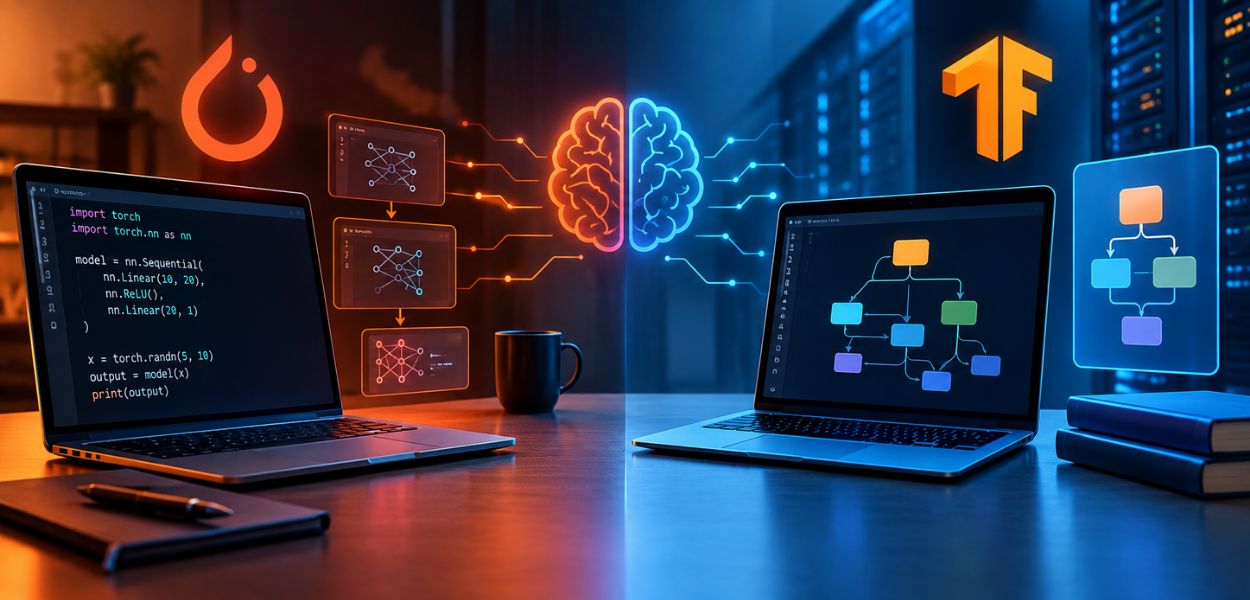
Choosing between eager execution and static graph architecture affects how deep learning teams build, debug, optimise, and deploy machine learning systems. The distinction is especially relevant when organisations evaluate PyTorch and TensorFlow programming for production-oriented workforce development.
For professionals beginning with the foundations, PyTorch and TensorFlow Programming for Deep Learning Training Courses provide the broader learning context around frameworks, model development, tensors, training workflows, and practical deep learning implementation. Understanding execution architecture then helps technical teams evaluate which development approach fits their operational requirements.
What is the difference between eager execution and static graph architecture?
Eager execution runs operations immediately as developers write and execute them, while static graph architecture defines a computational graph before execution. This difference changes debugging, model construction, optimisation, deployment, flexibility, and how technical teams manage deep learning development workflows.
Eager execution follows an immediate programming model. When a tensor operation runs, the framework executes it directly and returns the resulting object. Developers can inspect tensors, test individual operations, and identify errors during normal program execution.
Static graph architecture separates graph construction from execution. Developers define a computational structure representing mathematical operations and data movement. A runtime then executes that predefined structure according to the framework's execution model.
The distinction is not simply about programming style. It affects the complete development lifecycle.
A team building experimental neural network architectures benefits from rapid feedback. A team deploying repeatable workloads across controlled infrastructure prioritises graph optimisation, predictable execution, and deployment compatibility.
The architectural difference therefore becomes a training and workforce decision rather than only a framework preference.
How does eager execution work in PyTorch?
PyTorch uses eager execution as its natural development model, allowing tensor operations and neural network computations to execute immediately. Developers work directly with Python control flow, inspect intermediate values, and use autograd dynamically during model development and training.
PyTorch represents numerical data through tensors. A tensor contains multidimensional numerical information and supports operations required for neural network computation.
When developers perform operations on tensors, PyTorch executes those operations immediately. The resulting tensors can then be inspected or passed into subsequent operations.
This approach integrates naturally with standard Python programming. Conditional statements, loops, functions, and debugging tools operate familiarly.
Autograd provides automatic differentiation. During a training process, PyTorch tracks relevant tensor operations and constructs the information required to calculate gradients. Backpropagation then uses these gradients to update model parameters.
This dynamic behaviour is particularly useful when neural network architectures change frequently. Developers can test different neural network layers without rebuilding a separate graph definition for every structural modification.
For corporate training, this model reduces the conceptual distance between conventional Python programming and deep learning development. Technical employees can learn tensors, forward passes, loss calculation, backpropagation, and optimisation within one interactive workflow.
How does TensorFlow use static graph architecture?
TensorFlow supports graph-based execution by representing mathematical operations as a computational structure that can be traced, compiled, optimised, and deployed. Its graph capabilities support controlled execution, performance optimisation, portability, and production-oriented machine learning workflows.
TensorFlow originally established a strong distinction between graph construction and graph execution. Developers defined operations within a computational graph and then executed that graph through a runtime.
Modern TensorFlow also supports eager execution by default, which makes its development experience more interactive. However, TensorFlow retains powerful graph-based capabilities through mechanisms such as function tracing and graph compilation.
The Keras API provides a higher-level approach to building neural networks. Developers can define neural network layers, configure model structures, select optimisers, and establish training workflows without manually constructing every low-level computational operation.
When a TensorFlow function is converted into a graph representation, the framework gains opportunities to analyse and optimise the computation. This becomes valuable for repeatable workloads and deployment environments.
For organisations, this distinction matters when training teams that need to move from model experimentation to operational machine learning. A development environment and a production environment do not always require identical execution behaviour.
Why does execution architecture matter for neural network development?
Execution architecture determines how developers interact with models, locate errors, control computation, optimise workloads, and prepare systems for deployment. The right approach depends on whether the priority is experimentation, debugging, reproducibility, computational optimisation, or scalable production execution.
Deep learning development involves repeated experimentation. Developers change neural network layers, adjust parameters, modify data processing, and test alternative architectures.
Eager execution provides immediate feedback after each operation. This makes it easier to investigate unexpected tensor values or isolate errors inside a model.
Graph-oriented execution approaches the problem differently. The computational structure provides a representation that the framework can analyse and optimise.
The difference becomes important when model complexity increases.
A small experimental model can tolerate interactive execution without significant operational constraints. A large production workload requires greater attention to hardware utilisation, memory behaviour, repeatability, and deployment architecture.
GPU acceleration also changes the evaluation criteria. Both PyTorch and TensorFlow support GPU-based computation, but effective acceleration depends on tensor placement, workload design, memory management, data pipelines, and model architecture.
Therefore, execution architecture should be evaluated alongside the complete machine learning workflow rather than treated as an isolated technical feature.
When is PyTorch eager execution more suitable?
PyTorch eager execution fits workflows where developers need rapid experimentation, interactive debugging, dynamic model behaviour, and direct control over Python execution. It is particularly useful when teams continuously modify architectures and need immediate feedback from each development step.
Research and development teams frequently work with incomplete assumptions. They test an architecture, inspect results, change neural network layers, and repeat the process.
Immediate execution supports this iterative pattern.
A developer can inspect a tensor after an operation without creating a separate execution session. Errors appear close to the operation that produced them. Standard debugging techniques also fit naturally into the workflow.
Dynamic model behaviour is another important factor. Some architectures use conditional computation or variable execution paths. Eager execution handles these patterns through ordinary programming constructs.
This does not mean eager execution is limited to experimentation. PyTorch provides mechanisms for optimisation and deployment that allow teams to move beyond interactive development.
The important consideration is the development lifecycle.
When HR and technical managers evaluate training programmes, they should distinguish between learning framework fundamentals and learning production deployment. A course that teaches only model construction leaves a workforce gap if employees later need to optimise and operationalise models.
When is graph-based TensorFlow execution more suitable?
Graph-based TensorFlow execution becomes valuable when teams prioritise repeatable computation, optimisation, deployment workflows, hardware utilisation, and controlled production environments. Graph representations provide a structured computational model that supports transformation and optimisation beyond interactive development.
Production machine learning systems often operate repeatedly against large datasets or high volumes of inference requests.
A graph representation gives the framework a structured view of the computation. This enables optimisation opportunities that are difficult to apply when every operation is treated only as an immediate interactive instruction.
TensorFlow's graph capabilities also support deployment scenarios where the model needs consistent execution across environments.
The Keras API adds another layer of abstraction. It allows development teams to construct models through reusable components and standardised training interfaces.
For organisations managing multiple technical teams, standardisation has measurable operational value. Consistent model structures simplify internal documentation, onboarding, code review, and knowledge transfer.
The relevant KPI is not simply model accuracy. Organisations can also measure training completion, development cycle time, model deployment time, infrastructure utilisation, defect rates, and the time required to move a trained model from development into production.
How do PyTorch and TensorFlow compare for debugging and development speed?
PyTorch generally provides a more direct debugging experience through immediate execution, while TensorFlow offers both interactive development and graph-oriented execution. The practical difference depends on model complexity, team expertise, deployment requirements, and how frequently developers modify computational structures.
Debugging is a major factor in workforce productivity.
With eager execution, developers can examine intermediate tensors and follow the execution path directly. Python debugging tools integrate naturally with this process.
TensorFlow's modern development experience also supports eager execution, reducing the historical gap between the two frameworks. Its graph capabilities then provide additional options when teams require graph-based optimisation or deployment.
The comparison therefore requires more than asking which framework is easier.
A training team should evaluate how quickly employees can complete defined tasks. Useful assessments include building a neural network, implementing backpropagation, diagnosing a tensor-shape error, training on a GPU, evaluating model performance, and preparing a deployment model.
These assessments produce stronger evidence than subjective preferences.
How do tensors, autograd, and neural network layers fit into the decision?
Tensors provide the computational data structure, neural network layers define transformations, and automatic differentiation calculates gradients required for optimisation. Understanding these components provides the foundation for comparing execution models because both frameworks organise these operations differently.
Tensors form the basic numerical units used throughout deep learning.
A training workflow normally moves data through multiple neural network layers. Each layer transforms the incoming representation before passing it to the next stage.
The model produces an output, which is compared with the expected result through a loss function. Backpropagation then calculates gradients that guide parameter updates.
PyTorch's autograd dynamically tracks operations involved in gradient computation. This integrates closely with eager execution.
TensorFlow provides automatic differentiation through its gradient mechanisms while also supporting graph-based transformation and optimisation.
The underlying mathematics remains similar. The execution architecture determines how those computations are represented and managed.
For professional development, employees therefore need both conceptual and practical knowledge. Teaching only framework commands produces limited transferability. Teaching tensors, gradients, loss functions, neural network layers, optimisation, and execution architecture builds a stronger technical foundation.
How should organisations evaluate PyTorch and TensorFlow training approaches?
Organisations should evaluate training approaches against technical capability, development workflow, deployment requirements, learning outcomes, and measurable business performance. The objective is to build skills that transfer into real machine learning projects rather than simply increase familiarity with framework terminology.
HR and learning teams should begin with the workforce skill gap.
If employees understand Python but lack deep learning experience, training should establish tensors, neural network layers, autograd, backpropagation, and GPU acceleration before introducing advanced optimisation.
If employees already build models, training should focus more heavily on execution architecture, performance, deployment, debugging, and production workflows.
Delivery format also matters.
Instructor-led programmes provide structured progression and direct technical guidance. Practical workshops allow participants to build and troubleshoot models. Project-based learning connects framework concepts to organisational use cases.
The effectiveness of training should then be measured.
Relevant indicators include assessment scores, practical project completion, error-resolution time, model development cycle time, deployment readiness, and post-training project participation.
For technical managers, a useful measure is the time employees require to move from a model specification to a functioning implementation.
This creates a direct connection between learning investment and workplace capability.
What should technical teams consider before choosing an execution approach?
Technical teams should assess model complexity, development frequency, debugging requirements, deployment targets, GPU workloads, team expertise, reproducibility, and operational constraints. The preferred execution approach should match the complete machine learning lifecycle rather than one isolated development preference.
The first consideration is development behaviour.
Teams conducting frequent experiments need flexibility and rapid feedback. Teams operating standardised production pipelines require predictable and optimised execution.
The second consideration is deployment.
A model intended for a controlled production environment has different requirements from a research prototype. Deployment targets influence how computation is represented, optimised, packaged, and executed.
The third consideration is workforce capability.
A technically advanced architecture does not automatically produce better organisational results if employees lack the skills to use it effectively.
The fourth consideration is infrastructure.
GPU acceleration can reduce training time substantially, but the result depends on workload characteristics and hardware utilisation. Organisations should measure actual training duration, GPU utilisation, memory consumption, and infrastructure cost rather than assuming that GPU support automatically improves performance.
The fifth consideration is maintainability.
A framework decision affects documentation, onboarding, debugging practices, testing, deployment processes, and internal technical standards.
How can organisations move from framework learning to production capability?
Production capability requires more than learning framework syntax. Teams need to connect model architecture, tensor operations, automatic differentiation, GPU acceleration, testing, optimisation, deployment, monitoring, and business requirements into one repeatable machine learning development process.
The transition from notebook experimentation to production introduces additional responsibilities.
A developer must understand how the model behaves outside the development environment. Data pipelines need consistency. Model inputs and outputs require validation. Performance must be measured under realistic workloads.
Testing also becomes essential.
Teams need repeatable processes for validating model behaviour after code changes. They need documentation that allows other developers to understand model architecture and dependencies.
Training programmes should therefore include practical production scenarios where appropriate.
For organisations evaluating structured professional development, Information Technology and Programming Courses can provide a broader training category for developing programming and technical capabilities relevant to modern workplace requirements.
The important distinction is between knowledge acquisition and operational competence.
An employee who can explain eager execution understands a concept. An employee who can diagnose an execution issue, optimise a workload, validate model behaviour, and prepare the implementation for deployment demonstrates applied capability.
What is the most useful decision framework for PyTorch and TensorFlow programming?
The practical decision begins with the workload, continues through development and deployment requirements, and ends with measurable technical outcomes. Teams should select an execution approach based on project constraints, workforce capability, operational requirements, and long-term maintainability.
For experimentation-heavy workflows, immediate execution and interactive debugging receive greater importance.
For structured production workloads, graph transformation, optimisation, deployment compatibility, and repeatability receive greater importance.
For training decisions, organisations should assess both frameworks against the same practical outcomes. Employees can complete equivalent exercises involving tensors, neural network layers, autograd, backpropagation, GPU acceleration, model training, and deployment preparation.
This creates a consistent basis for evaluating capability.
The decision should also account for existing organisational infrastructure. A team already using a particular framework can face unnecessary migration and retraining costs when the existing system meets operational requirements.
Explore More Expert Insights:
Modern and Post-Quantum Cryptography: Why Harvest-Now-Decrypt-Later Changes Key Lifetimes
Design Analog Electronics and RF Circuits That Perform Reliably at High Frequencies
At the same time, new machine learning initiatives can justify evaluating both execution approaches before establishing technical standards.
When the evaluation reaches the point of selecting a structured learning pathway that connects development knowledge with production application, Go From Notebook to Production with PyTorch and TensorFlow Programming at The British Academy for Training and Development is the appropriate decision-stage resource to examine.
The key evaluation principle remains straightforward: execution architecture should serve the machine learning lifecycle. Framework familiarity is useful, but measurable development capability, deployment readiness, debugging efficiency, and operational performance provide stronger evidence of training effectiveness.