
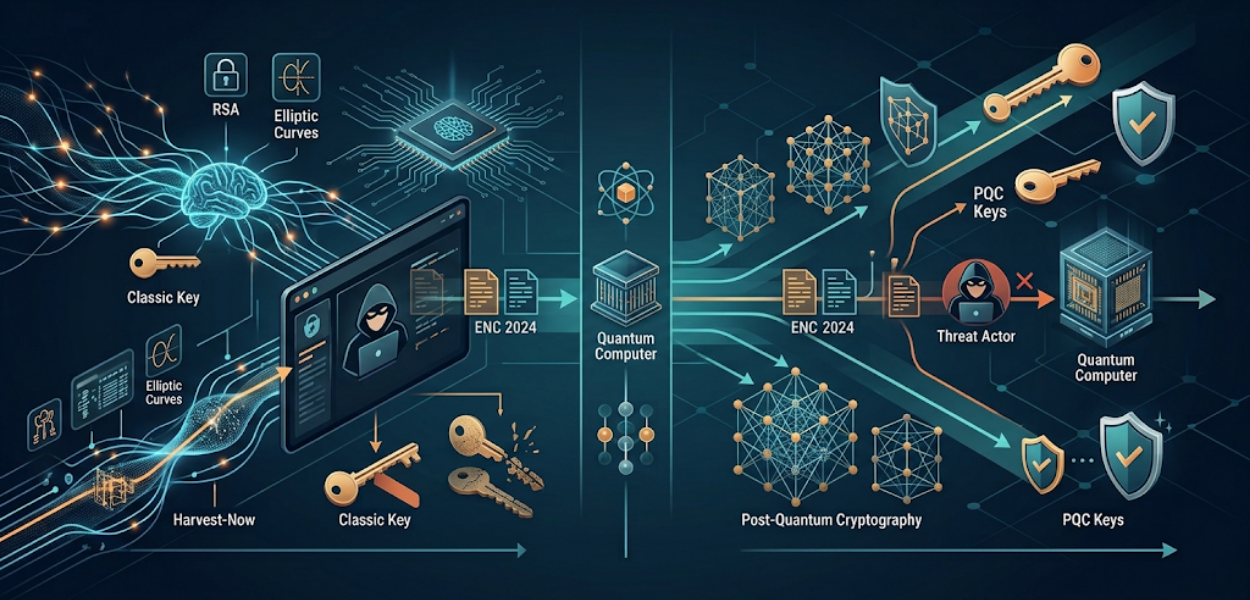
Cryptographic infrastructure was built on an assumption that no longer holds: that data encrypted today stays unreadable for decades. Quantum computing breaks that assumption, and the gap between "encrypted" and "protected" is now measured in years, not certainty. Organisations that manage sensitive data — financial records, health data, government communications, intellectual property — face a specific and quantifiable risk called Harvest-Now-Decrypt-Later (HNDL). Understanding this risk changes how key lifetimes, algorithm selection, and migration timelines get planned.
HNDL describes an attack pattern where adversaries collect encrypted data now, store it, and decrypt it once a sufficiently powerful quantum computer exists. Elliptic curve cryptography and RSA, the backbone of current key exchange and digital signatures, are mathematically vulnerable to Shor's algorithm running on a large-scale quantum computer. Data with a confidentiality requirement of ten years or more is already at risk, because the decryption capability arriving in 2030 or 2035 still compromises information encrypted in 2026. Teams building technical capability around this shift often start with structured Modern and Post-Quantum Cryptography Implementation Training Courses, which cover the mathematical foundations, migration mechanics, and standards teams need before touching production systems.
What is Harvest-Now-Decrypt-Later and why does it change key lifetimes?
Harvest-Now-Decrypt-Later is an attack strategy where encrypted data is intercepted and stored today for decryption once quantum computers can break current public-key algorithms, making long-lived data vulnerable regardless of present-day encryption strength.
Key lifetime traditionally referred to how long a cryptographic key remained valid before rotation, based on usage volume and exposure risk. Under HNDL, key lifetime must account for a second variable: the retention period of the data itself. A hospital record with a 25-year retention requirement, encrypted with RSA-2048 today, is not protected for 25 years. It is protected until a cryptographically relevant quantum computer becomes operational, an event most standards bodies estimate could occur within 10 to 15 years. That timeline sits inside the data's retention window, not outside it.
This reframes cryptographic planning from "how strong is the algorithm now" to "how long does the data need protection, and does the algorithm survive that entire window." Organisations handling long-retention data — legal records, defence communications, genomic data, financial contracts — need to migrate before the threat materialises, not after. The National Institute of Standards and Technology (NIST) has already finalised three post-quantum standards: ML-KEM (based on Kyber) for key encapsulation, and ML-DSA (based on Dilithium) and SLH-DSA for digital signatures. These became official federal standards in August 2024, giving organisations a fixed reference point rather than a moving target.
How does post-quantum cryptography differ from classical elliptic curve cryptography?
Post-quantum cryptography relies on mathematical problems believed resistant to quantum attacks, primarily lattice-based structures, while elliptic curve cryptography depends on the discrete logarithm problem, which Shor's algorithm solves efficiently on a quantum computer.
Elliptic curve cryptography (ECC) has been the efficiency standard for over a decade, offering strong security with small key sizes. A 256-bit ECC key provides security comparable to a 3072-bit RSA key, which is why ECC dominates TLS handshakes, VPN protocols, and mobile authentication. Its weakness is structural: the discrete logarithm problem it depends on has a known quantum algorithm that solves it in polynomial time. Once a large enough quantum computer exists, ECC and RSA fail simultaneously, not gradually.
Lattice-based cryptography avoids this failure mode. Problems such as Learning With Errors (LWE) and Module-LWE, which underpin Kyber, have no known efficient quantum solution. The trade-off is size and computational overhead. ML-KEM-768, the NIST-recommended parameter set for most enterprise use, produces public keys around 1,184 bytes compared to 32 bytes for an ECC-256 key, and ciphertexts near 1,088 bytes. This increases bandwidth consumption in high-frequency transaction systems by a measurable margin, typically 3 to 5 times larger payloads per handshake, which affects infrastructure sized for classical cryptography.
Digital signatures follow a similar pattern. Dilithium (ML-DSA) signatures run between 2,420 and 4,595 bytes depending on the security level, against 64 to 96 bytes for ECDSA. Systems performing millions of signature verifications daily — certificate authorities, code-signing pipelines, blockchain infrastructure — need capacity planning before switching algorithms, not after deployment failures appear.
What role does NIST standardisation play in enterprise adoption decisions?
NIST standardisation gives organisations a defined, government-endorsed algorithm set to migrate toward, reducing vendor fragmentation risk and establishing FIPS 203, 204, and 205 as the baseline for procurement and compliance requirements.
Before August 2024, organisations evaluating post-quantum readiness faced a coordination problem: multiple candidate algorithms, no finalised parameters, and no guarantee that early implementations would match the eventual standard. NIST's finalisation of FIPS 203 (ML-KEM), FIPS 204 (ML-DSA), and FIPS 205 (SLH-DSA) removed that uncertainty. Federal agencies in the United States now operate under a mandate to inventory cryptographic assets and begin migration planning, with full transition targeted by 2035 under National Security Memorandum 10. Financial services regulators and defence-adjacent industries are adopting equivalent timelines.
Standardisation also affects vendor selection. Cloud providers, hardware security module manufacturers, and TLS library maintainers now build against fixed parameter sets rather than experimental drafts. OpenSSL 3.2 and later, BoringSSL, and major cloud key management services have added ML-KEM support directly. Procurement teams evaluating vendors can now ask a specific, testable question: does this product support FIPS 203/204 natively, or does it require a bridging layer? That question did not have a stable answer before standardisation, and it changes technical due diligence for any organisation renewing infrastructure contracts in 2026 and beyond.
For organisations with defined compliance deadlines or contractual obligations tied to national cryptographic standards, the practical next step is Prepare Your Organisation for Modern and Post-Quantum Cryptography Before the Migration Deadline Arrives, which addresses inventory, prioritisation, and phased rollout planning specific to regulated environments.
How should organisations reassess key lifetimes under a hybrid migration model?
A hybrid migration model combines classical and post-quantum algorithms in the same handshake, protecting against both current threats and future quantum decryption, and requires key lifetime policies to account for dual-algorithm validity periods.
Few organisations can switch algorithms in a single step. A hybrid approach — running ECC and ML-KEM together in the same key exchange — is the transitional model most standards bodies recommend, including the Internet Engineering Task Force's draft specifications for hybrid TLS 1.3 key exchange. In this model, session security depends on both algorithms remaining intact; an attacker must break both the classical and post-quantum component to compromise the session. This gives immediate HNDL protection without requiring full removal of legacy systems that still depend on ECC for compatibility.
Key lifetime policy under hybrid deployment needs three distinct parameters instead of one: rotation frequency for the classical component, rotation frequency for the post-quantum component, and a defined sunset date when the classical component is retired entirely. Rotation frequency for ML-KEM keys in high-volume systems is typically set shorter during the transition period, often 90 days instead of the 12-month cycles common under ECC, because early implementations are still being hardened against side-channel attacks specific to lattice operations. Teams managing certificate authorities and PKI infrastructure need updated key management procedures that track both components independently, which is a departure from single-algorithm lifecycle tools most organisations currently operate.
What skills and training approaches prepare technical teams for this migration?
Effective preparation combines applied cryptography fundamentals, hands-on migration exercises using NIST-standardised libraries, and role-specific training for security architects, developers, and compliance teams, rather than a single generic awareness session.
Workforce skill gaps in post-quantum cryptography are structural, not superficial. Most security engineers trained in the last fifteen years learned ECC and RSA as the default, with quantum threats treated as theoretical. Closing this gap requires three distinct learning tracks. Security architects need depth in algorithm selection, hybrid protocol design, and compliance mapping against FIPS 203–205. Developers need hands-on exposure to updated libraries — OpenSSL, BouncyCastle, liboqs — and the specific API changes that come with larger key and ciphertext sizes. Compliance and risk teams need enough technical grounding to interpret vendor claims and audit migration progress without relying entirely on external consultants.
Delivery format affects retention more than content volume. Instructor-led technical labs, where teams implement a hybrid TLS handshake or migrate a signing pipeline to ML-DSA in a sandboxed environment, produce measurably higher operational readiness than lecture-based awareness training. Organisations building this capability internally, particularly within existing technical and engineering functions, often integrate post-quantum modules into broader Information Technology and Programming Courses, allowing security-adjacent staff to build cryptographic competence alongside existing development skill paths rather than as an isolated specialism.
How should organisations measure ROI and readiness for post-quantum migration?
ROI for post-quantum migration is measured through reduced long-term breach exposure, audit and compliance cost avoidance, and infrastructure readiness scores tracked against a defined cryptographic asset inventory, rather than short-term productivity metrics.
Migration cost is front-loaded: algorithm inventory, library updates, hybrid protocol testing, and staff training all occur before any measurable risk reduction appears. This makes traditional ROI calculation difficult using output-based metrics. A more accurate readiness measure tracks four indicators over time: percentage of cryptographic assets inventoried against total estate, percentage of TLS endpoints supporting hybrid key exchange, percentage of signing infrastructure migrated to ML-DSA or SLH-DSA, and staff certification rates against defined competency benchmarks.
Explore More Expert Insights:
Analog Electronics and RF Circuits: Why Components Behave Differently Above 100 MHz
VHDL/Verilog and FPGA Devices: How Hardware Description Languages Map to Silicon
Organisations with mature cryptographic asset inventories report migration timelines 30 to 40 per cent shorter than those starting inventory and migration simultaneously, based on early adopter data from financial services pilots conducted in 2025. This gap comes from avoiding rework: systems migrated without a complete inventory frequently require a second migration pass when previously unknown dependencies surface. Business application of this data extends beyond IT — boards and audit committees increasingly request cryptographic risk exposure as a standing agenda item, particularly for organisations in regulated sectors where breach liability extends to data compromised years after the original encryption event.