
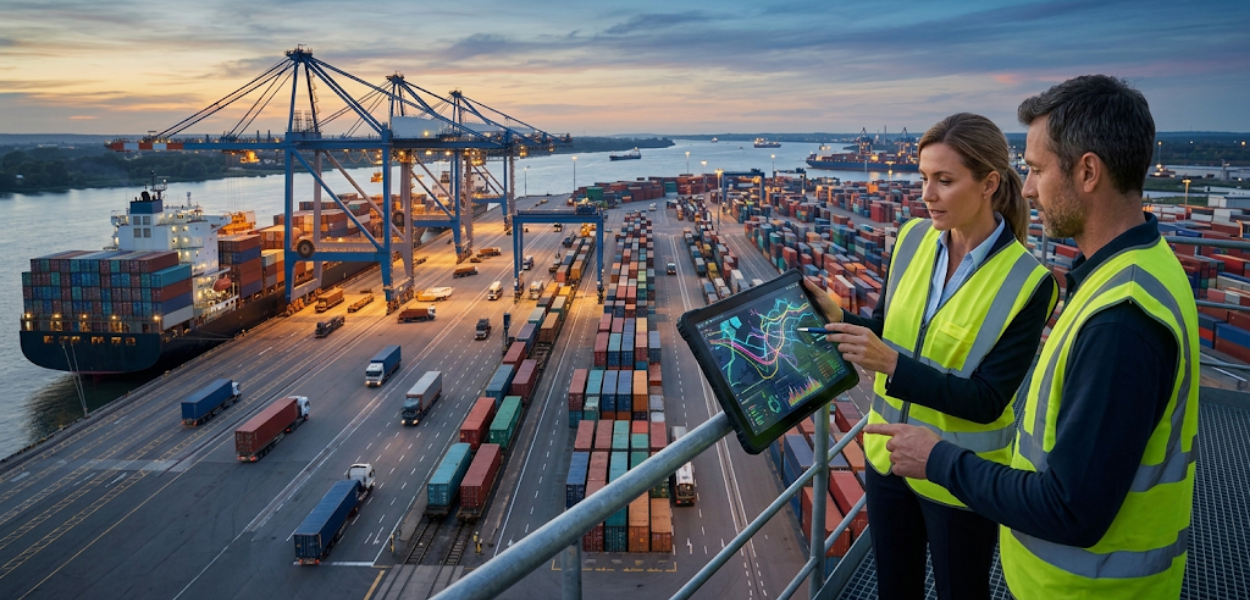
Container logistics management is the coordinated control of container movement, cost allocation and routing decisions across ocean, rail and road networks. It sits between procurement and final delivery, and it determines how quickly cargo reaches its destination and how much that journey costs the business. A single routing choice, a delayed pickup, or an empty container left at the wrong depot can change total landed cost by a significant margin. Organisations that manage containers as one connected system, rather than as separate bookings handled by different teams, consistently spend less per container and recover faster when networks are disrupted.
The decisions made inside a container logistics network depend heavily on what happens the moment a box reaches a port. Container terminal operations explain how vessels are berthed, how containers are discharged and loaded, and how cargo is staged before it enters road or rail networks. This foundation matters because routing plans, free-time windows and cost estimates further down the chain are all built on terminal throughput, yard capacity and equipment availability established at this first stage. A shipper who understands terminal mechanics negotiates better transit windows and avoids unnecessary demurrage charges later.
What Does Container Logistics Management Actually Cover?
Container logistics management covers booking and documentation, routing selection, empty container repositioning, demurrage and detention control, customs clearance, and the handoff between ocean, rail and road carriers, all measured against cost and delivery-time targets.
Booking decisions set the tone for the entire movement. A shipper selects a carrier, a service string and a container type based on transit time, cost and reliability history. Documentation follows immediately: bill of lading, packing list, customs declarations and, for regulated goods, additional certificates. Errors at this stage cause delays that ripple through the rest of the chain.
Routing selection determines whether cargo moves through a direct service or transships at an intermediate hub. Empty container management balances the need to reposition boxes to export-heavy regions against the cost of moving air. Demurrage and detention control tracks free-time windows at both the terminal and the depot, since charges accrue per day once those windows close. Customs clearance runs in parallel, and any mismatch between documentation and physical cargo halts release. Each of these functions is managed separately in many organisations, which is precisely why total cost visibility is often weak.
What Are the Main Cost Components in Container Logistics?
Ocean freight typically accounts for 40 to 55 per cent of total container cost, with terminal handling charges, inland haulage, demurrage, detention and empty repositioning making up the remaining 45 to 60 per cent depending on route and network design.
Ocean freight rates fluctuate with fuel prices, vessel capacity and trade lane demand, and they remain the largest single line item on most cost sheets. Terminal handling charges (THC) are levied at both origin and destination and typically range from 100 to 300 US dollars per TEU, depending on the port and cargo type. Inland haulage, covering the move from port to warehouse or from factory to port, varies by distance and mode, with rail generally costing 20 to 30 per cent less than road over long distances.
Demurrage and detention are avoidable costs that many organisations still absorb unnecessarily. Demurrage applies when a container remains at the terminal beyond its free days, typically 50 to 150 US dollars per day depending on the port. Detention applies once the container leaves the terminal but is not returned empty within the agreed window, with similar daily rates. Empty container repositioning, needed to balance trade imbalances between import-heavy and export-heavy regions, adds a further 15 to 20 per cent to network overhead when not planned proactively. Customs and documentation fees are smaller individually but recur on every shipment, so poor process design compounds their impact across volume.
How Is Routing Determined in Container Shipping Networks?
Routing is determined by transit time, port congestion, carrier alliance networks, the choice between direct calls and hub-and-spoke transhipment, and the availability of rail or road capacity at the destination region.
Direct services move cargo from origin port to destination port without intermediate stops, which reduces transit time and lowers the risk of missed connections. Hub-and-spoke routing consolidates cargo at a major transhipment hub before distributing it to smaller regional ports, which increases carrier flexibility but adds three to seven days to average transit time. Carrier alliances influence which routing options are even available, since vessel-sharing agreements determine which ports a given service calls at.
Port congestion changes routing calculations in real time. A congested port adds dwell time, which increases the risk of demurrage regardless of how efficiently the rest of the network performs. Inland routing decisions follow the same logic: rail offers lower cost per container over distances above 500 kilometres, while road offers faster last-mile delivery for time-sensitive cargo. A well-designed routing strategy blends these modes rather than defaulting to a single option across the whole network, and it reassesses that blend as congestion, fuel prices and lead-time requirements shift.
What Optimisation Methods Reduce Container Logistics Costs?
Route consolidation, carrier diversification, dynamic empty-container matching, transport management system (TMS) visibility, and demurrage-free-day tracking together reduce container logistics costs by 10 to 25 per cent when applied consistently across a network.
Route consolidation combines smaller shipments into full container loads or coordinated bookings, reducing the number of individual movements and the administrative cost attached to each. Carrier diversification spreads volume across two or three carriers rather than one, which improves negotiating leverage and reduces exposure to a single carrier's congestion or schedule changes. Dynamic empty-container matching identifies nearby empty boxes that can be repositioned to an export customer instead of returning them to a depot first, cutting unnecessary movements.
Transport management system visibility gives planners a single view of container status, free-time windows and estimated arrival across every carrier and mode, replacing the fragmented tracking that causes missed deadlines. Demurrage-free-day tracking flags containers approaching their free-time limit automatically, which is one of the highest-return optimisation practices available, since demurrage and detention are entirely avoidable costs. Key performance indicators such as cost per TEU, on-time-in-full (OTIF) delivery rate, and average dwell time give operations teams a measurable baseline to track improvement against, rather than relying on anecdotal reports of network performance.
How Do Organisations Build the Capability to Manage Container Logistics Effectively?
Skill gaps in procurement, operations and documentation teams limit the impact of optimisation tools, since software and route data only produce results when staff can interpret costs, negotiate with carriers and apply routing logic correctly.
Many organisations invest in tracking systems and cost dashboards without training the teams who use them. A planner who does not understand how THC, demurrage and detention interact will still miss avoidable charges even with full visibility into container status. A procurement lead who does not understand carrier alliance structures will negotiate service contracts without leverage. This gap between tooling and capability is one of the most common reasons container logistics costs remain higher than network design would predict.
Structured training closes this gap directly. A Container Logistics and Terminal Operations training programme builds the applied skills needed to manage routing decisions, interpret cost structures, and reduce dependency on external freight forwarders for decisions that internal teams are capable of making themselves. Programmes of this kind typically combine terminal process knowledge, cost analysis frameworks and documentation accuracy training, so that operations and procurement staff can act on network data rather than simply receive it. Organisations that invest in this capability report faster decision-making during disruption, since staff already understand which routing alternatives are viable and which cost trade-offs are acceptable, without waiting on external advisors.
What Should HR and Operations Leaders Consider When Selecting a Training Approach?
Selection should weigh role relevance, delivery format, measurable skill outcomes and alignment with existing supply chain systems, rather than treating training as a generic add-on to logistics operations.
Role relevance determines whether the training builds skills the team actually applies. A procurement lead needs cost negotiation and contract structure knowledge, while a terminal-facing coordinator needs process and documentation depth. Delivery format affects adoption: instructor-led sessions suit teams needing discussion and case analysis, while shorter modular formats suit staff who cannot step away from daily operations for extended periods. Measurable skill outcomes, tested through applied scenarios rather than passive content review, confirm whether the training changes day-to-day decision-making or simply adds a certificate to a file.
Alignment with existing systems matters because training that ignores the tools a team already uses creates a disconnect between what staff learn and what they apply. A broader Logistics, Supply Chain & Shipping programme extends this thinking beyond containers alone, covering procurement, warehousing and distribution skills that support the same cost and routing decisions from a wider operational view. HR and operations leaders evaluating training providers should ask for evidence of applied outcomes, such as reduced demurrage incidents or improved routing turnaround, rather than accepting course completion alone as proof of impact.
Explore More Expert Insights:
Demand Planning Skills: Tools, Methods and Career Paths
Advanced Supply Chain Management: Resilience, Visibility, Analytics
Container logistics management rewards teams that combine system visibility with the judgement to act on it. Cost components are well documented, routing variables are measurable, and optimisation methods are established practice across the industry. The differentiator between networks that reduce cost consistently and those that do not is almost always the capability of the people making routing and cost decisions day-to-day, not the availability of data alone.