
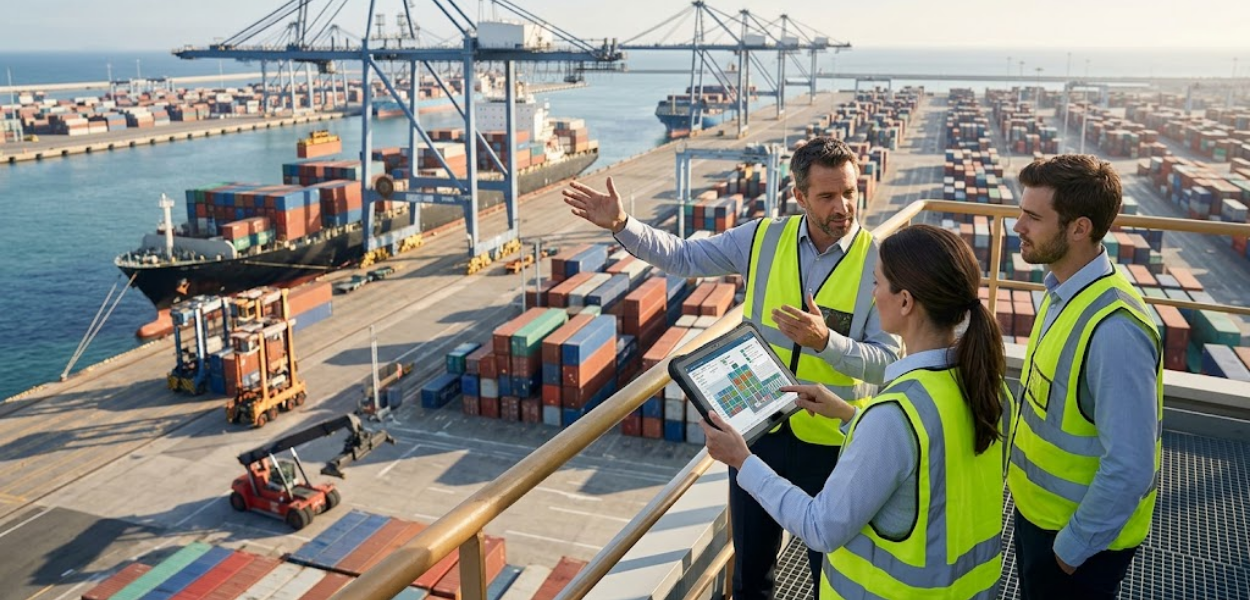
Global container terminals handle hundreds of millions of TEUs every year, and every delay at the berth, yard, or gate carries a direct cost to the businesses that depend on that cargo. HR teams and operations leaders are under pressure to build staff who understand not only how freight moves, but why terminals are scheduled, staffed, and audited the way they are. Readers who want a plain, sequential explanation of terminal mechanics can start with our earlier guide on container terminal operations, which sets out the physical and procedural stages from vessel arrival to gate release.
This article moves past that groundwork. It sets out what the British Academy for Training and Development actually teaches inside its Logistics, Supply Chain & Shipping course, how the curriculum is built, and what an organisation can expect once staff complete it.
The distinction matters because most professionals entering a terminal-facing role already have some exposure to shipping concepts, picked up through induction sessions, vendor briefings, or informal shadowing. What they typically lack is a structured way to apply that exposure when a berth schedule slips, a yard reaches capacity, or a customs query holds up a release. This course is built to close that specific application gap, not to re-teach shipping from first principles.
What is the course and what workplace problem does it solve?
The course addresses a specific gap: staff who can describe port workflows but cannot plan berth allocation, yard capacity, or multimodal handovers under real operational constraints. Many logistics coordinators learn terminal processes informally, through rotation or observation, without a structured framework for decision-making.
This gap shows up in measurable ways. A shipping coordinator may know that containers move from vessel to yard to gate, but struggle to explain why a terminal prioritises certain vessels during peak congestion. A warehouse manager may understand inventory principles but lack the vocabulary to negotiate demurrage terms with a carrier. The British Academy for Training and Development designed this course specifically to close that operational-to-strategic gap, rather than to repeat general shipping theory.
The course sits within the Academy's Shipping, Maritime and Ports specialisation, and it is built for professionals who already have exposure to logistics but need a structured, assessed pathway into terminal-level decision-making.
Consider a typical scenario inside a mid-sized freight forwarding department. A newly promoted operations supervisor is expected to approve routing changes when a berth window is missed, but has only ever observed that decision being made by a manager. Without a framework for evaluating yard capacity against cost exposure, the supervisor either escalates every decision upward, which slows the department down, or guesses, which introduces risk. The British Academy for Training and Development built this course to give that supervisor a repeatable method rather than a set of anecdotes.
Why is the course structured this way?
The curriculum follows a deliberate progression: terminal fundamentals first, then cost and routing logic, then digital systems, then compliance and risk, so each module depends on the one before it. This sequencing exists because terminal decisions are rarely isolated; a routing choice affects yard dwell time, which affects cost, which affects contractual exposure.
Readers evaluating whether to prioritise a terminal-operations course over a broader logistics-management programme often ask how the two relate. Our comparison piece, container logistics management, sets out how routing, cost control, and optimisation decisions are made at the network level. This course narrows that lens to the terminal itself: the physical asset where those network decisions are executed or undone. Organisations that have already reviewed network-level logistics training typically choose this course to build the operational layer underneath it.
The British Academy for Training and Development structures every module around a decision a participant will actually face on the job, rather than a topic to memorise. This is why the course reads more like a specification document than a general survey of shipping.
How the modules connect
Each module closes with a checkpoint tied to the next module's starting point. Berth and yard planning feeds directly into the routing and cost module, because yard congestion is a routing variable. The routing module then feeds into the digital systems module, because most terminals now track routing decisions through terminal operating systems (TOS) rather than manual logs.
What will participants learn?
Participants gain four measurable skill sets: terminal layout and berth planning, cost and routing analysis, terminal operating system literacy, and compliance-driven risk assessment, each assessed independently before progression. The modules are designed to be applied immediately, not studied in the abstract.
Terminal and yard operations fundamentals
Participants learn how berth allocation, crane scheduling, and yard stacking decisions interact. They work through case-style exercises involving quay-side congestion and reduced crane productivity, and they are assessed on their ability to propose a revised stacking or berthing plan under time pressure.
Cost, routing and multimodal optimisation
This module covers demurrage and detention exposure, inland haulage cost drivers, and the trade-offs between rail, road, and short-sea routing options. Participants calculate landed cost scenarios and identify where routing changes reduce total logistics spend without increasing transit risk.
Digital systems and terminal automation
Participants are introduced to terminal operating systems, automated gate processing, and real-time data dashboards used for throughput monitoring. The module includes a simulated TOS exercise so participants can practise reading utilisation and dwell-time reports rather than only discussing them conceptually.
Compliance, safety and risk management
This module covers ISPS Code obligations, customs and documentation checkpoints, and safety protocols specific to container handling. Participants complete a documentation review exercise, checking a sample cargo file for compliance gaps before it can proceed through the terminal.
How is the course delivered?
The course is delivered through a hybrid format combining instructor-led workshops, applied simulation exercises, and self-paced digital modules, structured to fit around live operational schedules. This format is deliberate: logistics professionals rarely have uninterrupted blocks of study time, so the course is built around short, applied sessions rather than long lecture blocks.
Workshops are delivered onsite or virtually, depending on the client organisation's preference, and typically run across several days rather than a single intensive block. Each workshop day pairs a short instructor-led briefing with a hands-on exercise, such as a berth-planning simulation or a routing cost calculation, so participants apply each concept before moving to the next module.
Assessment runs throughout rather than at the end only. Each module closes with a scenario-based assignment, and the course concludes with a combined simulation covering yard planning, routing, and compliance together. This mirrors how terminal decisions are actually made: not as separate tasks, but as one interconnected judgement call under time and cost pressure.
The British Academy for Training and Development offers this course as part of its wider Logistics, Supply Chain & Shipping portfolio, and organisations can commission it as a standalone programme or as one stage within a broader supply chain training pathway.
Group sizes are kept small enough that every participant completes the berth-planning and routing simulations individually, rather than watching a single group exercise. This matters for assessment integrity: a manager reviewing a completion certificate needs confidence that the participant personally worked through the yard-planning and cost-calculation exercises, not that they sat in on a group discussion. Sessions are scheduled in blocks that HR teams can slot around existing shift rotations, so training does not require pulling an entire team off the floor at once.
What results can be expected?
Organisations typically see faster onboarding into terminal-facing roles, fewer routing and documentation errors, and clearer internal reporting on yard and berth performance within the first operational cycle after training. These outcomes are measurable against the assessment benchmarks set during the course itself, rather than relying on general satisfaction feedback.
For HR teams building a logistics talent pipeline, this course provides a shared baseline across staff who previously learned terminal processes inconsistently, through different supervisors or different ports. A logistics manager who completes the compliance module, for example, can review a documentation file against a checklist rather than relying on memory of past incidents. A warehouse team lead who completes the routing module can justify a modal shift decision with a cost comparison rather than a general preference.
Departments that have sent cohorts through the British Academy for Training and Development's terminal-operations training report clearer handovers between shift teams, because staff share a common vocabulary for berth status, yard utilisation, and routing constraints. This reduces the time managers spend re-explaining decisions that were made on a previous shift, which is a recurring friction point in terminal-facing operations.
The course also supports leadership pipelines within logistics functions. Participants who complete all four modules are positioned for supervisory or planning roles, because the assessed skill set matches what those roles actually require: reading operational data, applying cost logic, and managing compliance exposure, rather than only executing instructions from a supervisor.
A finance department working alongside logistics also benefits indirectly. When operations staff can explain demurrage exposure and routing costs in the same terms the course teaches, finance teams receive clearer justification for spend variances, rather than after-the-fact explanations once an invoice has already landed. This cross-department clarity is one of the more consistent outcomes reported by organisations that have trained a full shift team through the British Academy for Training and Development rather than a single individual.
How does enrolment work?
Enrolment requires a working background in logistics, freight, or port operations, a completed application through the Academy, and confirmation of the preferred delivery format before a start date is scheduled. There is no formal academic prerequisite, but participants without operational exposure to shipping or logistics generally struggle with the applied exercises, so the Academy recommends at least basic familiarity with freight terminology before starting.
Organisations enrolling multiple staff can request a cohort intake, which allows shift teams or departments to complete the course together and apply the shared vocabulary immediately afterwards. Individual professionals can apply directly through the standard enrolment process. Once an application is confirmed, the Academy schedules the workshop dates and confirms whether delivery will be onsite, virtual, or hybrid, based on the organisation's operational calendar.
Explore More Expert Insights:
Why British Academy for Training & Development& Demand Planning Training Is the Backbone
How British Academy for Training & Development's Advanced Supply Chain Management Course Builds a Competitive Edge
HR teams coordinating a cohort intake are asked to confirm headcount and shift patterns in advance, since workshop scheduling is built around keeping groups small enough for individual assessment. The Academy also confirms language and delivery-site logistics at this stage, particularly for organisations enrolling staff across more than one terminal location. This upfront coordination is what allows the course to run against a live operational calendar rather than a fixed academic term.
Completion is confirmed once all four module assessments and the final combined simulation are passed, and participants receive a certificate documenting the specific competencies assessed, rather than a general attendance record. Organisations planning to build or expand a logistics training pathway can enrol in this programme directly through the Academy's course enrolment page.