
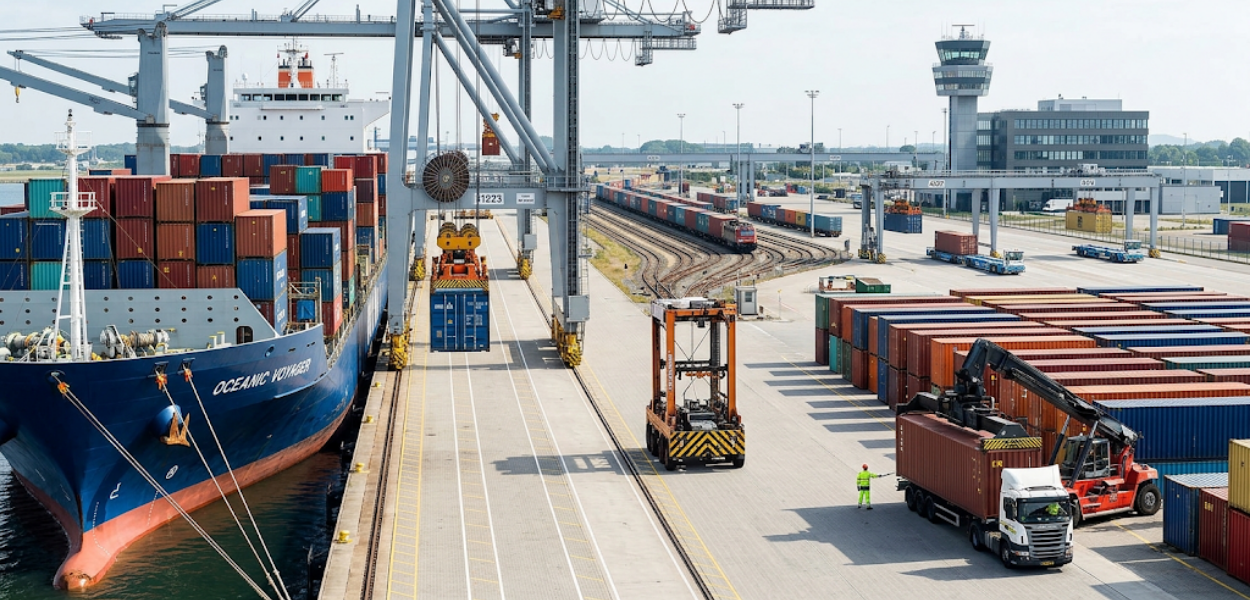
Container terminal operations move 800 million containers through global ports every year. Every one of those movements depends on trained personnel, coordinated systems, and defined procedures. Organisations that ship goods, manage logistics teams, or oversee supply chain departments need employees who understand how a terminal functions. This article explains what container terminal operations involve, how the process works, and what organisations gain from building this knowledge into their workforce.
What Is Container Terminal Operations From A Workforce Perspective?
Container terminal operations refer to the coordinated processes of loading, unloading, storing, and transferring shipping containers at a port. From a workforce perspective, it means the technical and procedural knowledge staff need to manage cargo movement safely, efficiently, and in compliance with regulations.
A container terminal functions as a controlled interface between sea transport and land transport. Ships arrive, containers are discharged, and cargo is redirected to trucks, trains, or storage yards. Each stage requires defined roles: crane operators, yard planners, documentation clerks, and safety officers.
Employee skill gaps in this area create direct commercial consequences. A logistics coordinator who does not understand berth allocation causes scheduling delays. A warehouse manager unfamiliar with container tracking systems creates inventory errors. Organisations in freight forwarding, manufacturing, retail distribution, and import-export trading depend on staff who grasp these operational fundamentals, even when their own job title sits outside the port itself.
Training in this area is not confined to dockworkers. HR managers building logistics departments, team leaders overseeing supply chain functions, and business owners negotiating freight contracts benefit from understanding how terminal operations affect cost, timing, and risk.
How Does A Port Move Containers From Ship To Storage?
A port moves containers through five defined stages: vessel berthing, discharge by quay crane, transfer to the yard, stacking or storage, and onward dispatch by truck or rail. Each stage has measurable time targets and safety protocols.
Vessel Berthing And Discharge
A ship reaches its assigned berth based on a schedule set by the terminal's vessel planning team. Quay cranes then lift containers directly from the vessel. A modern quay crane completes 25 to 35 lifts per hour under standard operating conditions. Terminal staff track this figure as a key performance indicator, since delays at this stage extend total vessel turnaround time, which port authorities often cap at 24 hours for standard container ships.
Yard Transfer And Stacking
Once lifted, containers move to the yard using straddle carriers, terminal tractors, or automated guided vehicles. Yard planners decide stacking positions based on destination, weight, and dispatch priority. Poor stacking decisions increase re-handling, which adds 15 to 20 minutes per container when a unit must be moved twice to reach one buried underneath it.
Dispatch By Truck Or Rail
Containers leave the terminal by road or rail once customs clearance and documentation checks are complete. Gate processing time, measured from truck arrival to exit, averages 30 to 45 minutes at well-run terminals. Training programmes that cover documentation accuracy reduce gate delays by up to 20%, based on port efficiency studies conducted across major container hubs.
Employees who understand this five-stage sequence make faster, more accurate decisions when problems arise mid-process. Training that walks staff through each stage, using simulations and case-based scenarios, builds this operational fluency without requiring on-site port access.
Organisations that manage this training internally often move from terminal-level knowledge into broader logistics decision-making, covering cost structures, route selection, and network optimisation. This is where container logistics management becomes the natural next step, since it builds directly on terminal operations knowledge to address routing efficiency and total landed cost across the supply chain.
What Key Components Make Up Container Terminal Operations Training?
Container terminal operations training includes four core components: equipment and process knowledge, safety and compliance standards, documentation and systems literacy, and performance measurement using KPIs. Each component maps to a specific operational function within the terminal.
Equipment And Process Knowledge
Trainees learn the function of quay cranes, rubber-tyred gantry cranes, straddle carriers, and terminal operating systems (TOS). A TOS assigns yard locations, tracks container status, and schedules vehicle movements. Staff who understand how a TOS generates a stacking plan can identify errors before they cause delays.
Safety And Compliance Standards
Port environments carry high injury risk from heavy machinery and moving vehicles. Training covers International Maritime Organisation (IMO) container handling codes, personal protective equipment requirements, and hazard reporting procedures. Terminals with structured safety training report incident rates 30% lower than terminals relying on informal on-the-job instruction alone.
Documentation And Systems Literacy
Bills of lading, customs declarations, and container release orders each require accurate data entry. A single documentation error delays a container's release by an average of 4 hours. Training modules that use realistic paperwork scenarios reduce this error rate measurably within the first 90 days of implementation.
Performance Measurement Using KPIs
Terminals track berth productivity, crane moves per hour, yard utilisation percentage, and gate turnaround time. Employees trained to read and respond to these KPIs contribute to continuous improvement rather than reacting only after problems escalate.
Delivery formats for this training vary by organisational need. Workshops suit teams requiring hands-on equipment familiarisation. Online modules suit distributed teams across multiple sites, such as logistics companies with staff in different countries. Hybrid learning, combining self-paced modules with live simulation sessions, produces the strongest retention rates, reaching 70% knowledge retention at 6 months compared with 40% for classroom-only formats.
What Benefits Does Container Terminal Operations Training Deliver For Organisations?
Structured training reduces cargo handling errors by 25%, cuts onboarding time for new logistics staff by 40%, and improves cross-department coordination between procurement, warehousing, and shipping teams. These outcomes translate into measurable cost savings within 12 months.
Organisations that invest in this training see fewer demurrage charges, which are penalty fees for containers held beyond free storage time at the port. Staff who understand dispatch timing reduce these charges by scheduling truck collection more accurately.
Team efficiency improves when staff share a common operational vocabulary. A procurement manager who understands berth scheduling communicates more effectively with a freight forwarder. This shared understanding shortens negotiation cycles and reduces miscommunication-driven delays.
Retention also improves. Employees who receive structured, practical training report higher job satisfaction than those trained informally. Logistics companies using formal training programmes report staff turnover rates 18% lower than industry averages, based on workforce development surveys within the freight sector.
Leadership pipeline development benefits as well. Team leaders who understand terminal operations at an operational level make better decisions when promoted into supply chain management roles, since they carry direct knowledge of where delays and costs originate.
Which Teams And Industries Rely On Container Terminal Operations Training?
Logistics coordinators, warehouse managers, procurement teams, and customer service staff handling shipment enquiries all rely on this training. Industries including manufacturing, retail, pharmaceuticals, and automotive depend on accurate terminal knowledge to manage inventory and delivery schedules.
Manufacturing companies importing raw materials need staff who can anticipate terminal delays and adjust production schedules accordingly. Retail businesses managing seasonal stock depend on accurate dispatch timing to meet shelf-stocking deadlines. Pharmaceutical companies shipping temperature-sensitive goods require staff who understand yard storage conditions and dwell time limits. Automotive manufacturers coordinating just-in-time parts delivery need terminal knowledge embedded across procurement and logistics functions.
Cross-functional teams benefit most. A customer service representative who understands why a shipment is delayed at the terminal gives clients accurate information instead of generic updates. This reduces client escalations and improves service reliability scores.
Organisations building this capability across departments, rather than isolating it within a single logistics unit, gain wider operational resilience when disruptions occur, such as port congestion or equipment breakdowns.
What Common Problems Undermine Container Terminal Operations Training?
Generic training programmes, lack of measurable outcomes, and one-time delivery without reinforcement are the three most common problems. These issues reduce knowledge retention and prevent organisations from demonstrating training ROI.
Generic programmes fail because port operations vary by terminal size, automation level, and regional regulation. Training built around a single global template does not address the specific documentation rules or equipment types staff encounter in their actual work environment.
Lack of measurable outcomes prevents organisations from justifying continued investment. Training that does not track pre- and post-training performance, such as error rates or processing time, leaves L&D teams unable to demonstrate value to finance departments.
One-time delivery without reinforcement causes knowledge decay. Studies on operational training retention show a 50% drop in recall within 3 months when training is not reinforced through refresher modules or applied practice. Programmes structured as a single course, from Logistics, Supply Chain & Shipping, combined with periodic assessments and scenario-based refreshers, sustain competency levels far more effectively than isolated sessions.
Explore More Expert Insights:
What Is Demand Planning? Forecasting Explained Simply
Supply Chain Complexity: Why Modern Chains Break Down
Misalignment between training content and actual job tasks also weakens outcomes. Staff disengage when training covers theoretical port structure without connecting it to their daily documentation, communication, or scheduling responsibilities. Effective programmes map each module directly to a task the employee performs, using real shipment scenarios rather than abstract case studies.
Container terminal operations knowledge sits at the foundation of effective supply chain management. Organisations that build this competency systematically, using structured, measurable, and role-specific training, position their teams to handle complexity, reduce costly errors, and support broader logistics decision-making across the business.