
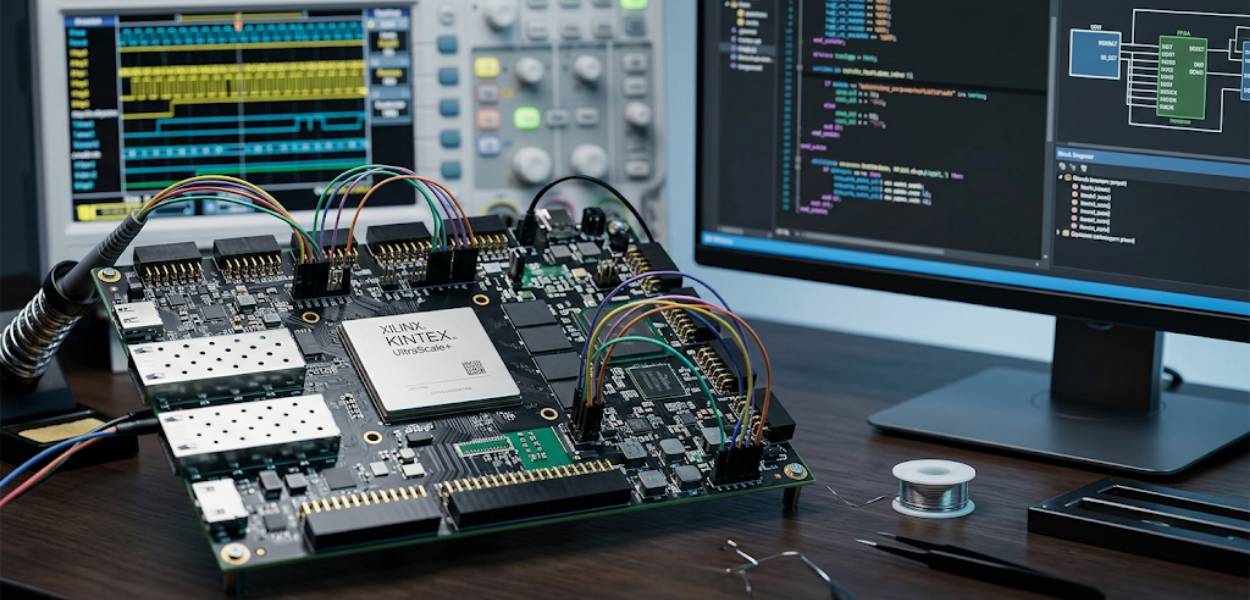
How does VHDL, Verilog and FPGA training address digital design skill gaps?
VHDL, Verilog and FPGA training builds workplace capability in hardware modelling, RTL design, synthesis, verification, timing analysis, and implementation. It gives engineering teams a structured process for converting digital specifications into tested FPGA designs while improving technical consistency, development efficiency, and design quality.
Digital design teams need practical capability across the complete hardware development lifecycle. A skill gap in one stage affects downstream engineering work. Weak RTL design creates synthesis problems. Poor verification increases debugging time. Incorrect timing constraints create implementation failures.
VHDL and Verilog are hardware description languages used to describe digital hardware behaviour and structure. FPGA devices are programmable integrated circuits that implement these hardware descriptions through configurable logic resources. Together, they form a core workflow for programmable digital systems.
For organisations, training therefore needs to connect language syntax with engineering outcomes. Employees need to understand how a specification becomes register transfer level logic, how synthesis converts that logic into hardware resources, and how verification confirms expected behaviour.
A corporate programme also needs measurable learning objectives. A typical programme measures RTL coding accuracy, simulation results, synthesis quality, timing closure, debugging performance, and successful FPGA implementation.
Training delivery works effectively when theory remains connected to practical tasks. Workshops can introduce design concepts. Online modules can cover language structures. Laboratory simulations can test RTL behaviour. Hybrid programmes can combine instructor-led sessions with independent implementation exercises.
This approach supports teams in industries like telecommunications, industrial automation, aerospace, medical technology, automotive systems, and embedded electronics.
How should organisations implement VHDL, Verilog and FPGA training?
Organisations implement effective FPGA training by starting with role-specific skill-gap analysis, defining measurable outcomes, delivering structured theory and laboratory practice, assessing RTL and verification tasks, and measuring post-training performance through design quality, debugging time, timing results, and implementation success.
The implementation process starts with a workforce assessment. Engineering managers identify the current capabilities of designers, verification engineers, embedded developers, and technical leads.
The assessment separates knowledge into areas such as digital logic, HDL syntax, RTL architecture, simulation, synthesis, verification, timing analysis, and FPGA implementation. Each area receives a defined competency level.
The next stage establishes business-aligned learning objectives. A team working on telecommunications hardware requires different exercises from a team developing industrial control systems. Training therefore uses representative engineering problems instead of generic examples.
Delivery then follows a progressive sequence. Participants first establish digital design fundamentals. They then write HDL constructs, build RTL modules, create testbenches, simulate designs, review synthesis reports, apply timing constraints, and implement designs on FPGA devices.
The transition from conceptual learning to solution evaluation requires an understanding of the complete technical path. A useful next step is to examine how hardware description languages map to silicon because this connects HDL development with synthesis and physical FPGA resources.
Assessment needs to test application rather than memorisation. A practical assessment can require employees to create an RTL module, develop a testbench, analyse simulation output, synthesise the design, resolve timing issues, and document the final implementation.
Managers can then compare baseline and post-training results. Useful measures include simulation defect rates, average debugging time, synthesis warnings, timing violations, rework hours, and successful implementation rates.
Which technical components should a corporate FPGA training programme include?
A complete programme covers digital logic, VHDL and Verilog syntax, register transfer level architecture, simulation, testbench development, synthesis, lookup tables, timing constraints, FPGA implementation, debugging, documentation, and design review practices.
Digital design and RTL architecture
Register transfer level describes digital systems through registers, combinational logic, and the data transfers occurring between them. RTL provides the design abstraction used before synthesis converts the description into implementable hardware.
Participants learn clocked processes, combinational logic, finite state machines, counters, multiplexers, arithmetic units, and data paths. These concepts establish the foundation for larger FPGA systems.
VHDL and Verilog development
VHDL provides a strongly structured approach to hardware description. Verilog provides a concise language for describing hardware behaviour and structure. Both support RTL design and simulation.
Training covers modules, entities, architectures, signals, variables, parameters, procedural blocks, operators, conditional statements, sequential logic, and reusable design structures.
The focus remains on writing synthesizable code. Synthesizable code describes hardware structures that FPGA synthesis tools convert into physical resources.
Testbench and simulation
A testbench is a verification environment that supplies inputs to a design and checks its responses. It does not become part of the final FPGA hardware.
Teams learn how to create stimulus, define expected results, monitor outputs, identify functional errors, and repeat tests. Simulation provides an early verification stage before hardware implementation.
Synthesis
Synthesis converts RTL descriptions into a hardware representation suitable for implementation. The synthesis process analyses HDL constructs and maps them to FPGA resources.
Engineers learn to review synthesis reports, identify unintended logic, understand resource utilisation, and correct coding structures that produce inefficient implementations.
FPGA lookup tables and resources
Lookup tables are configurable logic resources used by FPGAs to implement combinational functions. FPGA architectures also contain registers, memory resources, arithmetic blocks, clocking resources, and routing structures.
Training connects HDL structures with these hardware resources. This helps engineers understand why different coding approaches produce different utilisation and performance results.
Timing constraints
Timing constraints define required relationships between clocks, inputs, outputs, and data paths. They guide implementation tools when optimising the design for required operating conditions.
Teams learn clock definitions, input and output constraints, setup and hold concepts, timing reports, and timing violations. Timing analysis becomes part of the design workflow rather than an activity performed only after implementation problems appear.
FPGA development tools
Corporate training often includes tools such as Xilinx Vivado for design entry, simulation, synthesis, implementation, timing analysis, and programming of supported FPGA devices.
Participants learn how to organise projects, run synthesis, review reports, apply constraints, execute implementation, analyse timing, and generate programming files.
How does training delivery improve FPGA engineering performance?
Training delivery improves engineering performance when instruction combines structured workshops, online learning, simulations, practical laboratories, assessments, code reviews, and project-based exercises. Each method addresses a specific competency while creating measurable evidence of technical performance.
Workshops provide direct instruction for complex concepts such as RTL architecture and timing analysis. Instructors can demonstrate the relationship between HDL statements and hardware behaviour.
Online modules support repeatable learning. Employees can revisit syntax, digital logic principles, simulation concepts, and tool procedures without disrupting project schedules.
Laboratory sessions provide practical implementation. Participants build designs and analyse real outputs. This exposes gaps that theoretical assessments often miss.
Simulation exercises develop verification discipline. Participants observe waveform behaviour and compare expected and actual results.
Case-based learning uses realistic corporate scenarios. Examples include designing a communication controller, developing a digital filtering module, implementing an industrial control interface, or creating a finite state machine.
Assessments should contain measurable tasks. A practical assessment can specify an RTL function, required timing target, verification conditions, and acceptable resource utilisation.
Code reviews add a collaborative learning layer. Engineers inspect architecture, naming conventions, synthesizability, verification coverage, and maintainability.
Hybrid learning combines instructor-led sessions with online resources and scheduled laboratory work. This format supports distributed engineering teams and organisations operating across multiple locations.
What measurable organisational outcomes should managers track?
Managers should track technical quality, development time, verification effectiveness, timing performance, resource utilisation, rework, defect rates, and successful implementation. These indicators connect learning activity with engineering KPIs and provide evidence for workforce-development decisions.
Training effectiveness needs operational measurements. Attendance alone does not demonstrate capability.
A useful baseline includes average time required to complete an RTL task, number of simulation defects, synthesis warnings, timing violations, hardware debugging hours, and implementation failures.
After training, the same indicators provide comparison points. Organisations can also track assessment scores and successful completion of practical design projects.
Productivity measurement should focus on engineering outputs. For example, a team can measure the number of verified RTL modules completed per development cycle.
Quality measurement can include escaped defects, repeated design changes, and verification failures detected after implementation.
Timing performance provides another technical KPI. Teams can measure the number of unresolved timing violations before and after training.
Resource utilisation also matters. FPGA designs consume finite logic, memory, arithmetic, and routing resources. Training that improves architectural decisions can support more predictable resource utilisation.
ROI analysis combines training cost with measurable operational changes. Relevant inputs include training expenditure, employee hours, rework hours, debugging time, project delays, and defect-resolution costs.
Retention and workforce development also form part of the organisational picture. Structured technical development gives managers a framework for building internal capability across junior engineers, experienced designers, verification specialists, and technical leads.
Where are VHDL, Verilog and FPGA skills used across corporate teams?
VHDL, Verilog and FPGA skills support corporate teams developing programmable digital systems in industries like telecommunications, aerospace, automotive, industrial automation, medical technology, electronics manufacturing, and embedded systems, where hardware performance, verification, and implementation quality directly affect engineering operations.
Telecommunications teams use FPGA-based systems for signal processing, communication interfaces, networking functions, and high-speed data handling.
Industrial automation teams use programmable hardware in control systems, monitoring equipment, machine interfaces, and real-time processing applications.
Automotive engineering teams apply digital design skills to embedded control, sensor processing, communication interfaces, and specialised electronic systems.
Aerospace and defence engineering teams use programmable digital hardware for signal processing, control systems, communications, and specialised computing architectures.
Medical technology organisations use digital design in imaging systems, diagnostic equipment, monitoring devices, and specialised processing platforms.
Electronics manufacturers use FPGA development for prototyping, product development, interface control, acceleration, and specialised digital functions.
Within these industries, several departments participate in the workflow. Hardware design teams create RTL. Verification teams develop test environments. Systems engineers define requirements. Technical leads review architecture. Project managers track development milestones and quality indicators.
Training therefore works best when organisations align learning with actual team responsibilities.
What common problems reduce the value of FPGA training?
Common problems include generic curricula, excessive focus on syntax, limited laboratory work, weak verification practice, poor timing knowledge, outdated examples, and no post-training measurement. Effective programmes connect every learning activity to a defined engineering task and measurable workplace outcome.
Generic training without role alignment
A single curriculum for every employee creates inefficient learning. A verification engineer requires deeper testbench skills. An RTL designer requires stronger architecture and synthesis knowledge. A technical manager needs capability assessment and review skills.
Role-based pathways solve this problem by assigning different modules to different competency requirements.
Syntax-focused learning
Memorising HDL commands does not establish digital design competence. Employees need to understand the hardware generated by their descriptions.
Practical exercises therefore need to connect HDL constructs with registers, combinational logic, lookup tables, memory, timing, and routing.
Limited verification practice
Teams that spend most training time writing RTL receive insufficient exposure to testbench development and debugging.
Verification needs dedicated exercises with expected results, waveform analysis, assertions, error identification, and regression testing.
Ignoring timing
A functionally correct design does not automatically satisfy timing requirements. Training needs to address timing constraints and timing reports before implementation becomes a project risk.
No measurement after training
Without post-training assessment, organisations cannot determine whether a skill gap has changed.
A structured evaluation compares baseline competency with practical assessment results and workplace KPIs. Managers can then identify remaining gaps and assign targeted development activities.
Outdated training environments
FPGA tools and development practices change over time. Training therefore needs current workflows, realistic design scenarios, and relevant tool usage.
How can organisations connect FPGA training with long-term workforce development?
Organisations connect FPGA training with workforce development by mapping competencies to job roles, establishing progressive learning levels, using practical assessments, assigning project-based development tasks, and reviewing technical KPIs at defined intervals to maintain capability across changing hardware requirements.
A long-term framework begins with a competency matrix. Roles are mapped against digital logic, HDL, RTL architecture, verification, synthesis, timing, FPGA implementation, and technical leadership.
Employees then follow structured development stages. Foundation-level training establishes digital design principles. Intermediate training develops RTL and verification capability. Advanced training addresses architecture, optimisation, timing closure, and complex implementation.
Project assignments reinforce each stage. An employee can progress from a basic counter design to a finite state machine, then to a communication interface or larger integrated RTL system.
Technical reviews provide evidence of progression. Managers can assess code quality, architecture decisions, verification discipline, documentation, and implementation results.
This approach also supports collaboration between engineering functions. Hardware designers, verification engineers, embedded developers, and technical leads develop a shared understanding of the design lifecycle.
The result is a workforce-development system based on observable capability rather than course attendance. Training becomes connected to engineering processes, measurable KPIs, and organisational requirements.
What should decision-makers evaluate before selecting an FPGA training approach?
Decision-makers should evaluate curriculum relevance, employee roles, practical laboratory depth, HDL coverage, verification methods, synthesis knowledge, timing analysis, tool exposure, assessment design, delivery format, and post-training measurement before establishing a corporate FPGA development programme.
The first consideration is the organisation's existing technology environment. The training needs to reflect the FPGA families, development tools, HDL practices, and design workflows used by engineering teams.
The second consideration is the skill gap. Managers should identify whether the main problem involves RTL architecture, coding quality, verification, synthesis, timing, implementation, or broader digital design knowledge.
The third consideration is delivery format. Workshops support intensive technical learning. Online modules provide flexibility. Hybrid learning combines structured instruction with practical implementation.
The fourth consideration is assessment. A programme should demonstrate capability through practical tasks rather than relying exclusively on knowledge tests.
Explore More Expert Insights:
Radio Jamming Techniques Detection and Countermeasures Training Courses
Software Defined Radio: IQ Sampling, Baseband Processing and Front-End Architecture
The fifth consideration is measurement. Organisations need defined KPIs before training begins. These indicators provide a basis for evaluating changes in productivity, quality, verification effectiveness, and implementation performance.
For structured development across related technical disciplines, organisations can also review Information Technology and Programming Courses as a broader category covering professional technical capability.