
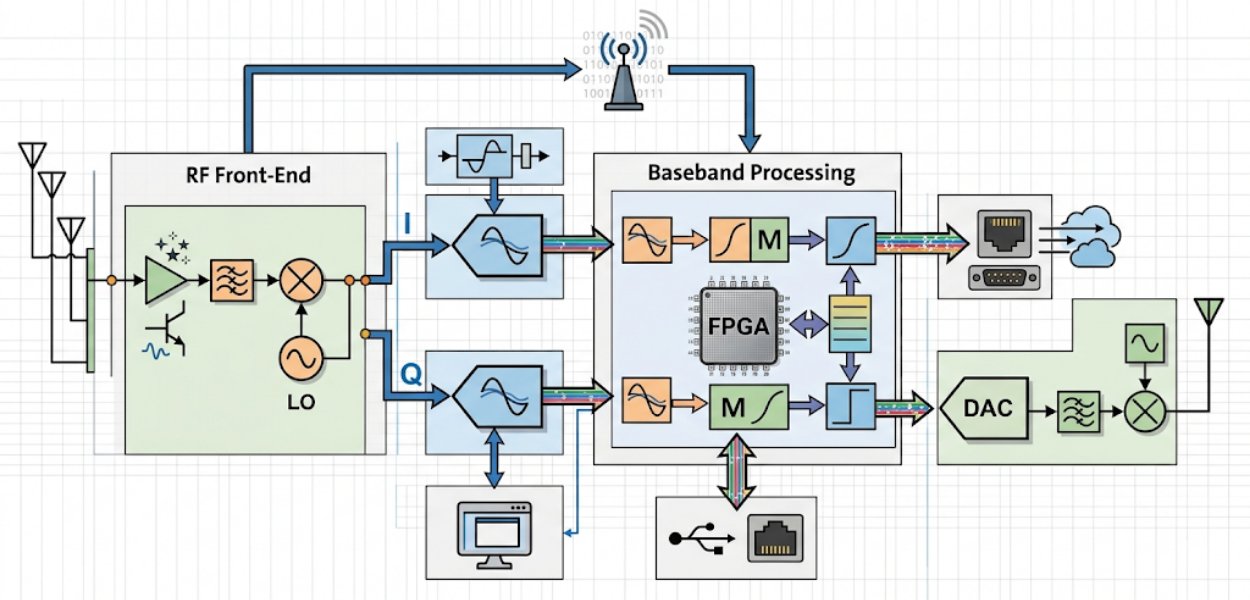
Software-defined radio (SDR) shifts signal processing from fixed hardware into software, and this shift now defines hiring and training decisions across telecommunications, defence, aerospace and IoT sectors. Engineering teams without SDR fluency face longer development cycles, higher hardware costs and slower product launches. This guide explains what SDR training covers, how organisations deliver it, and what measurable outcomes it produces for technical departments.
What Is Software Defined Radio Training and Why Does It Matter for Technical Teams?
Software-defined radio training teaches engineers to process radio signals through software instead of fixed analogue circuits, covering IQ sampling, baseband processing and front-end architecture. Organisations use this training to close radio-frequency skill gaps and cut hardware redesign costs by 30-40%.
Software-defined radio replaces dedicated hardware components, such as mixers, filters and demodulators, with software algorithms running on general-purpose processors or field-programmable gate arrays (FPGAs). A radio-frequency (RF) front end captures the signal, converts it to digital form, and passes it to software for filtering, demodulation and decoding. Engineers who understand this architecture can modify a radio's function through code updates rather than physical rebuilds.
Companies in telecommunications, defence contracting and industrial automation report skill shortages in three specific areas: digital signal processing (DSP), RF hardware interfacing, and software toolchains such as GNU Radio. A 2023 IEEE workforce survey found that 62% of RF engineering teams delayed product releases due to insufficient in-house SDR expertise. Structured training addresses this gap directly, rather than relying on slow, unstructured on-the-job learning.
How Does Software Defined Radio Skills Training Work Inside an Organisation?
Organisations deliver SDR training through a four-stage process: theory instruction, hardware-based labs, simulation exercises and applied projects. Each stage builds toward independent signal-chain design, typically across 40-80 hours of structured learning, blending online modules with hands-on hardware sessions.
The first stage covers mathematical foundations: sampling theory, Nyquist rate calculations, and quadrature signal representation. Trainees learn why signals are represented as In-phase and Quadrature (IQ) pairs, and how sample rate determines the maximum signal bandwidth a system can capture without aliasing.
The second stage introduces hardware. Low-cost devices such as RTL-SDR dongles let trainees capture real radio signals for under $30 per unit, making this stage accessible for teams of any size. Trainees connect hardware to GNU Radio, an open-source software framework, and build basic signal-processing flowgraphs.
The third stage uses simulation environments to test digital down-conversion, filtering and demodulation without live RF exposure. This reduces equipment costs and lets trainees repeat experiments until concepts are fixed.
The fourth stage assigns applied projects: decoding a specific signal type, building a spectrum analyser, or designing a basic transceiver chain. Assessment is project-based, not exam-based, matching how RF engineering teams actually work.
Organisations selecting a delivery format for this training weigh cost, team size and existing infrastructure differently. A detailed hardware comparison, covered in Software Defined Radio Platforms Compared: RTL-SDR, HackRF and USRP for Practical Applications, helps L&D managers and technical leads choose the correct platform before committing training budget.
What Are the Key Components of an Effective SDR Training Programme?
Effective SDR training programmes cover five components: IQ sampling theory, baseband processing, front-end architecture, software toolchains including GNU Radio, and hardware familiarisation using devices like RTL-SDR. Missing any component leaves trainees unable to complete full signal-chain projects independently.
IQ Sampling
IQ sampling converts an analogue radio signal into two digital streams, In-phase (I) and Quadrature (Q), that together preserve both amplitude and phase information. Trainees must understand sample rate selection, since an incorrectly chosen rate causes aliasing and corrupts the captured signal. Training modules typically require trainees to calculate correct sample rates for signals with bandwidths ranging from 200 kHz to 20 MHz.
Baseband Processing
Baseband processing applies digital filtering, decimation and demodulation to the IQ data after digital down conversion shifts the signal from its original radio frequency to a lower, more manageable frequency band. Trainees practise building filter chains in GNU Radio and measuring the effect of filter design on signal-to-noise ratio.
Front-End Architecture
Front-end architecture covers the physical signal path: antenna, low-noise amplifier, mixer and analogue-to-digital converter. Trainees learn how front-end component choices affect dynamic range and sensitivity, and why hardware selection changes depending on frequency band and application.
Software Toolchains
GNU Radio remains the dominant open-source toolchain for SDR development, used in academic, defence and commercial settings. Training programmes teach flowgraph construction, custom block development in Python, and integration with hardware drivers.
Hardware Familiarisation
Hardware familiarisation exposes trainees to multiple SDR devices, from entry-level RTL-SDR units to mid-range HackRF and professional-grade USRP platforms. Each device offers different bandwidth, frequency range and cost trade-offs, directly affecting which projects a team can complete.
What Benefits Does SDR Training Deliver for Organisations and Departments?
SDR training reduces product development time by 25-35%, cuts external contractor dependency, and builds internal capacity for custom radio applications. Organisations report faster prototyping cycles and measurable reductions in RF-related project delays within 6 months of training completion.
Organisations measure SDR training impact through specific, quantifiable indicators rather than general satisfaction scores. Common key performance indicators (KPIs) include: time-to-prototype for new RF applications, number of engineers capable of independent signal-chain design, and reduction in outsourced RF consulting spend.
Teams with in-house SDR capability respond faster to changing project requirements, since software updates replace hardware redesigns. A defence contractor case published by the IEEE Signal Processing Society reported a 40% reduction in prototype iteration time after training 12 engineers in SDR fundamentals over 3 months.
Retention also improves. Engineers trained in current, in-demand technical skills such as SDR report higher job satisfaction, and organisations offering structured technical upskilling see lower voluntary turnover among specialist RF staff compared to teams left to learn independently.
Which Teams, Departments and Industries Use Software Defined Radio Skills?
Telecommunications, defence, aerospace, IoT development and amateur radio research departments use SDR skills for signal interception, spectrum monitoring, prototype radio design and communications testing. Each industry applies the same core technical foundation to different regulatory and operational contexts.
Telecommunications teams use SDR for base station testing, spectrum analysis and 5G protocol validation. Defence and aerospace departments apply SDR to electronic warfare training, signal intelligence and secure communications prototyping. IoT development teams use SDR to test wireless protocols such as LoRa and Zigbee before committing to fixed-function hardware.
Research and development departments in universities and corporate labs use SDR platforms for rapid experimentation, since software changes replace weeks-long hardware redesign cycles. Quality assurance teams testing wireless products use SDR to simulate interference conditions and validate device performance across frequency bands.
What Common Problems Undermine Software Defined Radio Training Programmes?
Generic, hardware-only training without applied projects produces trainees who understand theory but cannot build working signal chains. Programmes lacking measurable KPIs, real hardware access, or structured progression from sampling theory to full-system design fail to deliver return on investment.
Three problems recur across poorly designed SDR training initiatives. First, theory-only instruction without hardware access leaves trainees unable to troubleshoot real signal issues, since RF behaviour rarely matches idealised textbook models. Second, generic programmes that skip front-end architecture produce engineers who can process signals in software but cannot diagnose hardware-level problems affecting signal quality. Third, training without defined KPIs makes it impossible for L&D managers to demonstrate return on investment to finance or operations leadership.
Organisations addressing these gaps typically restructure training around applied, hardware-based projects with measurable completion criteria, rather than lecture-based instruction alone. Technical teams building this capability internally can structure their learning path through the Information Technology and Programming Courses, which cover the programming and technical foundations that underpin SDR development work, including Python scripting used extensively in GNU Radio custom block design.
Explore More Expert Insights:
Coordinating Training Programmes: The Coordinator's Complete Checklist
What Is Training of Trainers (ToT)? Purpose and Structure
Selecting the right training approach requires matching hardware platform, team size and project goals before committing budget. Organisations at this decision point benefit from comparing available SDR hardware options against their specific technical requirements.