
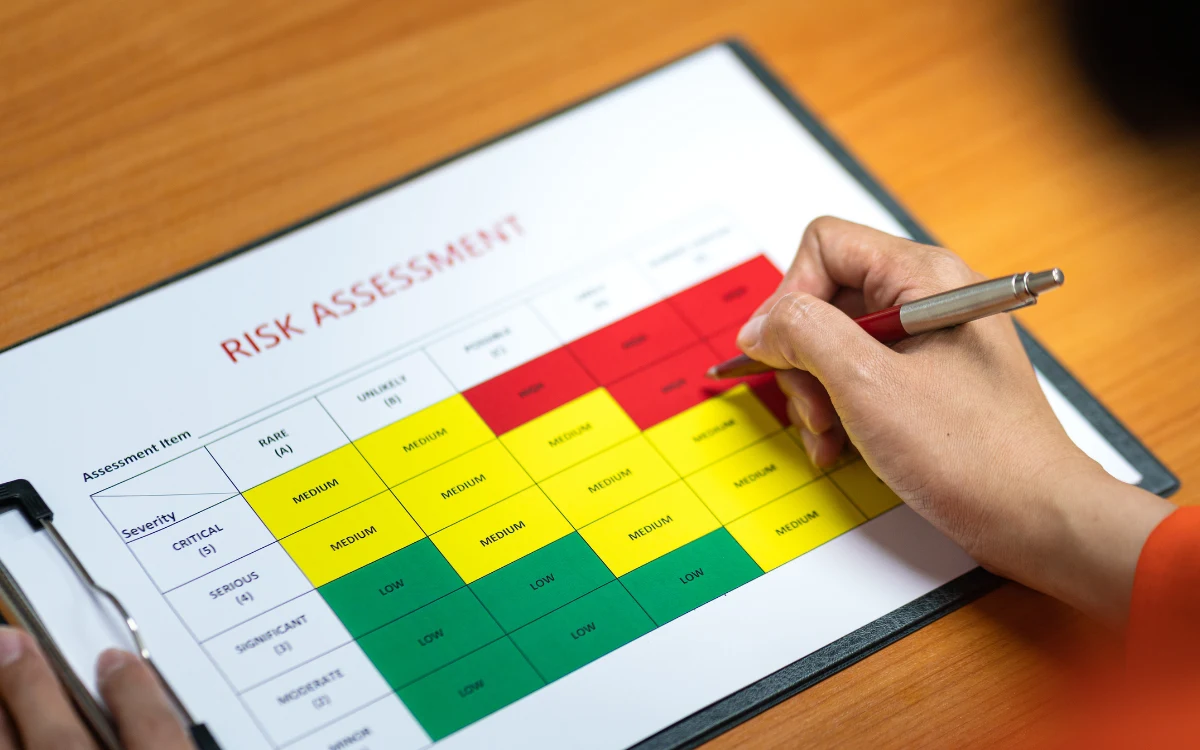
A risk matrix converts two assessment dimensions—likelihood and impact—into a structured risk rating. It helps teams compare exposures consistently, prioritise controls, and communicate risk decisions using a common scoring language across projects, departments, and organisational functions.
Understanding the matrix requires more than assigning numbers. The quality of the result depends on how consistently an organisation defines likelihood, measures impact, selects scoring scales, and interprets the combined result. This connects directly with the broader composite risk management meaning, where multiple risk factors are assessed through a structured process rather than treated as isolated events.
For a wider explanation of how risk identification, assessment, control, and monitoring connect, see Composite Risk Management: Meaning, Process and Chart Explained as the awareness-stage resource.
What is a risk matrix and why is it used?
A risk matrix is a structured assessment tool that combines likelihood and impact scores to produce a risk rating. Organisations use it to prioritise exposures, compare risks, allocate controls, support escalation, and create consistent decisions across operational and strategic activities.
The two dimensions have distinct meanings. Likelihood describes the probability or frequency of an event occurring. Impact describes the consequence if the event occurs.
A matrix normally places likelihood on one axis and impact on the other. Each axis uses defined numerical categories. A common model uses five levels, producing a 5 × 5 matrix with 25 possible combinations.
The matrix does not remove professional judgement. It structures that judgement. This distinction matters because two managers can evaluate the same event differently when definitions are unclear.
For example, a supply interruption with a likelihood score of 4 and an impact score of 5 produces a higher priority than an interruption scored at 2 and 3. The numbers create a common basis for discussion.
The matrix therefore functions as a decision-support mechanism rather than a prediction system. Its value depends on the quality of the evidence and definitions behind each score.
How should likelihood be scored in a risk matrix?
Likelihood should be scored against defined probability or frequency criteria rather than personal intuition. A five-level scale works effectively when each level has measurable descriptions, historical evidence, timeframes, and consistent interpretation across organisational teams and risk owners.
A typical five-level likelihood scale moves from rare to almost certain. Each category requires an operational definition.
For example, a business can define level 1 as an event that occurs less than once in five years. Level 2 can represent an event occurring once in two to five years. Higher levels then represent progressively greater frequency.
The exact thresholds depend on the organisation, industry, exposure type, and available evidence. A financial institution and a construction company do not necessarily use identical frequency criteria.
Historical incidents provide useful evidence. Incident registers, audit findings, equipment failures, supplier records, customer complaints, security events, and operational disruptions all contribute to likelihood assessment.
Forecasting also matters. A risk with no recent incident history still receives a meaningful likelihood assessment when external conditions indicate increased exposure.
Consistency is critical. If one department treats "likely" as a 50% probability and another treats it as a monthly occurrence, the resulting matrix becomes unreliable.
How should impact be scored correctly?
Impact should reflect the severity of consequences across defined business dimensions such as finance, operations, compliance, safety, reputation, customers, and strategic objectives. A consistent impact scale prevents teams from assigning scores based only on their immediate departmental concerns.
Impact assessment requires a clear definition of consequence. A single event can create several types of damage.
A technology outage, for example, can generate financial losses, service disruption, regulatory exposure, customer dissatisfaction, and reputational damage. The assessment process therefore needs to identify the relevant impact dimensions before assigning a final score.
Organisations frequently use thresholds to make impact categories measurable. A level 1 financial impact can represent a minor loss below a defined amount. Level 5 can represent a major financial exposure that threatens strategic objectives.
Financial thresholds alone are insufficient for many organisations. A compliance breach with limited direct financial cost can still create serious regulatory consequences. Likewise, an operational incident can have limited financial impact but create substantial customer or safety consequences.
The strongest approach defines impact criteria before assessment sessions begin. Risk owners then evaluate events against established standards rather than creating new criteria for each individual risk.
This produces more reliable scoring and makes risk assessments easier to review during audits, management meetings, and periodic risk reviews.
What is the difference between likelihood and impact?
Likelihood measures how probable or frequent an event is, while impact measures the severity of its consequences. Separating these dimensions prevents common scoring errors and allows organisations to distinguish frequent low-consequence risks from rare events with severe organisational consequences.
A risk can have high likelihood and low impact. An example is a minor processing error that occurs frequently but is corrected quickly.
Another risk can have low likelihood and high impact. A major data centre failure illustrates this category. The event is uncommon, but the consequences are significant.
The distinction matters because frequency does not automatically determine priority. High-impact risks require appropriate attention even when their likelihood is low.
Similarly, frequent minor incidents require attention when their cumulative effect consumes resources or indicates a weak control environment.
This separation also improves management discussions. Risk owners can explain whether a rating is driven primarily by exposure frequency or consequence severity.
A strong risk matrix therefore avoids combining the two concepts into a single subjective judgement. Likelihood and impact are assessed independently before they are combined into an overall rating.
How is a risk matrix score calculated?
A basic risk matrix score is calculated by combining the likelihood and impact values, commonly through multiplication. A likelihood score of four and an impact score of five therefore produces a score of twenty within a five-level assessment model.
The common formula is:
Risk Score = Likelihood × Impact
Using a five-point scale, the lowest theoretical score is 1 × 1 = 1. The highest is 5 × 5 = 25.
The numerical result is then mapped to a risk category. An organisation might classify scores from 1–4 as low, 5–9 as moderate, 10–16 as high, and 17–25 as very high.
These boundaries are examples rather than universal standards. The organisation establishes thresholds according to its governance framework, risk appetite, regulatory requirements, and operational context.
Multiplication is useful because it creates a simple numerical relationship between likelihood and impact. It is not the only scoring method.
Some organisations use qualitative combinations such as low, medium, and high. Others apply weighted scoring where particular impact dimensions receive greater importance.
The important requirement is consistency. Once an organisation selects a scoring method, risk owners need to apply the same method across comparable assessments.
What mistakes make risk matrix scoring unreliable?
Risk matrix scoring becomes unreliable when organisations use undefined categories, inconsistent evidence, arbitrary ratings, duplicated risks, inappropriate thresholds, or outdated assessments. The most serious weakness occurs when numerical scores appear precise but the underlying assessment criteria remain subjective or inconsistent.
One common mistake is treating the number as objective simply because it appears mathematical. A score of 16 does not represent the same level of exposure when two departments use different definitions.
Another problem is scoring inherent and residual risk incorrectly. Inherent risk represents exposure before controls. Residual risk represents exposure after existing controls operate.
Using the same score for both conditions prevents management from understanding whether controls actually reduce exposure.
Another error involves confusing control strength with impact. A strong control does not automatically reduce the consequence of an event. It normally reduces likelihood, impact, or both, depending on the control design.
Risk registers also become unreliable when scores remain unchanged for long periods. External threats, business processes, technology, suppliers, regulations, and operating conditions change.
A risk matrix therefore requires scheduled reassessment. High-priority risks often require more frequent review than low-priority exposures.
The assessment process also needs independent challenge. Risk owners provide operational knowledge, while risk managers, compliance teams, internal audit, or senior management provide governance oversight.
How does a composite risk management chart relate to a risk matrix?
A composite risk management chart shows how multiple risk factors move through identification, assessment, control, and monitoring, while the risk matrix provides a focused scoring mechanism within that process. The two tools support different levels of risk analysis.
Composite risk management addresses risks through an integrated process. It considers multiple exposures, their relationships, existing controls, and changing conditions.
The composite risk management chart provides a visual representation of that broader workflow. The risk matrix sits within the assessment stage.
This distinction is important for organisations developing risk capability. A matrix alone does not constitute a complete risk management system.
For example, a project team can identify supplier failure, cyber disruption, regulatory change, resource shortages, and equipment failure. Each risk receives its own likelihood and impact assessment.
The team then compares the results and identifies relationships between exposures. A supplier failure can increase operational disruption. A cyber incident can increase regulatory and financial exposure.
Composite assessment therefore provides context around individual matrix scores. It prevents teams from viewing each risk as completely independent.
This broader perspective is especially relevant for HR and L&D teams designing risk management training. Employees need to understand both the technical scoring mechanism and the organisational process in which the matrix operates.
Which risk matrix approach is most suitable for workplace training?
The most effective training approach combines conceptual instruction, scoring exercises, case analysis, calibration discussions, and workplace application. This approach develops assessment judgement rather than memorisation and enables participants to apply likelihood and impact criteria consistently across organisational situations.
Lecture-based learning provides foundational terminology. Participants learn likelihood, impact, inherent risk, residual risk, controls, risk appetite, risk owner, and risk treatment.
Practical workshops develop scoring judgement. Participants assess the same scenario independently and compare results. Differences reveal where definitions require clarification.
Case-based learning adds organisational context. A financial services team can assess operational resilience. A construction team can evaluate project safety and supply risks. An HR function can assess workforce continuity and critical-skill dependency.
Simulation creates another useful learning layer. Participants receive changing information and reassess the risk score as circumstances develop.
The strongest corporate learning model connects assessment exercises with organisational risk registers. Employees then work with realistic data rather than artificial examples.
For HR teams, training effectiveness should also be evaluated after delivery. Assessment scores before and after training provide evidence of knowledge improvement. Workplace audits can then measure whether risk owners apply the scoring framework consistently.
How should organisations compare risk matrix training methods?
Organisations should compare training methods by assessing practical application, scoring consistency, assessment quality, workplace transfer, instructor interaction, and measurement capability. The best format is the one that closes the identified competency gap rather than simply delivering risk terminology.
Instructor-led workshops provide immediate discussion and feedback. They work well when employees need calibration across departments.
Live virtual training provides structured interaction without requiring participants to travel. It suits geographically distributed teams and organisations with multiple locations.
Self-paced online learning provides flexibility and repeat access. It works well for foundational concepts, terminology, and introductory assessment exercises.
Blended learning combines these approaches. Participants complete foundational learning independently and use facilitated sessions for practical risk scenarios.
The correct selection depends on the workforce skill gap. A team unfamiliar with risk terminology needs foundational learning. Experienced risk owners need advanced calibration, scenario analysis, and governance application.
Training duration also requires evaluation. A short awareness session is not equivalent to a multi-day competency programme. The decision depends on the behaviours the organisation expects participants to demonstrate after training.
The evaluation therefore shifts from "Which format is best?" to "Which format produces the required workplace competency?"
How can HR measure whether risk matrix training improves performance?
HR can evaluate risk matrix training through knowledge assessments, scoring consistency, assessment quality, risk register improvements, control effectiveness, review completion, and management feedback. These measures connect learning activity with observable workplace behaviour and organisational risk performance.
Knowledge tests measure conceptual understanding. They establish whether participants understand the difference between likelihood, impact, controls, inherent risk, and residual risk.
Practical assessments provide stronger evidence of competency. Participants can score a scenario before and after training. HR can compare accuracy against an agreed expert benchmark.
Inter-rater consistency is another useful measure. If ten trained employees assess the same scenario and produce closely aligned results, the organisation has stronger evidence of scoring consistency.
Risk register quality also provides a workplace KPI. HR and risk teams can review whether descriptions become clearer, control owners become more explicit, and reassessment dates become more reliable.
A longer-term measure involves control effectiveness. Training is valuable when improved assessment leads to better treatment decisions, earlier escalation, and stronger monitoring.
ROI should therefore not be measured only through attendance or satisfaction scores. A corporate learning investment requires evidence of changed capability and operational application.
When does risk matrix training need formal certification?
Formal certification becomes relevant when an organisation needs structured competency evidence, professional development recognition, standardised risk knowledge, or a defined learning pathway for employees responsible for risk assessment and management activities across business functions.
Certification and training serve different purposes. Training develops knowledge and practical capability. Certification provides formal evidence that defined learning or assessment requirements have been completed.
For an individual, certification becomes more relevant when risk management forms part of a professional development pathway. Risk managers, project professionals, compliance specialists, internal auditors, operational managers, and governance professionals all work with structured risk processes.
For an employer, certification provides a clearer training record. HR teams can use certification status alongside practical assessments, performance reviews, and competency frameworks.
The decision should still be based on the role. A frontline employee who only reports operational incidents does not require the same level of formal risk qualification as a risk manager responsible for enterprise-level assessment.
When the learning objective shifts from general awareness to professional competency, organisations can evaluate structured certification programmes as part of their development strategy. This is the point where decision-stage resources such as Why British Academy for Training & Development's Risk Management Certification Is a Smart Career Move become relevant for evaluating a specific certification pathway.
Explore More Expert Insights:
Quality Engineer Career Path: Courses, Certifications and Salaries
Building a Quality Audit System: Framework and Templates
How should professionals choose a risk management learning programme?
Professionals should select a risk management programme according to learning objectives, practical application, assessment depth, delivery format, trainer expertise, certification requirements, and workplace relevance. Programme selection works best when competency requirements are defined before comparing providers or formats.
The first criterion is curriculum relevance. A programme focused only on terminology does not provide the same capability as one covering risk identification, assessment, controls, monitoring, escalation, and reporting.
The second criterion is practical application. Participants need opportunities to assess realistic risks, calculate scores, challenge assumptions, and interpret results.
The third criterion is assessment. A programme with practical evaluation provides stronger evidence of competency than attendance alone.
The fourth criterion is delivery suitability. HR teams should consider whether employees need classroom interaction, live virtual delivery, online flexibility, or a blended structure.
The fifth criterion is workplace alignment. Risk terminology and scoring criteria need to connect with the organisation's existing risk framework.
For professionals evaluating a structured learning pathway, Risk Management Training Courses provide a relevant service category for comparing formal development options. The programme should be assessed against the individual's existing competency level and intended workplace responsibilities rather than selected solely because it includes a certificate.
What is the correct decision process for using a risk matrix?
The correct decision process begins by defining risk criteria, scoring likelihood and impact independently, calculating the rating, comparing it with risk appetite, evaluating controls, assigning ownership, and establishing review requirements. This creates a repeatable connection between assessment and action.
A risk matrix becomes valuable when the score influences a decision.
A low rating can support routine monitoring. A moderate rating can require additional controls or management review. A high rating can trigger escalation, treatment planning, or senior approval.
The thresholds need to connect with organisational risk appetite. Risk appetite defines the level and type of exposure an organisation is prepared to accept while pursuing its objectives.
The matrix should also distinguish between assessment and treatment. A high score does not automatically identify the correct control. It signals the need for a management response.
Risk owners then determine whether to avoid, reduce, transfer, accept, or otherwise treat the exposure according to the organisation's framework.
The final stage is monitoring. Scores require review when incidents occur, controls change, business conditions shift, or new information changes the assessment.
The risk matrix therefore works best as part of an ongoing management cycle rather than as a one-time scoring exercise.