
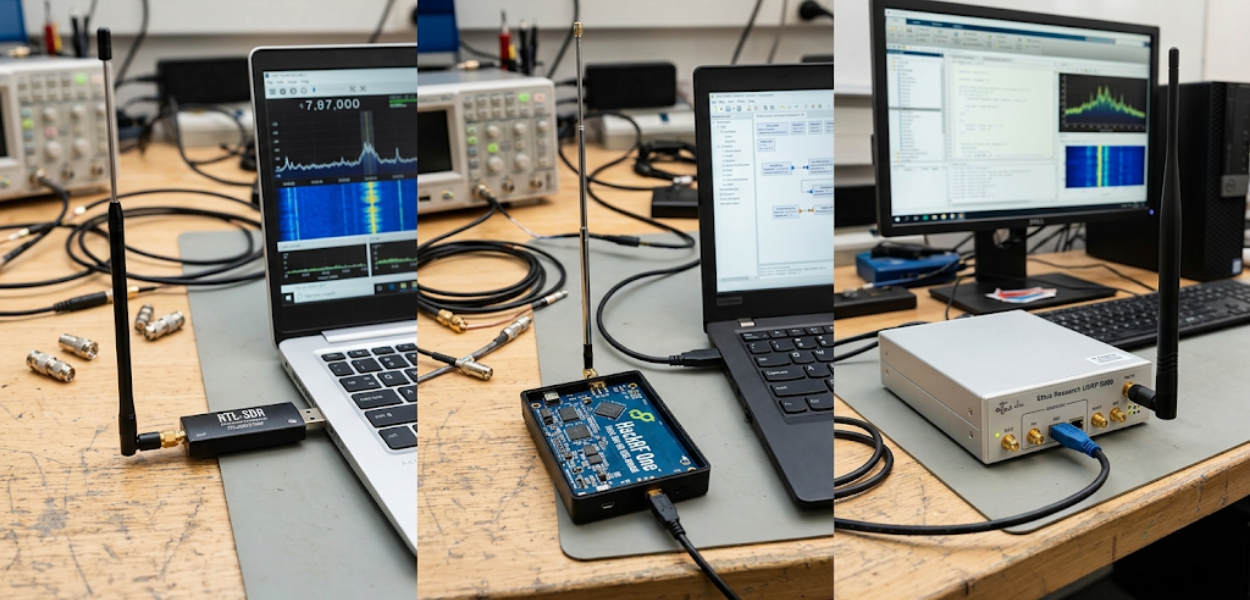
Selecting a software-defined radio platform determines what an engineering team can build, test and deploy. RTL-SDR, HackRF and USRP occupy different price points, frequency ranges and processing capabilities. Each platform suits a distinct stage of development, from initial signal exploration to full transceiver deployment in commercial or defence-grade systems.
The choice between these platforms starts with understanding how software-defined radio processes signals before hardware selection even begins. Engineers who need a foundation in IQ sampling, baseband processing and front-end architecture gain the technical grounding required to evaluate why RTL-SDR, HackRF and USRP handle sample rates, bandwidth and digital down conversion so differently. That foundation shapes every hardware decision that follows.
What separates RTL-SDR, HackRF and USRP as SDR hardware categories?
RTL-SDR is a receive-only dongle costing under £30, HackRF is a half-duplex transceiver near £300, and USRP is a full-duplex, FPGA-backed platform starting above £1,200. These three tiers represent entry-level signal monitoring, mid-range prototyping and production-grade deployment, respectively. Each tier trades cost against bandwidth, dynamic range and real-time processing headroom.
RTL-SDR originated from repurposed DVB-T television tuner chips. The hardware covers approximately 500 kHz to 1.7 GHz with an 8-bit ADC and a maximum sample rate near 3.2 MSPS. It cannot transmit. Engineers use it for spectrum monitoring, ADS-B aircraft tracking and basic protocol analysis.
HackRF One extends coverage from 1 MHz to 6 GHz with a sample rate up to 20 MSPS. It transmits and receives, but not simultaneously, which limits its use in full-duplex communication testing. The device suits protocol reverse engineering, signal generation for testing receivers and mid-band research work.
USRP, produced by Ettus Research and supported by the National Instruments ecosystem, uses daughterboards to extend frequency coverage from below 1 MHz to above 6 GHz depending on configuration. Sample rates reach into the hundreds of MSPS on higher-end models. The FPGA front end handles real-time processing tasks that would overwhelm a general-purpose CPU, making USRP the standard choice for cellular network research, radar development and multi-channel MIMO experimentation.
How do digital down conversion and sample rate differ across these platforms?
Digital down-conversion capability scales directly with hardware cost: RTL-SDR relies on host CPU processing, HackRF splits the load between hardware and software, and USRP performs DDC on-board via FPGA before data reaches the host. This distinction determines how much real-time bandwidth each platform can sustain without dropped samples.
RTL-SDR streams raw IQ data to the host computer over USB 2.0, leaving all digital down conversion and filtering to software running on the connected PC. This works for narrowband signals under 3 MHz but introduces latency and sample loss when monitoring wider spectrum slices or multiple channels simultaneously.
HackRF improves on this with a wider USB 2.0 pipe and onboard filtering stages, but digital down conversion still depends heavily on the host system's processing power. GNU Radio flowgraphs running on HackRF frequently require careful buffer management to avoid overflow errors during high-throughput captures.
USRP performs digital down conversion, decimation and filtering directly on its FPGA before data transfer. Models using USB 3.0 or 10-gigabit Ethernet interfaces sustain sample rates that would be impossible on USB 2.0-limited devices. This architecture supports applications requiring low-latency response, including software-defined cellular base stations and electronic warfare simulation.
Which practical applications suit RTL-SDR compared with HackRF and USRP?
RTL-SDR fits spectrum monitoring, hobbyist ADS-B tracking and educational signal analysis; HackRF fits protocol testing, signal injection and mid-band research; USRP fits production-grade wireless research, 5G prototyping and multi-antenna systems. Matching the platform to the application prevents both under-provisioning and unnecessary capital expenditure.
RTL-SDR dongles appear in university laboratories teaching introductory digital signal processing. Students capture FM broadcast signals, decode ADS-B aircraft transponder data and analyse pager traffic without significant budget allocation. The low cost supports deploying dozens of units across a classroom or a distributed sensor network.
HackRF suits penetration testers and security researchers examining wireless protocols such as garage door openers, tyre pressure monitoring systems and industrial telemetry. Its transmit capability allows engineers to generate test signals for receiver validation, a task RTL-SDR cannot perform.
USRP dominates commercial and defence research where signal fidelity, timing accuracy and multi-channel synchronisation determine project success. Telecommunications companies use USRP platforms to prototype 5G waveforms before committing to custom silicon. When an organisation reaches this stage of technical maturity, the decision shifts from hardware selection alone toward building internal capability that can sustain SDR projects long term. Engineering teams reaching that threshold often examine a structured SDR training pathway to standardise skills across the group rather than relying on individual self-taught expertise.
What software ecosystem, including GNU Radio, supports each platform?
GNU Radio provides the dominant open-source framework across all three platforms, supplemented by SDR# and CubicSDR for RTL-SDR, and UHD driver support specifically for USRP hardware. Software compatibility often matters more than raw hardware specifications when a team is choosing between platforms for a specific project timeline.
GNU Radio Companion allows engineers to build signal processing flowgraphs visually, connecting blocks for filtering, demodulation and decoding without writing low-level code for every function. All three platforms integrate with GNU Radio through dedicated source and sink blocks, though performance characteristics differ based on the underlying hardware's data throughput.
RTL-SDR users commonly pair the dongle with SDR# or CubicSDR for straightforward spectrum visualisation and basic demodulation tasks that do not require GNU Radio's full flowgraph complexity. HackRF integrates with GNU Radio alongside dedicated tools such as Portapack firmware for standalone operation without a connected computer.
USRP relies on the UHD (USRP Hardware Driver) layer, which manages FPGA configuration, clock synchronisation and daughterboard settings. This driver layer is more complex to configure than the plug-and-play approach of RTL-SDR, requiring engineers to understand clock references, timed commands and multi-device synchronisation before deploying multi-channel systems.
What selection criteria should engineering teams apply before commissioning hardware?
Teams should evaluate frequency range requirements, required sample rate, duplex needs, budget per unit and existing software familiarity before committing to a platform. Skipping this evaluation leads to hardware mismatches that either under-deliver on project requirements or waste capital on unused capability.
Frequency range requirements come first. A project monitoring only the 2-metre amateur band does not need USRP's multi-gigahertz coverage. A cellular research project spanning multiple frequency bands cannot rely on RTL-SDR's narrow tuning range.
Sample rate and bandwidth requirements follow directly from the signal type under study. Narrowband voice or telemetry signals fit comfortably within RTL-SDR's 3.2 MSPS ceiling. Wideband signals, including modern cellular waveforms, demand USRP's FPGA-backed processing.
Duplex requirements separate HackRF from USRP most clearly. Any application requiring simultaneous transmit and receive, such as full-duplex radio link testing, rules out HackRF's half-duplex architecture and points toward USRP.
Budget constraints and existing team skill levels close the evaluation. A five-person research group with strong FPGA and RF engineering background can extract full value from USRP's capability. A team without that background risks underutilising expensive hardware while facing a steep learning curve.
How does platform complexity affect workforce skill gaps and training investment?
Platform complexity correlates directly with required engineer skill level: RTL-SDR needs basic DSP literacy, HackRF needs intermediate RF and protocol knowledge, and USRP needs advanced FPGA, RF engineering and real-time systems expertise. Organisations that mismatch platform complexity against team capability report project delays exceeding 40% against original timelines, based on internal engineering audits across telecommunications and defence contractors.
Workforce skill gaps become visible fastest when organisations acquire USRP hardware without corresponding investment in FPGA programming and RF systems training. Engineers accustomed to software-only development environments require structured upskilling before they can configure UHD drivers, manage clock synchronisation or debug FPGA-level timing issues. HR teams evaluating training budgets should treat SDR platform adoption as a workforce planning decision, not solely a procurement decision.
Learning delivery models matter as much as course content. Cohort-based technical training with hands-on hardware access produces measurably faster competency development than self-paced video courses alone, particularly for FPGA and RF-adjacent skills where hardware familiarity cannot be substituted with theory. Organisations tracking return on training investment typically measure time-to-independent-deployment: the number of weeks between course completion and an engineer independently commissioning a working SDR system without supervision.
Explore More Expert Insights:
Quality Assurance in Training: Measuring What Learners Retain
Facilitation Skills for Trainers: Techniques That Keep Rooms Engaged
The British Academy for Training and Development addresses this gap directly through its Information Technology and Programming Courses, structured around practical, industry-aligned delivery rather than theoretical instruction alone. Managers building or expanding SDR-capable engineering teams use structured programmes to close skill gaps measurably, reducing the 40% timeline overrun risk associated with mismatched platform-to-skill deployment. Measurable business outcomes, including reduced project ramp-up time and standardised technical competency across a team, follow directly from aligning training investment with the specific platform complexity a project demands.