
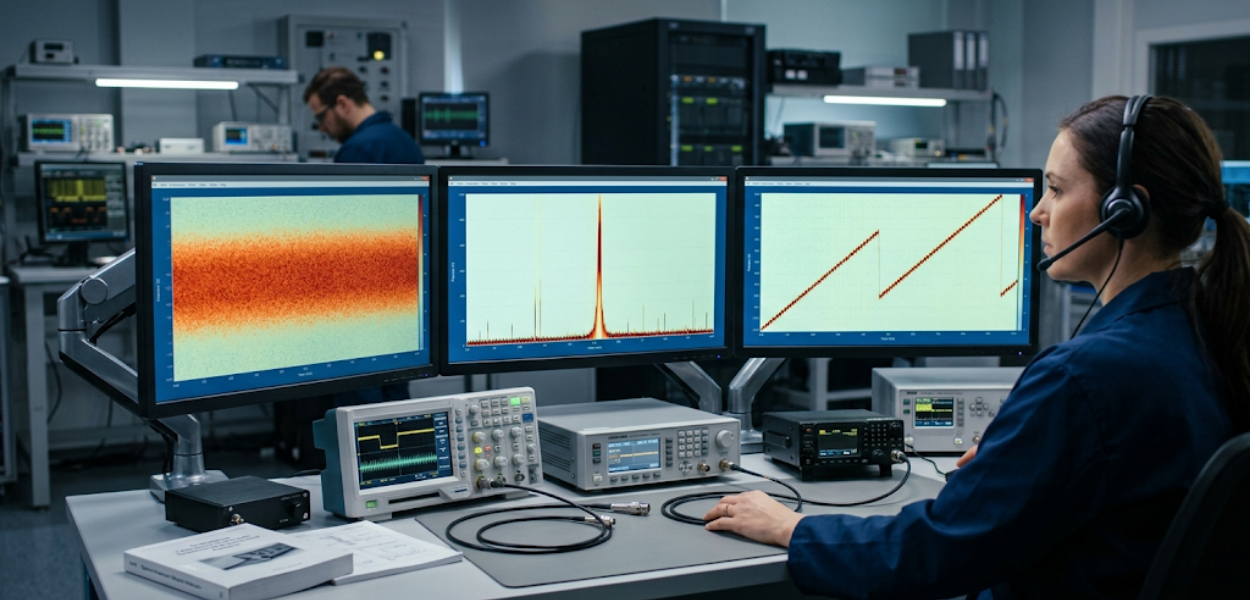
Radio jamming disrupts communication by injecting interference into a target frequency or frequency range. Understanding how different jamming signatures behave is central to spectrum defence, electronic warfare readiness, and workforce capability in sectors that depend on secure radio links.
Radio jamming is the deliberate transmission of interfering signals to block, degrade, or deny communication on a specific frequency or band. Analysts identify jamming activity by studying signal power, bandwidth occupation, and timing patterns. These patterns, known as signatures, allow spectrum monitoring teams to classify an attack as barrage, spot, or sweep jamming within seconds. Organisations that operate radio-dependent systems, from defence communications to industrial telemetry, treat signature recognition as a core operational skill. Teams that build this capability through structured Radio Jamming Techniques Detection and Countermeasures Training Courses reduce response time during live interference events and lower the risk of prolonged communication blackout.
Jamming signatures differ by bandwidth coverage, power distribution, and how long the interference dwells on a given frequency. A jammer using a wide bandwidth trades signal strength for coverage. A jammer targeting one frequency concentrates power for maximum disruption on a single channel. A jammer that moves across a band trades dwell time for unpredictability. Each approach produces a distinct fingerprint on a spectrum analyser, and each demands a different countermeasure.
How does barrage jamming disrupt communication systems?
Barrage jamming floods a wide frequency band with continuous interference, denying multiple channels simultaneously at the cost of reduced power per channel. This technique suits attackers who do not know the exact frequency a target system uses, or who want to disable an entire communication band rather than a single link. Military convoys, emergency response networks, and multi-channel radio systems face this threat most often because barrage jamming does not require precise targeting.
The bandwidth of a barrage jammer can span several megahertz, sometimes covering an entire VHF or UHF band in one transmission. Because the jammer distributes its output power across this wide range, the interference on any single frequency is weaker than a targeted attack. Detection teams identify barrage jamming through a flat, elevated noise floor across a wide portion of the spectrum, visible on a waterfall display as a solid block rather than a narrow spike.
Countermeasures against barrage jamming rely on frequency hopping and spread spectrum techniques. Frequency hopping changes the transmission frequency dozens or hundreds of times per second according to a pre-shared sequence, making it difficult for a barrage jammer to maintain effective coverage across every hop. Spread spectrum systems distribute the signal across a wide bandwidth at low power density, which increases resilience against wideband interference without requiring frequency changes.
What distinguishes spot jamming from other techniques?
Spot jamming concentrates all available power on a single, known frequency to achieve maximum disruption on one specific channel while leaving adjacent frequencies clear. This method requires the attacker to identify the target frequency in advance, either through signal intelligence, interception, or knowledge of standard operating frequencies used by a specific system.
Because spot jamming directs full transmitter power at one frequency, it produces the strongest possible interference-to-signal ratio on that channel. A spectrum analyser shows spot jamming as a sharp, narrow spike of elevated power at a fixed point, distinct from the flat plateau of barrage jamming. This narrow signature makes spot jamming easier to isolate but harder to survive if the target system has no alternative frequency available.
Anti-jam waveforms designed for spot jamming resistance typically use frequency agility, allowing the receiver to switch away from a jammed frequency within milliseconds of detecting degraded signal quality. Interference source location becomes critical against spot jamming because the narrow, stable signature allows direction-finding equipment to triangulate the jammer's physical position with high accuracy, often within one or two bearing measurements.
Organisations that operate on fixed, predictable frequencies face higher exposure to spot jamming. Migration to frequency-agile systems, or adoption of anti-jam waveforms with built-in frequency diversity, reduces this exposure directly. Teams tasked with defending single-channel systems benefit from focused signature recognition training, since spot jamming events are typically shorter in duration but higher in disruptive impact than barrage attacks.
How does sweep jamming behave across a frequency range?
Sweep jamming transmits interference across a range of frequencies in rapid succession, cycling through the band faster than most receivers can track, creating intermittent disruption on each individual channel. This technique sits between barrage and spot jamming in both coverage and power concentration, offering an attacker a way to affect multiple frequencies without the power dilution of a full barrage.
A sweep jammer moves through its target range at a defined rate, sometimes completing a full cycle in under a second. On a waterfall display, this produces a diagonal or zigzag line moving across the frequency axis over time, distinct from both the flat barrage signature and the fixed spot signature. The speed of the sweep determines how much dwell time each frequency receives, which in turn determines how disruptive the jamming is to any single channel.
Systems using frequency hopping are particularly vulnerable to sweep jamming when the sweep rate matches or exceeds the hop rate, because the jammer can intercept the receiver at multiple points in its hopping sequence. Detection requires spectrum monitoring equipment capable of capturing fast time-domain changes, since a slow sweep of the spectrum by the monitoring system itself can miss a rapid sweep jammer entirely.
How do these jamming signatures differ in practical application?
Barrage, spot, and sweep jamming create three distinct operational problems, and each demands a different detection and response posture. Barrage jamming demands wideband monitoring and frequency-hopping resilience. Spot jamming demands frequency agility and precise direction-finding. Sweep jamming demands high-speed spectrum capture and hop-rate coordination that outpaces the sweep cycle.
Personnel trained to recognise only one signature type often misclassify the other two, leading to the wrong countermeasure being applied. A team that responds to sweep jamming with a fixed frequency change, appropriate for spot jamming, gains no benefit because the sweep will eventually cycle back to the new frequency. Correct classification within the first few seconds of an interference event determines whether the countermeasure applied actually restores communication.
Interference source location techniques also vary by signature. A stable spot jammer allows straightforward triangulation from two or three receiver locations. A moving sweep jammer requires synchronised, time-stamped measurements across multiple sensors to reconstruct its sweep pattern and estimate a position. A barrage jammer, given its wide power distribution, often requires closer proximity for accurate bearing measurement because the signal-to-noise ratio at any single frequency is lower.
What business and workforce implications come with detecting radio jamming?
Organisations operating radio-dependent infrastructure face measurable financial and operational exposure when personnel cannot classify jamming signatures correctly. A communication blackout during a critical operation carries direct costs in lost productivity, delayed response, and, in defence or security contexts, mission failure. Workforce skill gaps in spectrum monitoring and electronic warfare fundamentals leave organisations dependent on a small number of specialists, creating a single point of failure during high-tempo incidents.
Structured training closes this gap by building signature recognition as a shared team competency rather than a niche specialism. Learning delivery models for this subject typically combine theoretical instruction on waveform behaviour with practical exercises using live or simulated spectrum data, allowing trainees to build recognition speed under realistic time pressure. Organisations that measure training effectiveness through post-course assessment report faster average classification times and fewer misapplied countermeasures during live incidents.
Return on investment for this training category is measured through incident response time, correct countermeasure application rate, and reduction in communication downtime during interference events. Teams that reach proficiency in signature classification typically cut initial response time from several minutes to under thirty seconds, a difference that matters directly in defence, aviation, and critical infrastructure contexts where every second of blackout carries operational risk.
Where should organisations apply anti-jam and detection training?
Training investment should target the personnel closest to spectrum-dependent operations: signals teams, communications officers, and technical staff responsible for maintaining link integrity under contested conditions. Learn Radio Jamming Techniques Detection the Way Defence Professionals Actually Apply Them provides a structured pathway for teams moving from theoretical awareness of jamming types toward operational competence in real-time classification and response, built around the same signature analysis principles covered above.
This training approach suits organisations that have already identified a gap in spectrum awareness and are ready to build internal capability rather than continue relying on external specialists for every interference event. Selection criteria for a training provider should include practical exposure to live signal data, coverage of all three primary signature types, and assessment methods that confirm trainees can classify and respond under time pressure, not only recall definitions in a written test.
Broader technical capability across an organisation also strengthens its ability to respond to spectrum threats. Teams that pair electronic warfare awareness with wider technical grounding, such as the skills covered in Information Technology and Programming Courses, are better positioned to build or adapt monitoring tools, automate signature classification, and integrate detection systems with existing network infrastructure. This combination of domain-specific and technical training gives HR and learning teams a clearer path to closing workforce skill gaps across both specialist and general technical roles.
Explore More Expert Insights:
Software Defined Radio Platforms Compared: RTL-SDR, HackRF and USRP for Practical Applications
Quality Assurance in Training: Measuring What Learners Retain
Organisations planning training budgets for the coming cycle should treat spectrum defence literacy as a baseline requirement for any role touching radio-dependent systems, not an optional specialism reserved for dedicated electronic warfare units. The cost of a single unresolved jamming incident, measured in downtime, delayed operations, or compromised communication, typically exceeds the cost of training an entire team to recognise and respond to the three signature types covered in this article.