
Agile is a project management approach, whereas Scrum provides a full-featured methodology under that approach. More about Agile and Scrum will clarify whether they suit your requirements.
The whole Agile-Scrum comparison is a bit misleading. Whereas Agile is an approach to project management based on iterations, Scrum is one out of many methodologies that you can make a career out of. It is less about choosing between Agile vs. Scrum and more about first determining whether Agile is a best-fit strategy for managing your team's projects, then whether Scrum is the best-fit methodology compared to others like Kanban or Lean.
To illustrate, a survey of 101,592 software developers showed that 85.9% of them used Agile for their work, but that does not imply that they used Scrum techniques and principles. Simply put, all teams implementing Scrum techniques and principles are Agile, yet not all Agile teams implement Scrum.
The British Academy for Training and Development offers an agile project management training course and a scrum master training course to better understand the difference between agile and scrum. Now that we understand how Agile and Scrum implement their methodologies, it is imperative that we understand how each methodology implements itself.
What is Agile?
Agile gives a more flexible approach to executing change compared to other methodologies of project management. It tries to meet an objective through smaller increments so that a team can deliver continuously in smaller time frames. This, in turn, gives the project team flexibility in changing priorities, reacting to issues that arise, and saving costs, time, and waste.
The four values that guide the Agile approach to project management are the following:
Individuals and interactions over processes and toolsWorking software over comprehensive documentationCustomer collaboration over contract negotiationResponding to change over following a planWhat is Scrum?
Scrum comes under Agile and is basically the same set of principles rocked with a bit more sophistication. Scrum is by far the most favoured child of Agile. It is also a flexible development method for software, not a serial or linear method that you can simply apply, but rather a framework with definite principles that can be tailored to meet the specific needs of a given organisation or one or more project teams so they may adequately solve the problems at hand and deliver a product high in quality.
Scrum is by far the most widely used Agile methodology. An interesting survey among over 2,000 participants found that 97% of all IT teams that had railroaded their projects using Scrum were very happy with the success rate of their projects and would therefore continue using Scrum methods in the future.
Agile vs. Scrum
Agile is the best methodology of all for the developers, altogether with iterative and incremental software development, while Scrum is part of Agile. Scrum is an implementation of Agile that a business or team might use to incorporate Agile methodology within business operations. With Scrum, incremental builds are happening fairly often, from one up to three weeks.
In terms of usage, Agile is applicable in any business environment that functions with a small team of experts, whereas the Scrum method has been introduced for a much more specialised environment with rapidly changing requirements. An effective Agile environment becomes possible with strong leadership to steer the change, while Scrum focuses more on self-organising cross-functional teams instead.
It is seen frequently that Scrum sprints are taking place; thus, it's relatively more adaptive among all forms of Agile methodology. The flexibility and responsiveness about changes are more because of the duration of the sprints. Continuous collaboration shares the points where Agile teams deal with face-to-face interactions, while Scrum's interaction occurs at a daily stand-up every morning with the Scrum Team.
There are several considerations attached to using an Agile approach with your project or company. Agile approaches have more purposefully arranged schedules of short development cycles, and they value collaboration and communication, along with being able to adapt to change and feedback. Then consider which of the many possible Agile methodologies could best suit your needs. Let us take a brief look at the differences among Scrum, Kanban, and XP.
1. Scrum
Work is organised in Scrum by means of sprints, which are defined periods of time lasting from one to four weeks. Teams maintain a list called the product backlog, which catalogues all pending work items and requirements.
Defined within the Scrum framework, there are three roles: the Scrum Master, who facilitates the process; the product owner, who prioritises and specifies requirements; and the development team, which does the work. The team members maintain alignment by way of a very short daily Scrum update on progress and any impending issues.
2. Scrum versus Kanban
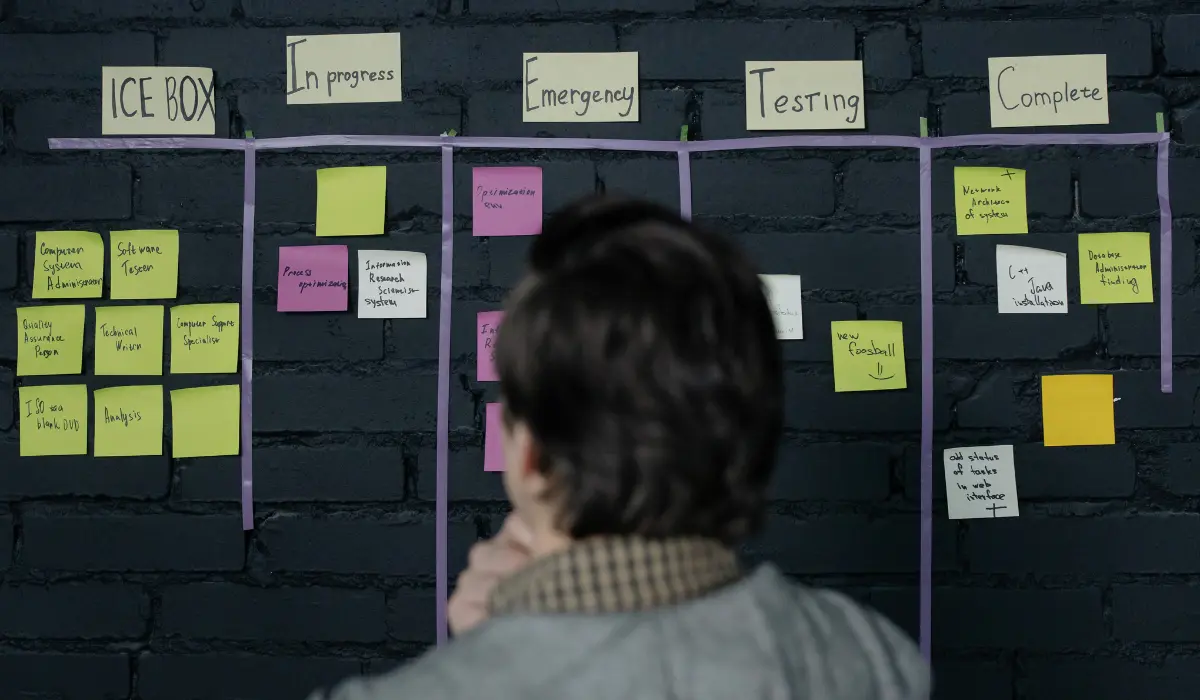
Kanban is a Japanese word that means "signboard". The process consists of a board, either real or virtual, that is divided into columns corresponding to phases of the project. As work proceeds, each sticky note or card that denotes the project moves into the next phase until the project is complete. Thus, it serves as a very visual way to represent the process and find bottlenecks.
Kanban does not adhere to strict timelines as Scrum does; work moves on in a continuous fashion. Roles such as product owners could be chosen any time in between. Some project managers have hybridised the concepts of Scrum and Kanban in a methodology called Scrumban.
3. Scrum vs. XP
XP, short for Extreme Programming, is an Agile method mostly used in software development. Like other Agile methods, it emphasises small releases and iterations. A distinguishing feature of XP is pair programming, where two programmers collaborate to develop code.
4. Agile vs. Waterfall
Waterfall project management is another popular approach employing a solution contrary to that of Agile. While Agile is an iterative and adaptive mode of project management, Waterfall itself is linear and does not permit going back to previously completed steps and phases.
Waterfall suits small projects which are completed with a concrete goal in mind, while Agile, on the other hand, works better when flexibility is needed for larger projects. Yet another difference between Waterfall and Agile is stakeholder involvement. Clients are more often not involved in Waterfall; the Agile methodology guarantees that client feedback is received during various phases of development.
Advantages and Challenges of AgileAdvantages of AgileHigher customer satisfaction: Continuous feedback ensures the final product meets real needs.Improved product quality: Iterative testing catches defects earlier.Better risk management: Problems are spotted early through constant iterations.Faster ROI: Deliverables are released incrementally, offering value sooner.Challenges of AgileRequires cultural change: organisations must shift away from rigid hierarchy.Demanding for stakeholders: Frequent input is needed.Harder scaling: Agile frameworks like SAFe have been developed to tackle large-scale adoption.