
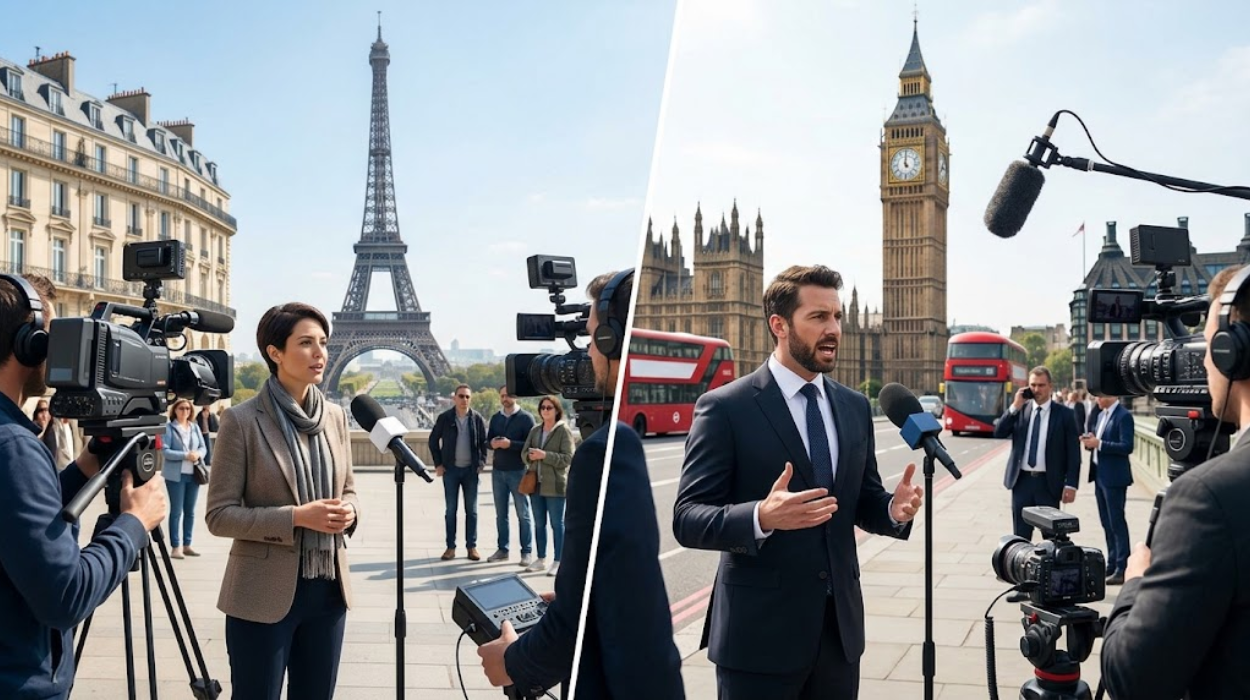
Media training in Paris and London follows the same core objective: preparing professionals to communicate clearly under media pressure, but programme structure, delivery style, language requirements, broadcast expectations and organisational priorities create meaningful differences between the two markets.
Media training prepares professionals to handle interviews, public statements, press conferences, live broadcasts and difficult questions. It combines communication skills with practical rehearsal, message development and performance feedback. For organisations comparing programmes, the relevant question is not simply which city offers better training. The useful question is which programme structure matches the organisation’s communication environment and workforce requirements.
Professionals entering broadcasting also need to understand the wider pathway into presenting. A useful starting point is how to become a TV presenter: skills and pathways, because presenter development involves communication, camera performance, research, interview technique and audience awareness alongside formal media training.
What does media training in Paris typically focus on?
Media training in Paris commonly emphasises structured communication, interview preparation, French-language delivery, public relations awareness and controlled responses, making it suitable for professionals operating within French-speaking media environments and organisations with strong European communication requirements.
Paris-based programmes often address communication within French corporate, governmental and cultural environments. The training typically places attention on message clarity, interview discipline and professional presentation.
Language is an important factor. Professionals who communicate primarily in French need to develop natural responses rather than translating prepared English statements word for word. Language-specific rehearsal improves vocabulary, tone and response speed.
The media environment also influences programme design. A spokesperson dealing with French television, radio or newspapers requires familiarity with local interviewing conventions. Preparation therefore extends beyond presentation technique.
Organisations should also consider whether employees communicate internationally. A Paris-based professional who regularly addresses English-speaking journalists needs bilingual media preparation. The programme then needs to cover language switching, terminology consistency and message control.
The strongest media training Paris programmes therefore connect presentation practice with the actual communication responsibilities of participants.
Which professionals benefit most from Paris-based training?
Paris programmes suit corporate spokespersons, executives, public-sector representatives, communications teams and professionals who regularly interact with French-language media.
They also suit employees preparing for European press activity. A company entering the French market needs representatives who understand both corporate messaging and the communication expectations of French audiences.
For HR and learning teams, participant selection should follow communication exposure rather than job title. A senior manager appearing on television requires different preparation from an employee who only contributes to written interviews.
How does media training in London differ from Paris?
London programmes generally place stronger emphasis on English-language broadcast performance, television interviews, live questioning, concise soundbites, presenter technique and communication for international audiences, particularly within the UK’s highly developed broadcast and corporate media environment.
London has a dense professional media ecosystem spanning television, radio, newspapers, digital publishers and specialist business media. This creates a training environment where participants can practise multiple interview formats.
The English-language focus also has international relevance. Professionals trained to communicate effectively for British media frequently develop transferable skills for international interviews because English remains a major language for global corporate communication.
London-based training often gives particular attention to soundbites. A soundbite is a short, quotable statement designed to communicate one clear idea. Executives need to deliver these statements without losing accuracy or appearing rehearsed.
Live interview preparation is another distinction. Participants practise responding when the interviewer changes direction, interrupts an answer or introduces an unexpected question.
This makes London programmes particularly relevant for companies whose executives represent brands across several countries.
Are London programmes more suitable for TV presenters?
London offers a strong environment for broadcast-oriented development because television presentation requires skills beyond ordinary corporate communication.
Professionals considering TV presenter courses need camera confidence, vocal control, scripting, teleprompter use, interviewing, timing and audience engagement. Media training overlaps with these skills but does not always provide the complete presenter pathway.
The distinction matters when HR teams select training. A spokesperson needs message control and interview resilience. A presenter needs performance, programme awareness and sustained audience engagement.
A programme should therefore be assessed against the participant’s role rather than the popularity of the training location.
Which programme structure is better for corporate spokespersons?
The stronger programme is the one that reflects the organisation’s actual media exposure, communication channels, languages and risk profile rather than simply choosing Paris or London as a training location.
Corporate spokesperson training should begin with a communication needs analysis.
The organisation first identifies where employees communicate. This includes television, radio, podcasts, conferences, online interviews and press briefings.
The next stage identifies common communication risks. These include unclear messaging, excessive technical language, defensive responses, inconsistent statements and poor handling of difficult questions.
Training then needs practical rehearsal. Participants should complete simulated interviews instead of relying only on classroom explanations.
A useful programme normally contains four connected stages:
This structure works in both Paris and London. The difference comes from language, media context, audience expectations and the type of interview participants face.
How should HR teams evaluate media training programmes?
HR teams should evaluate media training through participant needs, practical rehearsal time, trainer expertise, language requirements, feedback quality, delivery format, assessment methods and measurable workplace outcomes rather than relying on programme location or course duration alone.
The first evaluation criterion is relevance. Training content must match the communication situations employees actually encounter.
The second is practice intensity. Media skills develop through repetition. A programme dominated by presentations and theory provides limited evidence of performance improvement.
The third is feedback quality. Participants need specific observations about verbal and non-verbal behaviour. Generic feedback does not provide a useful improvement path.
The fourth is delivery format. Organisations can choose face-to-face programmes, live virtual training or blended learning. Each model affects rehearsal and accessibility.
Face-to-face delivery provides direct physical observation. Virtual delivery supports geographically distributed teams. Blended programmes combine structured digital learning with live practice.
The fifth criterion is measurement. HR teams should define baseline performance before training and assess the same behaviours afterwards.
Useful measures include:
These indicators create a more useful evaluation than attendance figures alone.
How important is practical simulation in media training?
Practical simulation is one of the strongest indicators of programme quality because media communication requires rapid decision-making, controlled delivery and composure under questioning that theoretical instruction cannot fully reproduce.
Participants should experience realistic scenarios during training.
An executive can face a hostile interview. A technical specialist can answer questions about a product problem. A communications manager can practise responding to an emerging reputation issue.
Recorded simulations provide measurable evidence. Participants can review posture, eye contact, speaking pace, vocabulary and message consistency.
Repeated simulation also exposes behavioural habits. Some professionals answer questions too broadly. Others provide unnecessary technical details. Some become defensive when challenged.
A good programme converts these observations into specific corrective exercises.
The same principle applies to presenter development. Camera rehearsal reveals behaviours that normal conversation does not expose. Facial expression, posture, timing and vocal energy become measurable performance elements.
How do programme duration and delivery models affect outcomes?
Programme duration should reflect communication complexity: short intensive sessions suit experienced professionals needing targeted preparation, while longer programmes provide more rehearsal, feedback and behavioural development for employees with limited media experience.
A one-day programme can address immediate needs such as interview preparation or an upcoming public appearance. It provides concentrated instruction and practice.
A multi-session programme allows participants to practise, receive feedback and return with improved performance. This model is more appropriate for organisations developing internal spokesperson capability.
A blended model supports larger international teams. Participants can complete preparatory learning online before attending live simulation sessions.
Duration should therefore be connected to the performance gap.
If participants already understand corporate messaging and need camera confidence, a focused programme is appropriate.
If employees have limited interview experience and represent the organisation regularly, a longer development pathway provides stronger preparation.
Which skills should a media programme develop?
A complete media programme should develop message discipline, interview technique, vocal delivery, body language, camera awareness, difficult-question handling, audience adaptation and post-interview evaluation so participants can perform consistently across different media formats.
Message discipline
Participants learn to identify the central message and communicate it without unnecessary detail.
Interview technique
Training covers direct questions, follow-up questions, interruptions and challenging assumptions.
Vocal delivery
Voice training addresses pace, pronunciation, volume, pauses and emphasis.
Non-verbal communication
Posture, facial expression, eye contact and gestures affect how audiences interpret a spokesperson.
Camera awareness
Camera positioning and visual presentation influence broadcast performance.
Difficult questions
Participants need frameworks for responding without becoming evasive or losing message control.
Audience adaptation
Technical information must be adjusted according to audience knowledge. A financial journalist and a general television audience require different explanations.
Performance evaluation
Recording and reviewing interviews allows participants to identify measurable improvements.
How should organisations choose between Paris and London?
Organisations should select Paris when French-language communication and local media conventions dominate, while London becomes more suitable when English-language broadcasting, international audiences and broader presenter or spokesperson development are central requirements.
The decision should begin with communication geography.
A company operating mainly in France needs representatives who can communicate naturally with French journalists and audiences. Paris-based training provides contextual relevance.
An international company using English as its primary media language benefits from London-oriented training. This is particularly relevant for multinational leadership teams.
The audience also matters. A spokesperson communicating with investors requires different preparation from a television presenter addressing a general audience.
Training objectives should then determine the programme type.
For executives, interview resilience and message discipline receive priority.
For communications teams, consistency across spokespeople becomes more important.
For aspiring presenters, camera performance and audience engagement require greater emphasis.
For HR departments, measurement and scalability become central considerations.
This approach avoids treating location as the deciding factor.
What should participants expect from a professional media programme?
Participants should expect a combination of communication theory, message preparation, practical interviews, camera or microphone exercises, trainer feedback, performance analysis and repeated practice designed around realistic workplace media situations.
The exact structure depends on programme objectives.
A corporate programme normally begins with communication principles and message development. Participants then move into interview exercises.
A broadcast-focused programme places greater weight on camera performance, presentation style and live delivery.
A public-relations-oriented programme focuses more strongly on organisational reputation, media relationships and consistent messaging.
The Media, Public Relations & Communication course aligns these areas within a broader professional communication framework. Its relevance depends on whether the participant requires an integrated understanding of media, public relations and workplace communication rather than a narrowly focused interview workshop.
For HR teams, this distinction is important. A broad communication programme supports wider workforce development, while a specialist media programme addresses a narrower performance requirement.
How can organisations measure media training ROI?
Media training ROI should be measured through observable communication improvements, reduced performance errors, stronger message consistency, improved spokesperson readiness and business outcomes linked to effective media and public communication.
Return on investment does not need to rely only on financial calculations.
HR teams can establish a performance baseline before training. Participants can complete a recorded mock interview and receive scores against defined criteria.
The same assessment can be repeated after training.
For example, an organisation can measure:
Longer-term measurement can examine media outcomes. These include successful interviews, reduced communication errors and greater availability of trained internal spokespeople.
For large organisations, the value also comes from reducing dependence on a small number of senior communicators.
Training several employees creates greater organisational resilience. More people become capable of representing the organisation accurately when media opportunities or communication incidents arise.
What is the best way to decide between a Paris and London programme?
The best decision comes from matching programme design to communication requirements: language, audience, media format, participant role, practical rehearsal needs, organisational risk, delivery model and measurable performance objectives should determine the final selection.
Paris and London should not be treated as competing labels for identical training.
Paris provides strong relevance for French-language communication and professionals operating within French media environments.
London provides strong relevance for English-language broadcast communication and professionals working with international audiences.
The programme itself remains more important than the city.
Explore More Expert Insights:
How British Academy for Training & Development's Presentation Skills Training Helps You Stand Out
Media, Public Relations & Communication: Handling Pressure Through Structured PR and Crisis Media Management Training
HR and communications leaders should therefore define the performance gap first. They should then assess programme content, practical exercises, trainer expertise and assessment methods.
For a spokesperson preparing for interviews, realistic interview simulation should receive priority.
For a developing presenter, camera and vocal performance should receive greater attention.
For an international organisation, language and audience adaptation should be assessed carefully.
The final choice becomes a training-design decision rather than a geographical preference.