
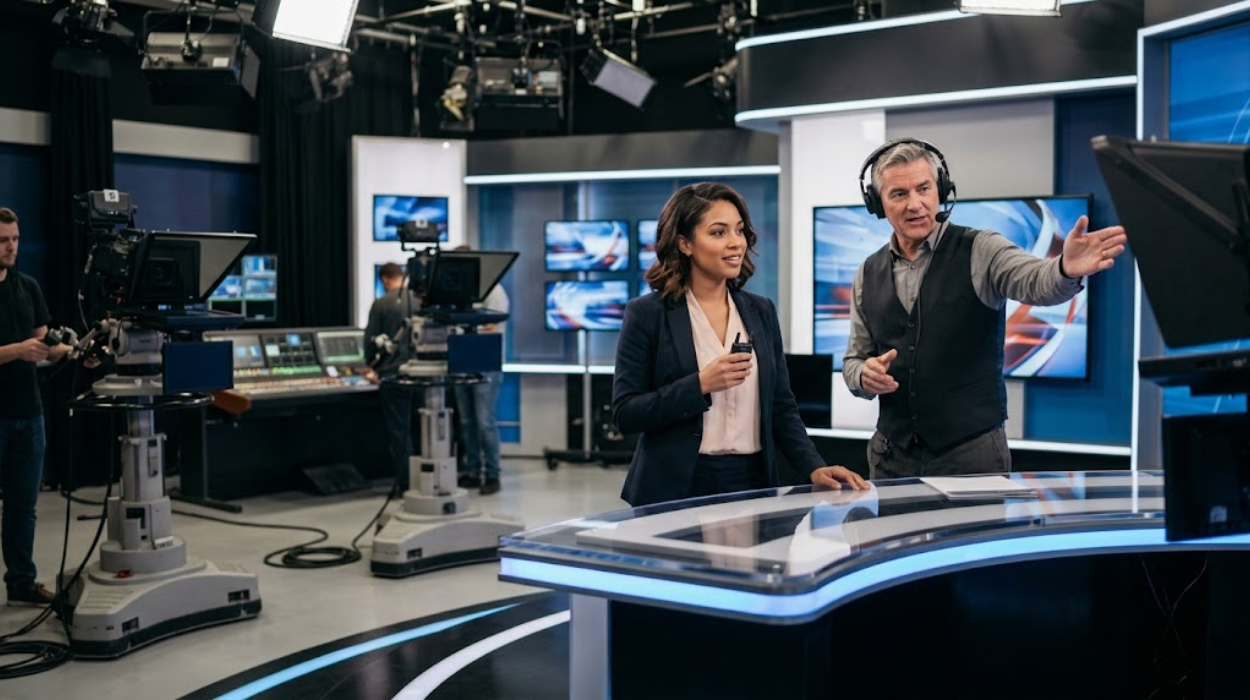
Becoming a TV presenter requires more than speaking clearly in front of a camera. Professional presenting combines communication, audience awareness, research, interviewing, storytelling, vocal control, visual presentation, and live performance. In corporate environments, these capabilities also support executives, media spokespeople, communications teams, trainers, and public-facing leaders.
For organisations, presenter skills form part of a broader communication capability. Employees who represent a company on television, online broadcasts, conferences, webinars, or recorded corporate content need consistent messages and controlled delivery. Training provides a structured way to identify skill gaps, practise communication behaviours, assess performance, and connect learning with business communication objectives.
What skills does a TV presenter need to develop?
A TV presenter needs communication, research, interviewing, camera, vocal, storytelling, improvisation, and audience-management skills. These capabilities help presenters deliver accurate information, maintain attention, respond to changing situations, and communicate messages consistently across broadcast and corporate environments.
A TV presenter is a professional who communicates information, introduces programmes, interviews guests, explains topics, or manages live and recorded broadcasts. The role requires both verbal and non-verbal communication.
Verbal communication includes pronunciation, vocabulary, pacing, tone, emphasis, questioning, and concise explanations. Non-verbal communication includes posture, facial expression, eye direction, gestures, and movement.
Research is another core capability. Presenters need to understand the subject before appearing on camera. Research skills involve identifying reliable information, checking facts, organising notes, and separating relevant details from background material.
Interviewing requires a different set of behaviours. A presenter must formulate questions, listen to answers, identify useful information, and ask follow-up questions. These skills also apply to corporate leaders interviewing employees, customers, specialists, or external stakeholders.
Camera skills determine how communication appears on screen. A presenter learns framing, eye-line control, body positioning, facial expression, and movement. These elements become important when employees represent organisations through television interviews, video announcements, webinars, or digital broadcasts.
How does TV presenter training work in a professional environment?
Professional presenter training starts with a skills assessment, continues through structured instruction and practical exercises, and ends with performance assessment. Workshops, online modules, hybrid sessions, simulations, role-play, recorded practice, and feedback create measurable opportunities to improve communication performance.
The first stage is a skills-gap assessment. The organisation identifies the communication behaviours that require development. These can include unclear speech, excessive filler words, weak questioning, poor camera awareness, inconsistent messaging, or difficulty responding under pressure.
The second stage establishes learning objectives. Objectives should describe observable behaviours. For example, a participant can be required to deliver a 3-minute television-style introduction, conduct a 5-question interview, or answer challenging questions without losing the central message.
The third stage introduces technical knowledge. Participants learn presentation structure, audience analysis, broadcast communication, interview techniques, vocal delivery, and camera behaviour.
The fourth stage uses practical application. Role-play places participants in realistic situations. One participant can act as the presenter while another acts as an interviewer, guest, journalist, executive, or stakeholder.
The fifth stage uses recorded performance. Video recording creates an objective reference for reviewing delivery. Trainers can assess speech speed, pauses, posture, eye contact, facial expression, message clarity, and response structure.
The final stage measures improvement against the initial assessment. Organisations can compare scores before and after training. A simple assessment can use a 1-to-5 scale across communication clarity, camera presence, questioning, message control, and response management.
Training delivery can use face-to-face workshops, online learning, or hybrid learning. A 1-day workshop can establish foundational skills. A multi-session programme provides additional time for practice, assessment, and performance refinement.
What are the key components of TV presenter training?
The main components include communication technique, vocal delivery, camera performance, research, interviewing, storytelling, audience analysis, live response, media handling, and performance assessment. Each component addresses a specific behaviour required for controlled and effective professional communication.
Communication and speech
Speech training develops pronunciation, articulation, sentence structure, pacing, pauses, and emphasis. Presenters need speech that remains understandable at different speeds and across different programme formats.
Vocal control
Vocal control involves pitch, volume, tone, rhythm, and emphasis. The objective is controlled variation rather than constant intensity. A presenter changes vocal delivery according to the subject, audience, and communication purpose.
Camera presentation
Camera presentation teaches participants how to position themselves, maintain appropriate eye direction, use facial expressions, and control gestures. These behaviours influence how audiences interpret confidence, authority, and clarity.
Interviewing
Interview training covers question design, active listening, follow-up questions, transitions, interruptions, and closing questions. The method is relevant to industries like healthcare, finance, technology, media, and professional services where specialists frequently communicate with external audiences.
Storytelling
Storytelling provides a structure for organising information. A presenter can introduce the subject, establish context, explain key information, provide evidence, and close with the central message.
Audience analysis
Audience analysis identifies what viewers already know, what information they require, and how the message should be structured. Corporate presenters use the same process when communicating with customers, employees, investors, regulators, or industry audiences.
Live communication
Live presenting requires rapid response. Participants practise handling unexpected questions, technical interruptions, changes in timing, and incomplete information without abandoning the communication objective.
How can organisations implement presenter skills across their workforce?
Organisations implement presenter development by identifying public-facing roles, mapping communication gaps, selecting relevant learning formats, practising realistic scenarios, assessing performance, and tracking business communication outcomes through defined KPIs, quality scores, audience feedback, and message consistency.
The first implementation step is role mapping. HR and L&D teams identify employees who regularly communicate externally or internally. These can include executives, marketing teams, public relations professionals, sales managers, subject-matter experts, trainers, and customer-facing representatives.
The next step is competency mapping. Each role receives defined communication requirements. An executive spokesperson requires interview and message-control skills. A webinar presenter requires audience engagement and structured delivery. A technical expert appearing on television requires translation of complex information into accessible language.
Training format should match the competency gap. A face-to-face workshop suits intensive practice. Online modules support knowledge acquisition. Hybrid learning combines digital instruction with live simulations and assessment.
At the point where an organisation starts comparing delivery approaches, programme structure becomes an important consideration. Factors such as location, training objectives, participant roles, practical exercises, assessment methods, and delivery format should guide the comparison. This is where media training in Paris vs London becomes relevant to solution evaluation.
Implementation should also include post-training practice. Communication skills decline when participants do not use them regularly. Organisations can schedule monthly interview simulations, quarterly camera assessments, or presentation rehearsals before major public events.
What benefits do presenter skills create for organisations?
Presenter training improves message consistency, communication quality, media readiness, leadership communication, audience engagement, and response control. Organisations can evaluate these outcomes through performance scores, error rates, response times, audience feedback, communication quality, and completion of defined communication objectives.
The first organisational benefit is stronger message consistency. Employees who understand approved communication structures are better positioned to deliver the same core information across interviews, presentations, webinars, and recorded content.
The second benefit is improved media readiness. Organisations can prepare designated spokespeople before interviews or public announcements rather than relying on unstructured preparation.
The third benefit is stronger leadership communication. Senior managers often communicate strategic changes, operational decisions, financial updates, or organisational priorities. Presenter training gives leaders structured techniques for delivering these messages.
The fourth benefit is improved response control. Simulated interviews expose employees to difficult questions before they encounter them publicly. Participants practise answering directly, maintaining accuracy, and returning to the central message.
The fifth benefit is measurable workforce development. L&D teams can compare assessment scores before and after training. They can also track practical indicators such as presentation completion time, message accuracy, unnecessary filler words, audience engagement scores, and evaluator ratings.
ROI should connect learning expenditure with a business outcome. For example, an organisation can compare the cost of training against reduced external presenter preparation costs, improved communication quality, fewer avoidable communication errors, or faster preparation for public-facing events.
Which corporate teams use TV presenter skills?
TV presenter skills apply to executive teams, communications departments, public relations teams, marketing functions, sales teams, trainers, technical specialists, and customer-facing departments that communicate with audiences through broadcast, video, webinars, conferences, or digital media.
Executive teams use presenter skills during interviews, corporate announcements, investor communications, and public statements.
Public relations teams use them when preparing spokespeople for journalists and broadcast appearances.
Marketing teams apply them to product demonstrations, campaigns, webinars, video content, and customer communications.
Sales teams use presentation and questioning techniques during product demonstrations, industry events, and client meetings.
Technical specialists require these skills when explaining complex subjects to non-specialist audiences. Industries like IT, healthcare, engineering, finance, and energy frequently require experts to communicate technical information in accessible language.
Training departments also use presenter techniques. Internal trainers need clear explanations, controlled pacing, audience interaction, and structured delivery when conducting workshops or online sessions.
Customer-facing teams use related skills when responding to public questions, hosting digital events, or representing an organisation during external communications.
What learning methods are effective for developing presenter skills?
Effective learning methods combine instruction with repeated practice, realistic simulations, role-play, recorded performance, structured feedback, and assessments. Practical methods expose employees to communication situations that closely resemble the interviews, presentations, broadcasts, and public interactions they manage at work.
Case-based learning provides realistic communication problems. Participants analyse a fictional or historical media situation and identify appropriate responses.
Role-play creates controlled practice. One employee can act as the presenter while another introduces challenging questions or unexpected changes.
Simulation reproduces real communication conditions. A training room can replicate a television interview, press conference, webinar, or live broadcast environment.
Video review provides direct performance evidence. Participants can observe their own delivery and compare it against assessment criteria.
Peer feedback adds another perspective. Participants can evaluate clarity, structure, pacing, and audience engagement using a defined scoring framework.
Assessment provides measurable evidence. A structured rubric can score performance from 1 to 5 across areas such as message clarity, vocal control, questioning, camera awareness, audience engagement, and response management.
These methods create a learning cycle: instruction, practice, observation, feedback, adjustment, and reassessment.
What are the common problems with TV presenter training?
Common problems include generic content, excessive theory, insufficient practice, weak assessment, poor workplace alignment, limited feedback, and unclear ROI. Effective programmes connect every learning activity to an observable communication behaviour and a defined organisational requirement.
Generic training is one common problem. A programme designed for television entertainment does not automatically address the needs of a corporate spokesperson, executive, or technical expert.
Another problem is excessive theoretical instruction. Presenting is a performance-based capability. Participants need opportunities to practise rather than only study presentation principles.
Limited feedback also reduces training effectiveness. Employees need specific observations about pacing, questioning, structure, body language, and message control.
A lack of assessment creates another problem. Without baseline and final measurements, organisations cannot demonstrate skill development.
Weak workplace alignment creates a further issue. Training should reflect the communication situations employees actually encounter. A healthcare executive, financial analyst, technology specialist, and marketing manager require different examples and simulations.
Unclear ROI creates difficulty for L&D teams. Training objectives should connect with measurable workplace outcomes. Relevant KPIs include presentation assessment scores, message accuracy, response quality, audience feedback, preparation time, and communication error rates.
How do TV presenter courses support broader corporate communication capability?
TV presenter courses provide structured practice in communication behaviours that transfer into corporate presentations, interviews, webinars, executive communication, public relations, and stakeholder engagement. Their value increases when learning objectives directly match organisational communication requirements and performance measures.
Presenter development should not operate as an isolated media skill. It forms part of a wider communication capability framework.
An organisation can integrate presenter training with leadership development, media relations, public speaking, crisis communication, sales presentation, and internal communication programmes.
The same communication principles appear across these functions. Participants need to organise information, understand audiences, communicate clearly, respond to questions, maintain professional delivery, and protect message accuracy.
The Media, Public Relations & Communication training area therefore fits within a broader workforce development structure. Its relevance depends on how the organisation defines communication competencies and connects training with practical workplace responsibilities.
Explore More Expert Insights:
Speech Training Basics: Voice, Pace and Presence
Crisis Media Management: The First Statement Matters Most
For HR and L&D teams, the strongest approach is competency-based. Each participant should receive clear objectives, relevant practice scenarios, measurable assessment criteria, and opportunities to apply the skills after training.
Presenter skills then become part of organisational capability rather than an isolated professional technique.