
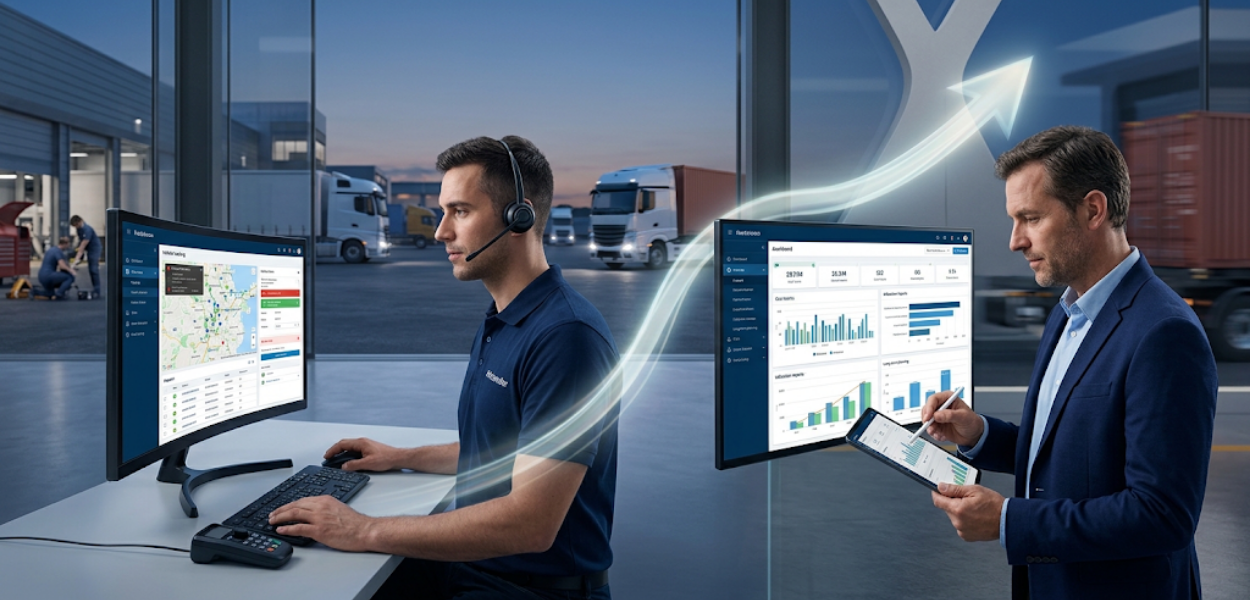
What is the difference between a fleet controller and a fleet manager?
A fleet controller manages daily fleet coordination, while a fleet manager owns broader operational performance, compliance, cost control, workforce capability, and strategic planning across vehicles and transport operations. The two roles overlap, but their authority, accountability, and decision-making scope differ.
A fleet controller is primarily responsible for coordinating the movement, availability, and operational status of vehicles. The role connects drivers, vehicles, maintenance teams, transport planners, customers, and internal departments. Its focus is operational control.
A fleet manager operates at a broader level. The role covers fleet strategy, budgets, compliance, vehicle acquisition, maintenance policies, driver performance, supplier management, risk management, and operational improvement.
The distinction becomes important when organisations design career pathways or identify employee skill gaps. A capable fleet controller already understands scheduling, vehicle utilisation, driver coordination, documentation, and operational exceptions. A fleet manager requires these foundations plus financial, leadership, analytical, compliance, and strategic capabilities.
The difference also affects performance measurement. A fleet controller tracks daily indicators such as vehicle availability, route adherence, driver allocation, maintenance status, and delivery exceptions. A fleet manager evaluates higher-level indicators such as total fleet cost, fuel consumption, utilisation rates, accident frequency, maintenance expenditure, compliance performance, and return on fleet investment.
For example, a logistics company operating 150 vehicles requires controllers to maintain daily visibility of vehicle movements. The fleet manager uses that operational data to determine whether vehicle replacement, route redesign, supplier changes, or driver training is required.
How does a fleet controller contribute to corporate fleet operations?
A fleet controller converts transport plans into daily operational actions by coordinating vehicles, drivers, schedules, maintenance requirements, documentation, and exceptions while maintaining accurate operational information for management decisions and performance monitoring.
Fleet control is a coordination function. Controllers monitor what is happening across the fleet and respond when operational conditions change.
Their responsibilities commonly include vehicle allocation, driver scheduling, trip monitoring, dispatch coordination, maintenance communication, fuel monitoring, transport documentation, and incident reporting.
A controller also maintains operational visibility. This involves collecting information from drivers, tracking systems, maintenance departments, and transport planners.
The role requires strong communication because fleet operations involve multiple dependencies. A vehicle breakdown affects scheduling. A driver absence affects allocation. A maintenance delay affects vehicle availability. A route disruption affects delivery performance.
Technology supports this work. Fleet management systems, vehicle tracking platforms, maintenance databases, fuel monitoring tools, and digital reporting systems provide information that controllers use to coordinate operations.
A structured fleet controller development programme therefore focuses on practical operational competence. Learning activities include dispatch simulations, scheduling exercises, vehicle allocation scenarios, incident-response exercises, and assessments based on real fleet data.
The result is a stronger operational foundation for progression into supervisory and management positions.
What responsibilities distinguish a fleet manager from a fleet controller?
A fleet manager carries accountability for fleet performance at the organisational level, including strategy, cost, compliance, asset lifecycle, supplier relationships, workforce performance, risk, sustainability, and continuous improvement across the transport operation.
Fleet management extends beyond daily coordination. Managers establish policies and systems that determine how the fleet operates over months and years.
A fleet manager develops fleet plans based on business demand. This includes determining vehicle quantities, specifications, replacement cycles, ownership models, maintenance arrangements, and operational requirements.
Financial management is another major distinction. Managers monitor acquisition costs, leasing costs, fuel expenditure, maintenance costs, insurance, depreciation, driver costs, and administrative expenses.
Compliance also sits within the management function. Depending on the operating environment, this includes vehicle inspections, driver documentation, working-time requirements, safety procedures, maintenance records, and regulatory reporting.
Supplier management forms another responsibility. Fleet managers evaluate maintenance providers, leasing companies, fuel suppliers, telematics providers, and other external partners.
Leadership is equally important. Managers establish performance expectations, review operational KPIs, identify capability gaps, and coordinate training interventions.
This creates a clear progression structure. A fleet controller develops operational expertise first. The next stage introduces supervision, analysis, budgeting, compliance management, leadership, and strategic planning.
How does fleet controller training support progression into fleet management?
Fleet controller training builds operational capability through structured learning in scheduling, compliance, fleet systems, driver coordination, maintenance control, reporting, and incident management, creating the foundation required for broader supervisory and fleet management responsibilities.
Effective corporate training begins with a skills-gap assessment. The organisation identifies the capabilities required for the current role and compares them with the employee's demonstrated performance.
The assessment should examine operational accuracy, communication, technology use, documentation, problem-solving, compliance awareness, and KPI interpretation.
Training delivery then follows a structured sequence.
Step 1: Assess operational capability
Managers establish a baseline using performance records, supervisor observations, assessments, and operational KPIs.
For example, an organisation can review dispatch errors, vehicle downtime, documentation errors, response times, and schedule deviations over a 90-day period.
Step 2: Build technical knowledge
Employees learn fleet terminology, vehicle categories, maintenance processes, transport documentation, compliance requirements, scheduling principles, and fleet technology.
Step 3: Apply knowledge through simulations
Case-based learning presents realistic operational situations. A vehicle breakdown, driver shortage, urgent delivery, maintenance conflict, or route disruption requires the learner to select an appropriate response.
Step 4: Measure workplace performance
Post-training assessment compares operational indicators with the baseline. Organisations can measure changes over 30, 60, and 90 days.
Step 5: Introduce management capabilities
Employees preparing for progression require additional training in budgeting, KPI management, supplier evaluation, risk management, leadership, workforce planning, and strategic fleet decisions.
This staged approach prevents organisations from treating fleet management as a single technical skill. It recognises the role as a combination of operational, analytical, financial, compliance, and leadership capabilities.
What skills are required for progression from fleet controller to fleet manager?
Progression requires a shift from task coordination to accountable decision-making, with stronger capability in fleet analytics, financial control, compliance, leadership, supplier management, risk assessment, workforce planning, and long-term asset strategy.
Fleet controller capability provides the operational base. Fleet manager capability expands that base into organisational decision-making.
Important skill areas include fleet planning, transport operations, financial analysis, compliance management, driver performance, maintenance strategy, supplier management, risk control, data interpretation, and leadership.
Fleet analytics is particularly important. It involves converting operational data into decisions.
Common fleet KPIs include vehicle utilisation, fleet availability, fuel consumption per kilometre, maintenance cost per vehicle, downtime, accident frequency, on-time delivery rate, and total cost of ownership.
Total cost of ownership measures the full economic cost of operating an asset. It includes acquisition, financing, fuel, maintenance, insurance, depreciation, administration, and disposal.
A manager also needs financial literacy. A decision to replace 20 vehicles requires analysis of purchase costs, maintenance trends, fuel efficiency, downtime, residual values, and operational requirements.
Leadership capability becomes increasingly important as the fleet grows. A manager coordinates drivers, controllers, maintenance teams, administrators, suppliers, and senior stakeholders.
What should organisations include in fleet manager qualifications and development pathways?
A structured qualification pathway should combine transport operations, fleet legislation, financial management, fleet technology, KPI analysis, risk management, leadership, procurement, sustainability, and practical assessment against workplace scenarios and measurable operational outcomes.
Organisations should avoid selecting development programmes based only on job titles. The curriculum should correspond to the actual responsibilities of the fleet manager.
Core areas include fleet operations, vehicle lifecycle management, transport compliance, maintenance planning, driver management, procurement, financial control, risk management, data analysis, leadership, and strategic planning.
Should be evaluated against the specific capability requirements of the organisation. A business operating a 500-vehicle commercial fleet has different development requirements from a healthcare organisation managing 40 service vehicles.
Assessment methods should also reflect workplace conditions. Written assessments test knowledge. Case studies test analysis. Simulations test decision-making. Role-play tests communication. Workplace projects test implementation.
A strong progression pathway can use three stages.
The first stage focuses on operational control.
The second stage develops supervisory and analytical capability.
The third stage develops strategic fleet management.
This model gives HR and L and D teams a practical structure for succession planning. It also creates measurable criteria for determining when an employee is ready for greater responsibility.
Which learning methods work best for fleet operations training?
Fleet training works best when classroom instruction, digital modules, case-based exercises, simulations, role-play, assessments, and workplace projects are combined to connect technical knowledge with operational decision-making and measurable performance.
Workshops are useful for complex operational concepts. Facilitators can examine fleet incidents, maintenance decisions, scheduling conflicts, and compliance cases with participants.
Online modules support standardised knowledge delivery. They work well for policies, terminology, regulatory principles, documentation procedures, and introductory technical concepts.
Hybrid learning combines both approaches. Employees complete knowledge modules online and use live sessions for practical application.
Simulation is particularly relevant to fleet control. A training scenario can present 10 vehicles, 12 drivers, two maintenance restrictions, one urgent delivery, and a route disruption. The participant must allocate resources while maintaining operational priorities.
Role-play supports communication skills. One participant can act as a driver reporting a breakdown while another acts as the controller responsible for coordinating the response.
Assessments provide measurable evidence of competence. Organisations can use knowledge tests, scenario assessments, practical exercises, and workplace performance reviews.
These methods align learning with actual fleet conditions instead of separating training from operational responsibilities.
How can organisations measure the business impact of fleet training?
Organisations should measure training impact through operational KPIs, behavioural assessments, cost indicators, compliance results, productivity measures, and employee progression data across defined 30-day, 60-day, and 90-day review periods.
Training ROI requires a measurable baseline.
Before training, the organisation records selected indicators. After training, the same indicators are reviewed over defined periods.
For example, a company can track dispatch errors before and after controller training. It can also compare vehicle downtime, fuel consumption, maintenance scheduling accuracy, incident response time, and documentation errors.
A fleet manager development programme can use management-level measures. These include maintenance cost per vehicle, total fleet operating cost, vehicle utilisation, supplier performance, accident rates, and replacement planning accuracy.
Productivity measurement should connect training to operational output. If a controller manages 40 vehicles and improves scheduling accuracy, the organisation can measure vehicle change idle time and daily trip completion.
Employee development provides another metric. Organisations can track the percentage of trained controllers who progress into supervisory or fleet management positions within 12, 24, or 36 months.
Retention is also relevant to workforce planning. A defined career pathway provides employees with visible progression criteria and gives organisations a structured internal talent pipeline.
Where are fleet controller and fleet manager capabilities used?
Fleet control and management capabilities apply across logistics, supply chain, shipping, construction, healthcare, public services, retail, manufacturing, utilities, and field-service operations where vehicles support business-critical activities.
The operating context changes the priorities.
In logistics, fleet teams focus heavily on delivery schedules, vehicle utilisation, route efficiency, and customer service.
In healthcare, fleet operations support patient transport, medical supply distribution, mobile services, and emergency response.
In construction, managers coordinate commercial vehicles, equipment transport, site requirements, maintenance, and driver availability.
In retail, fleets support distribution between warehouses, stores, and customers.
In manufacturing, transport operations connect production facilities with suppliers, warehouses, and distribution networks.
In utilities, vehicle availability directly affects field-service productivity. Delays can prevent technicians from reaching service locations.
Public-sector fleets require strong attention to compliance, procurement, cost control, asset utilisation, and accountability.
The common requirement is operational reliability. Organisations need vehicles and drivers to support business processes without creating unnecessary cost, downtime, compliance exposure, or productivity losses.
What common problems reduce the effectiveness of fleet training?
Fleet training becomes ineffective when programmes are generic, disconnected from operational KPIs, delivered without skills-gap analysis, assessed without workplace evidence, or treated as a one-time activity rather than part of an ongoing capability-development system.
Generic training is one of the most common problems. A programme that ignores fleet size, vehicle type, regulatory environment, technology, and operating model provides limited workplace relevance.
Another problem is the absence of measurable objectives. Employees can complete training successfully without changing operational behaviour.
Training also fails when organisations do not involve line managers. Supervisors need to reinforce new procedures and monitor workplace application.
A lack of post-training measurement creates another gap. Without 30-day, 60-day, and 90-day reviews, organisations cannot establish whether learning changed operational performance.
Another misconception is that fleet management is primarily about vehicles. Fleet performance depends on people, processes, technology, finance, suppliers, compliance, and data.
Career progression also becomes unclear when organisations do not distinguish controller responsibilities from manager responsibilities. Employees then receive inconsistent development opportunities.
A structured competency framework resolves this problem by defining the knowledge, skills, behaviours, and performance evidence required at each career stage.
How should HR and L and D teams build a fleet management career pathway?
HR and L and D teams should map fleet roles by competency level, identify skill gaps, assign targeted learning, assess workplace performance, review KPIs, and connect successful capability development with clearly defined progression into supervisory and management responsibilities.
The pathway should begin with role analysis.
Organisations define the responsibilities of fleet controllers, senior controllers, supervisors, and fleet managers. Each role receives measurable competency requirements.
The next step is skills-gap analysis. Current employees are assessed against those requirements.
Training is then assigned according to the gap. Operational weaknesses require technical development. Leadership gaps require management training. Analytical weaknesses require KPI and data interpretation development.
The course area of Logistics, Supply Chain and Shipping provides a relevant corporate learning context for developing capabilities that connect fleet operations with wider transport and supply-chain performance.
Progression should depend on demonstrated competence rather than training attendance alone. Employees should demonstrate that they can analyse operational data, manage incidents, control costs, apply compliance requirements, lead teams, and make evidence-based decisions.
This creates a transparent workforce-development system.
It also supports succession planning. Instead of recruiting every fleet manager externally, organisations can identify controllers with the operational foundation and develop the additional competencies required for management.
The progression model therefore becomes a business process rather than an informal career decision.
What does successful fleet capability development look like?
Successful fleet capability development produces clearer role accountability, stronger operational control, better KPI visibility, improved compliance, stronger leadership succession, more consistent decision-making, and measurable alignment between workforce capability and transport performance.
The strongest model connects training directly to operational requirements.
A controller understands how to coordinate vehicles and drivers.
A supervisor understands how to control performance across a team.
A fleet manager understands how operational decisions affect cost, risk, compliance, productivity, assets, suppliers, and business strategy.
Each level requires different evidence of competence.
For HR managers, this creates a measurable workforce-development framework. For L and D professionals, it creates clear learning objectives and assessment criteria. For business owners, it connects training expenditure with operational performance. For team leaders, it establishes practical expectations for progression.
Explore More Expert Insights:
Green Shipping Technology: How the Maritime Industry Decarbonises
Container Terminal Operations: How a Port Works, Step-by-Step
Fleet capability development therefore works best as a continuous cycle: assess, train, practise, measure, review, and progress.
This approach connects practical learning with organisational impact while maintaining clear standards for operational excellence, integrity, innovation, collaboration, and measurable performance.