
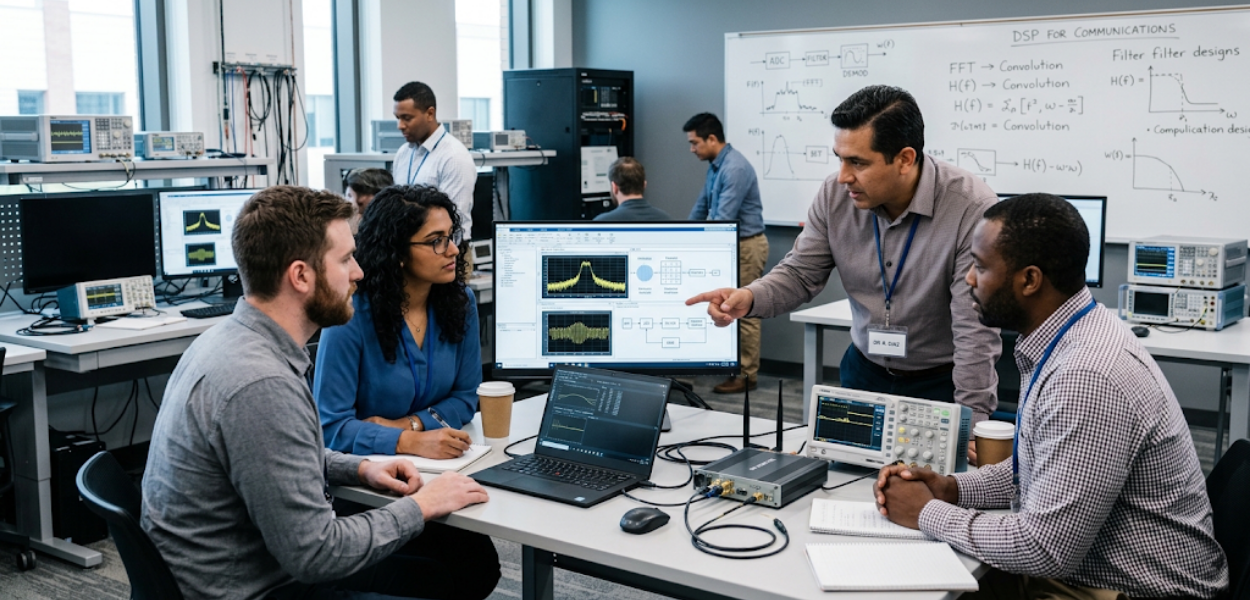
Digital Signal Processing for Communication Systems Training Courses develop the technical capability required to process, analyse, filter, transform, and interpret digital signals in modern communication environments. For organisations, the subject connects engineering knowledge with communication system performance, transmission quality, signal accuracy, and operational efficiency.
What Is Digital Signal Processing for Communication Systems and Why Does It Matter at Work?
Digital Signal Processing is the use of mathematical algorithms and computational techniques to analyse, transform, filter, and improve digital signals, helping communication teams achieve measurable gains in signal quality, system reliability, processing efficiency, and transmission performance.
Digital Signal Processing, commonly called DSP, converts signal information into a digital form that computers and specialised processors can analyse. Communication systems use DSP to remove unwanted components, reconstruct useful information, control bandwidth, and prepare signals for transmission or reception.
The business relevance is linked to communication quality and system performance. Industries like telecommunications, aerospace, defence, broadcasting, automotive technology, and electronics depend on accurate signal processing for operational systems. Poor signal processing creates noise, distortion, inefficient bandwidth use, processing delays, and unreliable communication.
A corporate training programme addresses these technical capability gaps through structured learning. Employees learn how signal processing concepts connect with communication receivers, transmitters, digital interfaces, embedded systems, and measurement environments. This creates a common technical foundation across engineering, research, operations, and technical management teams.
Training also establishes measurable technical competencies. Organisations can assess employees through signal analysis exercises, filter design tasks, simulation assignments, receiver troubleshooting scenarios, and technical assessments. These activities provide evidence of learning instead of relying only on attendance or course completion.
How Does Digital Signal Processing Training Work in Organisations?
Effective DSP training follows a structured sequence covering foundational theory, mathematical representation, signal analysis, filtering, frequency-domain processing, communication applications, practical simulation, assessment, and workplace implementation using measurable technical performance indicators.
The first stage identifies employee skill gaps. An organisation maps existing knowledge against job requirements such as signal analysis, digital filtering, frequency-domain analysis, receiver design, or embedded signal processing. The assessment establishes the starting competency level for engineers, technical specialists, developers, and team leaders.
The second stage establishes learning objectives. Objectives should identify what employees must perform after training. Examples include designing FIR filters, applying the sampling theorem, explaining aliasing, performing frequency analysis using the fast Fourier transform, and applying the z-transform to discrete-time systems.
The third stage introduces core concepts. Employees study discrete-time signals, digital representations, sampling, quantisation, filtering, frequency-domain analysis, and mathematical transformations. Trainers connect each concept with communication-system applications rather than treating mathematical theory as an isolated academic subject.
The fourth stage applies the concepts through practical learning. Workshops can use simulation environments, signal datasets, receiver models, filter-design exercises, and troubleshooting scenarios. Case-based learning allows participants to analyse realistic communication problems and identify the DSP technique required to address each one.
The fifth stage measures competency. Assessments should include practical exercises, technical problem-solving, simulations, knowledge tests, and project-based tasks. Organisations can compare pre-training and post-training assessment results to establish a measurable learning improvement.
The final stage transfers learning into operational work. Managers assign relevant projects, technical reviews, signal analysis tasks, or process-improvement activities. Performance indicators then determine whether the training has improved technical execution rather than simply increasing theoretical knowledge.
Training delivery can use classroom workshops, instructor-led online modules, recorded technical lessons, laboratory simulations, or hybrid learning. A hybrid programme can combine structured online theory with live practical sessions for complex signal-processing applications.
What Key Components Should a Corporate DSP Training Programme Include?
A complete DSP programme should cover sampling, quantisation, discrete-time signals, FIR filters, frequency analysis, the fast Fourier transform, z-transform, decimation, signal reconstruction, communication receivers, simulation, troubleshooting, and practical technical assessment.
Sampling and the Sampling Theorem
Sampling converts a continuous-time signal into discrete measurements. The sampling theorem defines the minimum sampling frequency required to represent a signal without introducing spectral overlap under ideal conditions. Employees need this principle to understand analogue-to-digital conversion and receiver performance.
Aliasing and Signal Reconstruction
Aliasing occurs when a sampled signal contains frequency components that cannot be represented correctly at the selected sampling frequency. Training demonstrates how incorrect sampling creates frequency distortion and how appropriate filtering and sampling strategies prevent this problem.
Quantisation
Quantisation maps continuous amplitude values to a finite set of digital levels. Employees study quantisation error, resolution, signal-to-noise considerations, and the effect of converter characteristics on communication performance. This knowledge supports better decisions around digital receiver architectures.
FIR Filters
Finite Impulse Response filters process digital signals using a finite number of previous input samples. Employees learn filter characteristics, coefficients, frequency response, design approaches, and practical applications. FIR filters are important for signal conditioning, channel processing, and communication receiver architectures.
Fast Fourier Transform
The fast Fourier transform is an efficient algorithm for calculating the discrete Fourier transform. It allows technical teams to examine signal frequency content using significantly fewer computational operations than direct calculation. Training connects FFT analysis with spectrum inspection, interference detection, and communication troubleshooting.
Z-Transform
The z-transform represents discrete-time signals and systems in a mathematical domain that supports system analysis. Employees use it to examine digital filters, system behaviour, transfer functions, stability, and frequency response.
Decimation
Decimation reduces the sampling rate of a digital signal. Proper decimation requires appropriate filtering before the reduction in sampling frequency. Training helps employees understand the relationship between sampling rate, bandwidth, processing requirements, and computational efficiency.
Practical Communication Applications
The technical concepts should be connected to real communication systems. Examples include digital receivers, wireless communication, satellite communication, radar systems, software-defined radio, audio transmission, and digital broadcasting. This application layer converts theoretical knowledge into operational capability.
How Should Organisations Deliver and Measure DSP Learning?
Organisations should combine technical instruction with practical workshops, simulations, case-based exercises, assessments, and workplace projects, then measure learning through competency scores, task accuracy, troubleshooting time, processing efficiency, project quality, and relevant operational KPIs.
A workshop format works well for complex concepts requiring direct interaction. Trainers can demonstrate sampling, aliasing, filtering, and frequency analysis before participants complete structured exercises. Each exercise should have a defined technical outcome and assessment criterion.
Online modules support foundational theory and repeated learning. Employees can complete lessons on discrete-time signals, sampling, quantisation, and mathematical transformations before attending practical sessions. This approach allows live training time to focus on problem-solving and application.
Hybrid learning combines the two approaches. Employees complete theory-based modules online and use live sessions for simulations, technical discussions, case studies, and assessments. This format also supports geographically distributed teams across locations and departments.
Simulation-based learning provides a controlled environment for technical experimentation. Participants can change sampling rates, filter parameters, signal frequencies, and system conditions to observe measurable outcomes. This approach helps employees understand cause-and-effect relationships without depending exclusively on production systems.
Assessment should operate at multiple levels. Knowledge assessments measure conceptual understanding. Practical tasks measure technical execution. Project assessments measure workplace application. Managers can then monitor performance indicators such as troubleshooting duration, technical error rates, signal-analysis accuracy, project completion time, and rework levels.
Training ROI should connect learning results with operational metrics. If a communication engineering team reduces troubleshooting time from 10 hours to 7 hours per case after training, the organisation can quantify the productivity impact. If technical rework falls from 12% to 7%, the improvement can also be incorporated into the ROI calculation.
What Business Benefits Can Digital Signal Processing Training Produce?
DSP training strengthens technical capability, improves signal-analysis accuracy, reduces avoidable technical errors, supports efficient system development, improves cross-functional collaboration, and creates measurable workforce capability for communication technologies used across multiple industries.
Improved Technical Productivity
Employees with stronger DSP knowledge spend less time resolving basic conceptual problems. Standardised technical understanding improves how engineers approach filtering, sampling, frequency analysis, and signal reconstruction. Teams can therefore establish more consistent workflows for technical investigation.
Better System Troubleshooting
Communication faults often involve several interacting signal characteristics. Employees trained in DSP can analyse signals systematically instead of relying on trial-and-error adjustments. Structured analysis improves fault isolation and supports more consistent technical decisions.
Improved Team Efficiency
DSP projects often involve engineers, software developers, hardware specialists, test teams, and technical managers. A shared technical vocabulary improves collaboration between these roles. Teams can communicate requirements and findings using consistent concepts such as sampling rate, frequency response, quantisation, bandwidth, and filtering.
Stronger Workforce Development
Organisations can use DSP training as part of technical career pathways. Junior engineers can develop foundational capabilities, experienced engineers can strengthen specialised skills, and technical leaders can improve their understanding of DSP-dependent projects.
Reduced Rework
Incorrect signal-processing assumptions create design changes and testing delays. Practical training reduces avoidable errors by giving employees structured methods for analysing signals and validating technical decisions before implementation.
Better Knowledge Retention
Practical assessments, simulations, case-based learning, and workplace projects reinforce technical concepts through repeated application. Organisations can also maintain competency records and identify employees who require targeted follow-up training.
Where Can Organisations Apply Digital Signal Processing Skills?
DSP skills apply across communication engineering, telecommunications, wireless systems, satellite technology, radar, broadcasting, embedded systems, electronics, automotive technology, aerospace, defence, and software-defined communication environments.
Telecommunications teams use DSP for signal conditioning, channel processing, modulation-related applications, and receiver operations. Wireless engineering teams apply DSP to spectrum analysis, filtering, digital receivers, and communication performance testing.
Satellite communication teams use digital signal processing for signal acquisition, filtering, channel processing, and receiver architectures. Radar teams apply DSP to analyse received signals and extract useful information from complex signal environments.
Broadcasting organisations use DSP in audio, video, transmission, and signal-quality workflows. Embedded technology teams apply DSP algorithms within hardware-constrained systems where processing speed, memory consumption, and power efficiency influence system design.
Software-defined radio environments provide another important application. Engineers can implement communication functions through software and configurable processing platforms, making knowledge of filtering, sampling, FFT analysis, decimation, and signal reconstruction directly relevant.
Automotive and aerospace organisations also use digital signal processing in communication, sensing, control, and monitoring applications. The exact technical requirements differ by system, but the underlying competencies remain connected to digital signal representation, analysis, transformation, and filtering.
How Can Organisations Choose the Right DSP Training Approach?
Organisations should select training according to employee skill gaps, communication technologies, job responsibilities, existing technical tools, required competencies, practical applications, assessment requirements, delivery constraints, and measurable business performance objectives.
A generic programme often fails when it ignores the technical environment in which employees work. A telecommunications engineering team requires different applications from a software development team supporting embedded communication products.
The first selection criterion is job relevance. Training objectives should correspond with actual responsibilities. Engineers working on receivers need practical knowledge of sampling, filtering, frequency analysis, and signal reconstruction. Technical managers require enough conceptual knowledge to understand project requirements and performance measures.
The second criterion is technical depth. Beginners need structured foundations in discrete-time signals and mathematical representations. Experienced engineers require deeper work involving filter design, system modelling, frequency-domain analysis, and optimisation.
The third criterion is practical application. Training should include exercises that resemble workplace tasks. Case-based learning, simulations, technical projects, and assessments create stronger evidence of competency than theory-only delivery.
At the point where organisations move from understanding DSP fundamentals to evaluating a specific learning pathway, a focused technical resource on Digital Signal Processing: Sampling, Aliasing and Quantisation in Communication Receivers provides a natural next step. It addresses core receiver concepts that connect directly with practical implementation decisions.
The course structure should also reflect organisational constraints. Teams distributed across several countries can use online or hybrid delivery. Engineering groups requiring intensive practical work can use instructor-led workshops and simulation-based sessions. Managers should select the format according to learning objectives rather than convenience alone.
For broader technical workforce development, organisations can place DSP learning within Information Technology and Programming Courses where it aligns with wider digital engineering, programming, and technical capability requirements.
What Common Problems Reduce the Effectiveness of DSP Training?
Common problems include generic technical content, insufficient practical work, weak assessment, unclear objectives, poor workplace transfer, inappropriate training depth, limited management involvement, and failure to connect learning outcomes with measurable operational performance indicators.
One common problem is excessive theory without application. Employees can memorise definitions of sampling, quantisation, or transforms without knowing how to apply them to communication systems. Practical exercises are therefore necessary for competency development.
Another problem is inappropriate technical depth. Advanced mathematical content can overwhelm employees who lack the required foundation. Conversely, experienced engineers receive limited value from programmes that repeat basic definitions. Skills assessment should determine the starting level.
Weak measurement also reduces training value. Attendance and completion rates do not demonstrate technical competence. Organisations should measure assessment scores, practical task accuracy, troubleshooting performance, project outcomes, and relevant operational KPIs.
A third problem is the absence of workplace transfer. Employees return to their roles without opportunities to apply what they learned. Managers should assign relevant technical tasks and review performance after training to establish whether learning has transferred into operational work.
Explore More Expert Insights:
Antenna Design and Measurement Techniques Training Courses
IP Protocols and Technologies for Network Engineers Training Courses
Generic examples create another limitation. Communication engineering involves different requirements across telecommunications, satellite systems, radar, broadcasting, aerospace, and embedded technology. Training should use examples that correspond with the organisation's actual technical environment.
Finally, training should not be treated as an isolated event. DSP capability develops through structured learning, practical application, technical feedback, assessment, and continuous skills development. A measurable learning cycle gives organisations clearer evidence of capability improvement and supports long-term workforce planning.