
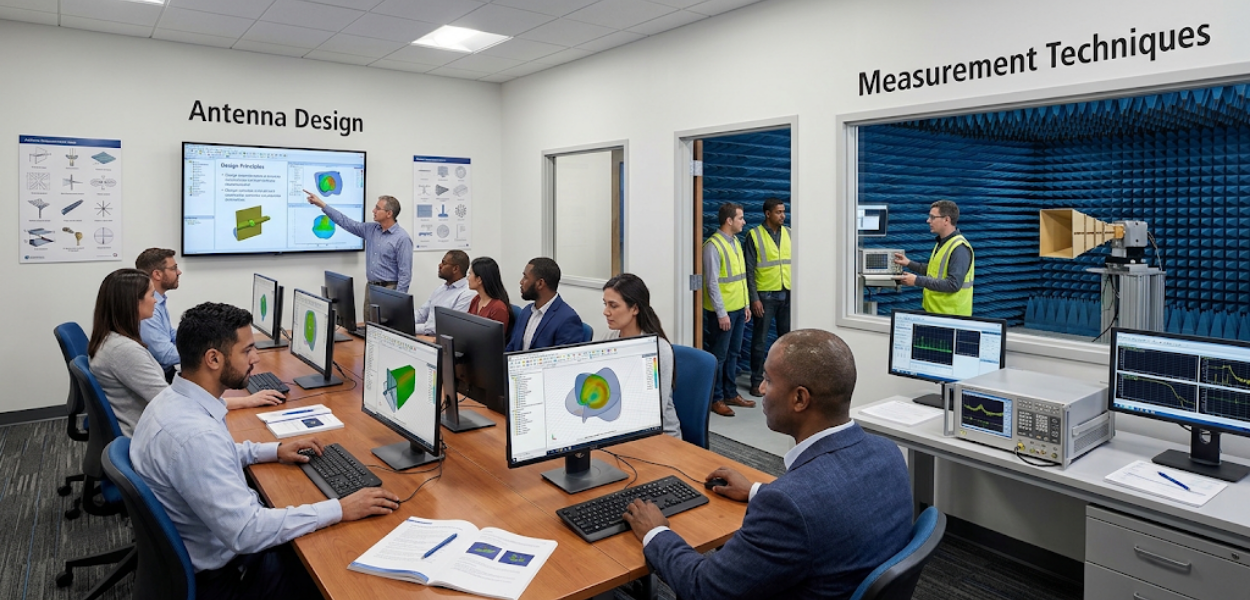
What Is Antenna Design and Measurement Training?
Antenna design and measurement training teaches engineers and technical teams to model, build, and test antennas using radiation pattern analysis, gain calculations, and impedance matching. Programmes combine theory with hands-on measurement in controlled environments to close performance gaps.
Antenna design and measurement is a technical discipline within radio frequency (RF) engineering. It covers the calculation of electrical properties, the selection of physical structures, and the verification of performance against defined specifications. Organisations in telecommunications, defence, aerospace, and consumer electronics depend on antenna performance for product reliability.
Employee skill gaps in RF engineering slow product development cycles. A design team without measurement competency produces prototypes that fail certification testing. Certification failures add 4 to 8 weeks to product launch timelines. Training closes this gap by teaching engineers to predict performance before physical testing and to interpret measurement data correctly during validation.
Corporate training in this field differs from academic instruction. Academic courses focus on electromagnetic theory. Corporate programmes focus on applied outcomes: reducing design iterations, cutting measurement errors, and shortening time to compliance. This shift from theory to workplace application defines the training as a business investment rather than an academic exercise.
How Does Antenna Design and Measurement Training Work in Organisations?
Training is delivered through structured modules combining classroom instruction, simulation software, and practical measurement sessions. Programmes run between 3 and 10 days depending on depth, followed by workplace application projects that reinforce retention and measurable skill transfer.
Delivery begins with a skills audit. Trainers assess current engineer competency against target job requirements. This audit identifies gaps in specific areas such as gain and directivity calculation or return loss interpretation.
Instruction follows a sequenced format. Day one covers electromagnetic fundamentals and design parameters. Middle sessions cover simulation tools and design software used to model antenna behaviour before manufacturing. Final sessions cover physical measurement using laboratory equipment.
Hybrid learning formats are common in this field. Theoretical modules are delivered online through recorded lectures and interactive simulations. Practical modules require in-person attendance because measurement equipment such as vector network analysers and anechoic chambers cannot be replicated remotely. This blended structure reduces training costs by 20 to 30 per cent compared with fully in-person delivery while preserving hands-on competency development.
Case-based learning replaces abstract theory with real design problems. Trainees redesign an underperforming antenna using data from a documented failure case. Simulations allow trainees to test multiple design variables without consuming physical materials. Role-play exercises simulate client specification reviews, where trainees defend design choices against performance requirements.
Choosing the correct training depth requires matching programme content to team seniority and existing measurement capability. Teams evaluating training options at this stage benefit from reviewing Antenna Design and Measurement: Gain, Directivity and Radiation Pattern Fundamentals, which details the specific measurement parameters covered at intermediate and advanced levels.
Assessments close each module. Written tests confirm theoretical understanding. Practical assessments require trainees to measure a sample antenna and produce a compliant test report. Organisations use assessment scores to certify engineer competency levels internally.
What Are the Key Components of Antenna Design and Measurement Programmes?
Core components include radiation pattern analysis, gain and directivity calculation, VSWR measurement, anechoic chamber testing, microstrip patch design, and return loss evaluation. Each component maps to a specific stage of the antenna development lifecycle.
Radiation pattern describes the directional distribution of energy radiated by an antenna. Engineers plot this pattern in two and three dimensions to confirm coverage direction matches application requirements. Applications such as satellite communication, mobile base stations, and radar systems each require distinct radiation pattern shapes.
Gain and directivity measure how effectively an antenna concentrates energy in a preferred direction compared with a theoretical reference. Directivity is calculated from pattern shape alone. Gain accounts for material and structural losses. Training separates these two concepts because confusing them produces incorrect performance claims in technical documentation.
VSWR (Voltage Standing Wave Ratio) quantifies impedance mismatch between the antenna and its feed line. A VSWR value above 2:1 indicates significant signal reflection and power loss. Training teaches engineers to tune matching networks to bring VSWR below acceptable thresholds before production.
Anechoic chamber testing provides a controlled, reflection-free environment for accurate radiation measurement. External signals and reflected waves distort results taken in open environments. Certified facilities such as compact and far-field anechoic chambers remove this distortion, producing measurement accuracy within 0.5 dB.
Microstrip patch design covers a compact antenna structure widely used in mobile devices, IoT sensors, and wearable technology. Trainees learn substrate selection, feed line placement, and patch dimension calculation to meet frequency and bandwidth targets.
Return loss measures the ratio of reflected to incident power at the antenna port, expressed in decibels. A return loss below -10 dB is the standard acceptance threshold in most commercial specifications. Training links return loss directly to VSWR, since both metrics describe the same underlying impedance mismatch from different mathematical angles.
What Benefits Does Antenna Design and Measurement Training Deliver to Organisations?
Trained teams reduce design iteration cycles by 30 to 40 per cent, cut certification failure rates by up to 50 per cent, and shorten product time to market. Organisations report measurable gains in team efficiency and internal technical capability retention.
Design iteration cycles shrink when engineers apply correct simulation practices before physical prototyping. Fewer prototype builds reduce material costs and laboratory booking time.
Certification failure rates drop when engineers understand regulatory measurement standards before submission. Regulatory bodies such as the FCC and CE testing authorities reject non-compliant designs, each rejection adding weeks of rework. Trained engineers submit designs that meet threshold values on first attempt more consistently.
Team efficiency improves through shared technical vocabulary. Engineers, project managers, and quality assurance staff who complete the same training use consistent terminology when discussing gain, pattern, and impedance issues. This consistency reduces miscommunication during design reviews.
Leadership pipeline development benefits organisations planning long-term technical capability. Senior engineers who complete advanced measurement training become internal trainers and technical reviewers. This internal knowledge transfer reduces dependency on external consultants for specification reviews.
Retention improves when technical staff receive structured development paths. Engineers in specialised fields such as RF and antenna design leave organisations that offer no advancement in technical skill. Structured training programmes with certification pathways address this retention risk directly.
Where Is Antenna Design and Measurement Training Applied Across Industries?
Industries including telecommunications, automotive, aerospace, defence, and consumer electronics apply antenna design and measurement training to product development teams, quality assurance departments, and compliance testing units.
Telecommunications teams use this training to design base station and mobile device antennas that meet coverage and bandwidth specifications across frequency bands. Automotive manufacturers train engineers to design antennas for vehicle connectivity systems, including GPS, cellular, and vehicle-to-vehicle communication modules.
Aerospace and defence organisations require antenna design competency for radar, satellite communication, and secure military communication systems. Measurement accuracy requirements in this sector exceed commercial standards, with tolerance thresholds often below 0.3 dB.
Consumer electronics manufacturers train product development teams to design compact antennas for smartphones, wearables, and IoT devices. Space constraints in these products require microstrip patch expertise as a core training component.
Quality assurance departments across all these industries apply training differently from design teams. QA staff focus on measurement verification and test report accuracy rather than design creation. Compliance testing units require training focused specifically on regulatory standard interpretation and anechoic chamber operating procedures.
What Common Problems Undermine Antenna Design and Measurement Training Programmes?
Generic, non-specialised training content produces low skill transfer and weak return on investment. Common problems include theory-only delivery, absent practical measurement components, and lack of post-training performance tracking.
Generic programmes teach broad electromagnetic theory without connecting concepts to workplace measurement tasks. Engineers complete these programmes able to recite formulas but unable to operate a vector network analyser or interpret a Smith chart during a live measurement session.
Theory-only delivery removes the practical component that produces actual skill transfer. Antenna measurement is a physical, equipment-dependent skill. Training without laboratory access or simulation practice produces certificates without corresponding competency.
Lack of return on investment tracking prevents organisations from justifying continued training budgets. Organisations that fail to measure design iteration counts, certification pass rates, or project timeline changes before and after training cannot demonstrate programme value to finance departments.
Absent follow-up application projects reduce retention of trained skills. Engineers who complete training but do not apply new measurement techniques within 30 days lose up to 50 per cent of acquired knowledge. Structured workplace projects following training sessions address this decay directly.
Misalignment between training content and actual job tasks creates a further problem. Teams working exclusively with microstrip patch antennas gain limited value from training weighted toward large-scale array systems. Effective programmes assess job-specific measurement tasks before selecting training content, avoiding one-size-fits-all curricula.
Explore More Expert Insights:
IP Protocols and Technologies for Network Engineers Training Courses
Advanced Linux Admin Training Courses
Organisations evaluating technical training providers should confirm programme content matches specific measurement equipment and antenna types used internally. Structured programmes such as those found within Information Technology and Programming Courses demonstrate how technical skill training integrates simulation, hands-on measurement, and workplace application to close documented skill gaps rather than delivering generic theoretical content.