
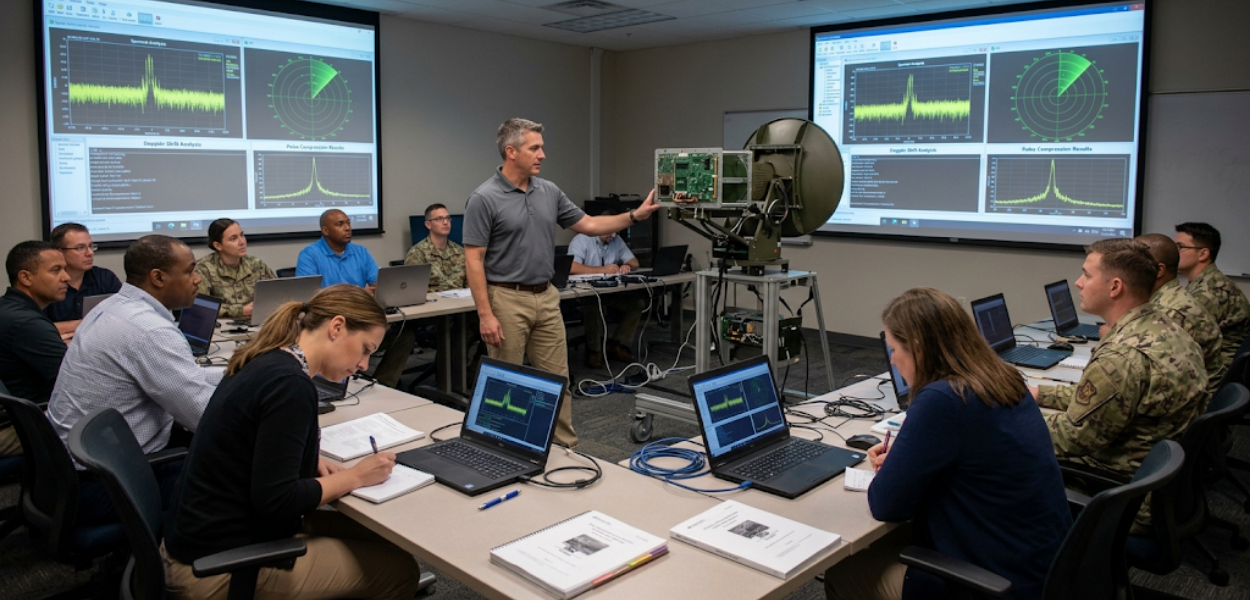
Radar systems and signal processing training courses develop the technical capability required to understand, operate, analyse, and improve radar-based systems in professional environments. For organisations, the subject connects engineering skills with measurable requirements such as detection accuracy, range resolution, signal quality, processing efficiency, system reliability, and operational decision-making.
Why do organisations need radar systems and signal processing skills?
Radar expertise closes technical skill gaps in detection, measurement, signal analysis, and system performance, helping engineering teams interpret radar data accurately, troubleshoot processing problems, and align technical operations with defined performance requirements across specialised environments.
Radar systems use electromagnetic waves to detect objects, estimate their distance, determine movement, and support situational awareness. Signal processing converts received radar signals into information that technical teams can analyse and use.
The organisational challenge is not limited to understanding radar theory. Teams need people who can connect transmitted signals, received echoes, digital processing, detection algorithms, and system outputs. Skill gaps in these areas create operational dependencies and increase the time required to diagnose technical problems.
Industries such as telecommunications, aerospace, defence, transportation, meteorology, automotive technology, and industrial monitoring use radar-related technologies for different operational purposes. Each environment applies different performance requirements.
For HR managers and L&D professionals, the training requirement therefore starts with a capability assessment. The organisation identifies which employees need foundational radar knowledge, advanced signal-processing skills, system analysis capabilities, or specialised technical competencies.
Training objectives should then connect directly to workplace responsibilities. Engineers responsible for radar performance need different competencies from managers supervising technical teams. A structured programme separates these requirements instead of delivering the same technical content to every employee.
How does radar systems and signal processing training work in organisations?
Effective corporate training moves from baseline assessment to radar fundamentals, signal analysis, practical exercises, performance testing, and workplace application, using workshops, online modules, simulations, and assessments to verify technical competence at each stage.
The first stage is a skills-gap assessment. L&D teams establish existing knowledge in electromagnetic principles, radar architecture, digital signal processing, mathematical concepts, and system diagnostics. The assessment creates a measurable starting point.
The second stage establishes common technical terminology. Participants learn the radar signal chain, including transmission, propagation, reflection, reception, filtering, detection, and interpretation. This common foundation helps multidisciplinary teams communicate using consistent technical concepts.
The third stage introduces practical signal-processing techniques. Participants analyse radar returns and examine how processing affects detection quality. Exercises focus on measurable outputs rather than passive knowledge acquisition.
The fourth stage uses simulations and case-based learning. A simulation represents radar behaviour under defined conditions. Participants adjust parameters, analyse signal responses, identify processing problems, and interpret resulting measurements.
The fifth stage applies assessment. Assessments can include technical tests, signal-analysis exercises, simulation tasks, and structured case studies. Each assessment measures a defined capability.
The final stage connects training with operational KPIs. Organisations can monitor diagnostic time, processing accuracy, system availability, technical error rates, assessment scores, and successful completion of workplace projects.
Training can use classroom workshops, instructor-led online sessions, self-paced modules, or hybrid learning. Hybrid delivery combines scheduled technical instruction with digital exercises and independent assessment.
The programme category can be aligned with Information Technology and Programming Courses, which covers technology-focused professional development across multiple organisational requirements.
What technical components should radar training cover?
A complete programme covers radar architecture, waveform fundamentals, range measurement, Doppler analysis, radar cross section, pulse compression, matched filtering, clutter rejection, detection principles, digital processing, system evaluation, and interpretation of radar performance metrics.
Radar architecture and signal flow
Participants first examine how a radar system operates as an integrated technical system. Core elements include transmitters, antennas, receivers, signal processors, timing systems, detection functions, and display or data interfaces.
Understanding the complete signal path helps employees identify where performance problems originate. A weak output does not always result from the signal processor. Antenna behaviour, transmission conditions, receiver performance, interference, or environmental clutter also influence results.
Range resolution and measurement
Range resolution describes the ability of radar to distinguish between objects located at different distances. Training explains how transmitted waveform characteristics and signal-processing methods influence this capability.
Participants examine practical examples involving closely spaced targets. They learn how processing parameters affect whether separate returns remain distinguishable.
Doppler shift and moving targets
Doppler shift represents the frequency change associated with relative motion between the radar and an object. Training connects Doppler analysis with velocity estimation and moving-target detection.
Teams examine frequency-domain information and learn how Doppler characteristics support target classification and tracking.
Radar cross section
Radar cross section describes how strongly an object reflects electromagnetic energy toward the radar. It is influenced by factors including object geometry, material properties, wavelength, aspect angle, and operating conditions.
Corporate training uses radar cross section to explain why different objects produce different signal strengths and why detection performance cannot be evaluated through distance alone.
Pulse compression
Pulse compression enables radar systems to achieve characteristics associated with long transmitted pulses while retaining fine range resolution through signal-processing techniques.
Training examines how coded or modulated waveforms interact with processing algorithms. Participants evaluate the relationship between waveform design, processing gain, range resolution, and detection performance.
Matched filtering
A matched filter is a signal-processing technique designed to maximise the signal-to-noise ratio for a known signal in the presence of noise.
Participants learn how matched filtering supports radar detection and how incorrect processing parameters affect the resulting output. Practical exercises demonstrate the relationship between filter design and detection quality.
Clutter rejection
Clutter consists of unwanted radar returns generated by environmental objects or other non-target sources. Examples include terrain, buildings, vegetation, weather phenomena, and sea surfaces.
Clutter rejection techniques help systems distinguish relevant target returns from unwanted signals. Training focuses on how filtering, detection thresholds, Doppler characteristics, and processing strategies affect target identification.
How should organisations measure radar training outcomes?
Organisations should measure radar training through technical assessment scores, signal-analysis accuracy, diagnostic time, processing error rates, simulation performance, project completion, knowledge retention, and operational KPIs linked directly to the employee’s technical responsibilities.
Attendance is not a sufficient measure of technical capability. A participant can complete a training programme without demonstrating the ability to analyse radar signals or diagnose processing problems.
A stronger measurement framework uses four levels.
The first level measures knowledge acquisition. A written or digital assessment establishes whether participants understand radar architecture, waveform concepts, Doppler shift, radar cross section, pulse compression, matched filtering, and clutter rejection.
The second level measures practical performance. Participants complete signal-analysis exercises or simulations under controlled conditions.
The third level measures workplace application. Managers track whether employees apply the techniques to assigned engineering tasks, troubleshooting activities, system evaluations, or technical projects.
The fourth level measures organisational impact. Relevant KPIs include average diagnostic time, technical error frequency, system processing efficiency, project completion time, repeat troubleshooting incidents, and assessment-to-application transfer.
ROI analysis should connect training expenditure with measurable operational changes. The calculation can compare training costs against quantified improvements such as reduced diagnostic hours, fewer technical errors, or improved project delivery.
Which teams and industries use radar training?
Radar training supports engineering, telecommunications, aerospace, defence, transportation, automotive, meteorological, research, and industrial teams where employees analyse electromagnetic signals, monitor detection systems, evaluate performance, or develop radar-enabled technical solutions.
Engineering and technical teams
Radar engineers, signal-processing specialists, systems engineers, electronics professionals, and technical analysts require different levels of radar competency. Training establishes shared technical foundations while allowing advanced participants to work with more complex processing scenarios.
Telecommunications teams
Telecommunications professionals work with radio-frequency signals, wireless propagation, interference, and spectrum-related technologies. Radar signal-processing knowledge provides relevant technical context for teams working with complex radio-frequency environments.
Aerospace and transportation
Radar supports aircraft monitoring, navigation, weather observation, traffic management, and other transportation applications. Training helps technical teams understand how detection, range, velocity, and signal quality interact.
Automotive technology
Automotive radar systems support functions such as object detection, distance measurement, and movement analysis. Training provides technical understanding of radar returns, Doppler information, signal processing, and target detection.
Industrial monitoring
Industrial organisations use sensing technologies for monitoring equipment, environments, movement, and operational conditions. Technical teams need the ability to interpret sensor outputs and distinguish meaningful signals from interference.
What problems make radar training ineffective?
Radar training becomes ineffective when programmes rely on theory alone, ignore employee skill gaps, use generic content, lack practical assessments, separate learning from workplace tasks, or measure attendance instead of measurable technical competence and operational outcomes.
One common problem is excessive theoretical content. Radar is technically complex, but employees need structured opportunities to apply concepts through simulations, calculations, signal analysis, and case-based exercises.
Another problem is inconsistent participant knowledge. A cohort containing advanced engineers and employees with no signal-processing background requires differentiated learning pathways. Baseline assessments establish appropriate starting points.
A third problem is generic curriculum design. Radar applications differ between automotive technology, aerospace, telecommunications, industrial monitoring, and other sectors. Examples should reflect the operating environment of the participating organisation.
A fourth problem is weak assessment. Multiple-choice tests alone do not demonstrate practical competence. Training should include applied tasks that require participants to interpret signals, evaluate processing results, identify errors, and explain technical decisions.
A fifth problem is the absence of post-training measurement. L&D teams should establish baseline KPIs before training and compare results after employees return to their roles.
How should organisations choose the right radar training approach?
Organisations should select radar training according to employee responsibilities, existing technical capability, application requirements, delivery constraints, assessment needs, and measurable business outcomes rather than choosing a generic programme based only on course title or duration.
The first consideration is job role. A signal-processing engineer requires deeper technical content than a manager responsible for supervising radar projects.
The second consideration is technical maturity. Beginners need foundational radar concepts before advanced processing methods. Experienced professionals need applied problem-solving and specialised system analysis.
The third consideration is application. A programme designed around automotive radar differs from one focused on aerospace surveillance or telecommunications research.
The fourth consideration is delivery format. Workshops support intensive collaboration. Online modules support distributed teams. Hybrid learning combines instructor interaction with digital practice.
The fifth consideration is assessment. Organisations should define what employees need to demonstrate at the end of training and select learning activities that directly prepare them for those assessments.
The sixth consideration is workplace transfer. Training becomes more useful when participants apply concepts to realistic organisational scenarios. Case-based learning, simulations, technical exercises, and structured assessments create a direct connection between learning and professional responsibilities.
When teams reach the solution-evaluation stage, technical decision-makers often need a deeper understanding of specific radar performance concepts before defining a training pathway. The article Radar Systems: Range Resolution, Doppler Shift and Radar Cross Section Explained provides the appropriate contextual transition from general radar awareness to detailed technical concepts.
How can radar training support long-term workforce development?
Radar training supports long-term workforce development by creating measurable technical capability, reducing dependency on isolated experts, strengthening knowledge transfer, improving cross-functional communication, and establishing structured progression from foundational radar knowledge to advanced signal-processing competence.
A sustainable learning strategy treats radar capability as a workforce system rather than a one-time course.
Organisations can establish competency levels covering foundational knowledge, practical signal analysis, system evaluation, advanced processing, and technical leadership. Each level can have defined learning objectives and assessment criteria.
Knowledge transfer also becomes important when only a small number of employees understand complex radar systems. Structured training distributes technical knowledge across teams and reduces dependence on individual specialists.
Cross-functional learning supports collaboration between engineering, IT, operations, project management, and L&D teams. Each group understands how its responsibilities connect with radar performance and signal-processing requirements.
Explore More Expert Insights:
Digital Signal Processing for Communication Systems Training Courses
Antenna Design and Measurement Techniques Training Courses
The long-term objective is measurable capability. Organisations can track assessment results, application rates, technical project outcomes, troubleshooting performance, and progression between competency levels.
This approach aligns professional development with operational requirements while maintaining a clear connection between technical learning, workforce capability, and organisational performance.