
What Is Spectrum Management and Radio Monitoring Training?
Spectrum management is the structured control of radio frequency use within an organisation, covering frequency allocation, licensing, interference hunting, and direction finding. Radio monitoring training equips employees to measure spectrum occupancy, detect unauthorised transmissions, and maintain regulatory compliance across telecommunications, defence, aviation, and broadcasting operations.
Radio frequencies are a finite resource. Every transmitter, from a mobile network base station to a maritime radio, operates within a licensed frequency band. Spectrum management training teaches staff how these bands are allocated, monitored, and protected from interference.
The discipline sits at the intersection of engineering, regulation, and operations. Engineers need it to design interference-free systems. Compliance teams need it to avoid licensing breaches. Operations managers need it to keep critical communications functioning during equipment failures or signal congestion.
Organisations in regulated sectors such as telecommunications, aviation, maritime, and defence depend on accurate spectrum use. A single unlicensed transmission can disrupt air traffic control, emergency services, or broadcast signals. Training reduces this risk by building internal capability instead of relying solely on external consultants.
The Information Technology and Programming Courses category places spectrum management within a wider technical skills framework, connecting radio frequency management to network infrastructure, systems engineering, and IT compliance functions that organisations already run.
How Does Spectrum Management Training Work in Organisations?
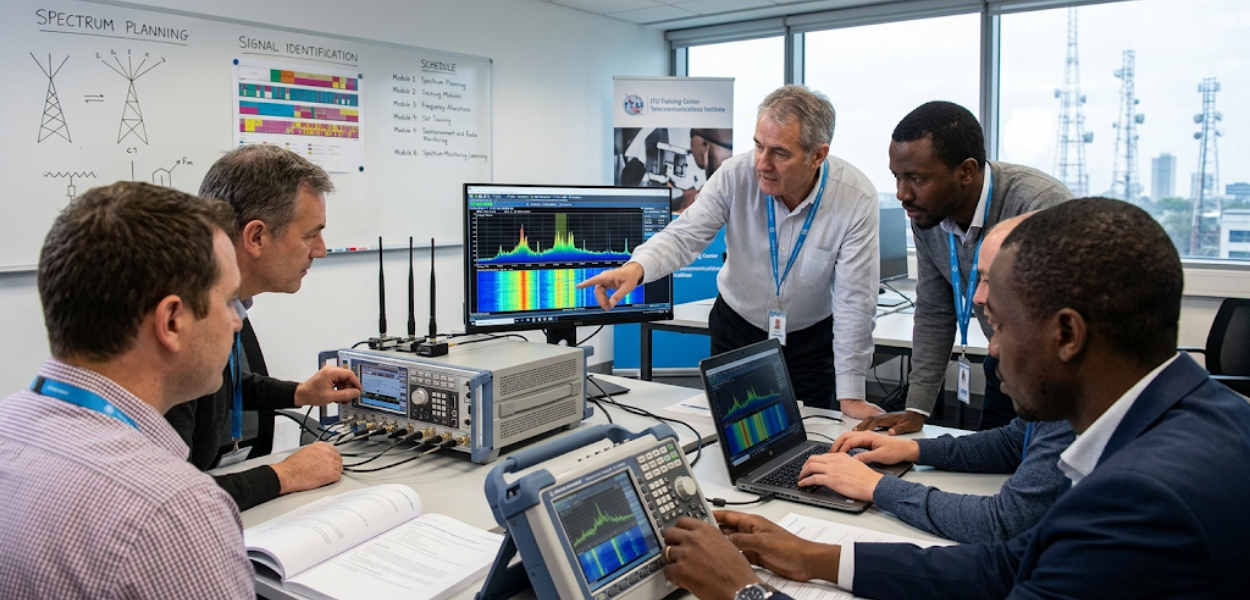
Training follows a structured process: skills-gap assessment, technical instruction on frequency allocation and monitoring tools, hands-on direction-finding exercises, and post-training competency evaluation. Delivery combines classroom instruction, simulation labs, and field exercises over programmes typically lasting 3 to 10 working days.
The process starts with a skills audit. Organisations identify which employees interact with spectrum-dependent systems: network engineers, compliance officers, field technicians, and regulatory affairs staff. This audit determines training depth, from foundational awareness to advanced interference-hunting certification.
Instruction covers three layers. The first layer is regulatory: national frequency tables, licensing procedures, and international coordination requirements under bodies such as the ITU. The second layer is technical: spectrum analysers, direction-finding equipment, and occupancy measurement software. The third layer is operational: incident response when interference disrupts a live system.
Delivery formats vary by organisational need. Workshops suit compliance and management staff who need conceptual understanding. Hands-on laboratory sessions suit engineers who operate monitoring equipment directly. Hybrid programmes combine online theoretical modules with in-person field exercises, reducing time away from operational duties by 40 per cent compared with fully in-person formats.
Implementation typically moves from awareness to specialisation. Organisations often start with a foundational cohort, then select employees for advanced direction-finding and interference-hunting certification based on operational role. Readers evaluating training providers at this stage benefit from a closer technical breakdown, covered in Spectrum Management: ITU Radio Regulations and National Frequency Allocation Explained, which sets out how frequency allocation and licensing rules apply at national level.
Assessment closes the process. Competency tests, practical exercises, and simulated interference scenarios confirm whether employees can apply the training independently, rather than only completing attendance requirements.
What Are the Key Components of Spectrum Management and Radio Monitoring Programmes?
Core components include frequency allocation principles, licensing procedures, direction-finding methodology, occupancy measurement techniques, and interference hunting protocols. Programmes also cover regulatory frameworks, monitoring equipment operation, and incident documentation standards required for compliance reporting.
Frequency Allocation and Licensing
Trainees learn how national regulators assign frequency bands to services such as broadcasting, aviation, maritime, and mobile telecommunications. Licensing modules cover application procedures, renewal timelines, and penalties for unauthorised transmission, which in many jurisdictions include fines exceeding £5,000 per violation.
Direction Finding
Direction finding identifies the physical source of a radio signal. Employees train on triangulation methods using fixed and mobile monitoring stations, a skill essential for locating unlicensed transmitters or diagnosing interference sources in industries like broadcasting, telecommunications, and defence.
Occupancy Measurement
Occupancy measurement determines how intensively a frequency band is used across a given period. Training includes reading spectrum analyser outputs, interpreting occupancy percentages, and identifying underused bands available for reallocation.
Interference Hunting
Interference hunting combines direction finding and occupancy analysis to resolve active disruptions. Employees practise scenario-based exercises simulating equipment malfunction, illegal broadcasting, or cross-border signal bleed, building response times down to under 30 minutes for standard interference cases.
Delivery Formats
Programmes typically combine four formats: classroom instruction for regulatory theory, simulation labs for equipment operation, field exercises for direction finding, and case-based assessments for interference response. Organisations select formats based on staff role and available training time.
What Benefits Does Spectrum Management Training Deliver for Organisations?
Trained organisations report fewer licensing violations, faster interference resolution, and reduced dependency on external consultants. Measurable outcomes include up to 35 per cent reduction in compliance incidents, 25 per cent faster fault resolution, and improved internal capability across engineering and compliance teams.
Compliance risk falls when staff understand licensing requirements directly. Organisations that previously relied on external audits to catch violations instead identify and correct issues internally, before regulators intervene.
Operational continuity improves. Interference disrupts communications systems in sectors like aviation, maritime, and emergency services, where downtime carries safety implications, not only financial cost. Trained teams resolve these incidents faster because they recognise interference patterns without escalating every incident to external specialists.
Cost efficiency follows from reduced consultant dependency. Organisations that train internal staff in direction finding and occupancy measurement cut recurring consultancy spend, since routine monitoring and first-line interference response move in-house.
Workforce capability strengthens across departments. Compliance officers gain technical literacy to interpret engineering reports accurately. Engineers gain regulatory literacy to design systems within licensing constraints. This cross-functional understanding reduces miscommunication between technical and compliance teams during audits or incident reviews.
Retention improves in technical roles. Employees in specialised fields such as radio frequency engineering value structured skills progression. Organisations offering recognised spectrum management training report measurably lower turnover in these roles compared with those offering no structured pathway.
Which Teams and Industries Use Spectrum Management and Radio Monitoring Skills?
Core users include telecommunications network teams, aviation and maritime regulatory staff, defence signals units, broadcasting engineers, and IT compliance departments. Industries with the highest demand are telecommunications, aviation, maritime transport, defence, and public safety communications.
Telecommunications teams use spectrum management daily. Network engineers coordinate frequency use across mobile base stations, avoiding interference between operators sharing adjacent bands.
Aviation and maritime organisations depend on interference-free communication for safety-critical operations. Air traffic control and vessel tracking systems require continuous spectrum monitoring, making direction-finding competency a regulatory expectation rather than an optional skill.
Defence and public safety units apply interference hunting to secure tactical and emergency communications. Signals teams identify jamming, unauthorised transmissions, or equipment faults that compromise operational security.
Broadcasting engineers manage occupancy measurement to protect licensed frequencies from encroachment. Radio and television broadcasters monitor adjacent bands to prevent signal degradation affecting transmission quality.
IT and compliance departments increasingly intersect with spectrum management as organisations deploy private wireless networks, IoT devices, and internal radio systems. Compliance staff need working knowledge of licensing obligations even outside traditional radio-heavy sectors.
What Common Problems Undermine Spectrum Management Training Programmes?
Common failures include generic training unrelated to organisational equipment, no measurable competency assessment, and one-off sessions without refresher cycles. These gaps produce compliance risk, poor ROI, and staff unable to apply skills during real interference incidents.
Generic programmes fail because spectrum management depends heavily on equipment and regulatory context specific to each organisation. A course built around one country's licensing framework does not transfer directly to another jurisdiction's frequency tables.
Lack of assessment produces a false sense of readiness. Attendance certificates confirm participation, not competency. Organisations relying only on attendance records discover the gap when employees cannot operate monitoring equipment during an actual incident.
One-off training loses value quickly. Spectrum regulations change as national regulators reallocate bands for new services such as 5G expansion. Without refresher training, employee knowledge becomes outdated within 12 to 18 months.
Explore More Expert Insights:
Satellite Communication Systems and Ground Stations Training Courses
Radar Systems and Signal Processing Training Courses
Poor ROI often traces back to misaligned training scope. Programmes covering broad theory without hands-on direction-finding practice leave employees unable to apply concepts operationally. Organisations measuring training success should track incident response times and compliance audit outcomes, not completion rates alone.
Fragmented ownership creates a further problem. When spectrum management training sits solely with IT, compliance risks get missed. When it sits solely with compliance, technical application weakens. Effective programmes involve both functions from the design stage.