
What Is Satellite Communication Systems and Ground Stations Training, and Why Do Organisations Need It?
Satellite communication systems and ground stations training teaches engineers, technicians, and IT staff how satellites transmit data, how ground stations receive it, and how organisations maintain reliable links for broadcasting, navigation, defence, and telecommunications operations.
Satellite communication depends on three connected elements: a satellite in orbit, a ground station on Earth, and the radio frequency link between them. Employees working in telecommunications, defence, broadcasting, and logistics need to understand how these elements interact before they can configure, troubleshoot, or manage a network. Skill gaps in this area cause measurable business risk. A misconfigured ground station antenna can disrupt signal reception for entire regions. A technician unfamiliar with link budget calculations can approve equipment that fails during adverse weather.
Organisations in sectors like maritime shipping, oil and gas, aviation, and emergency services rely on satellite links where terrestrial networks do not reach. Training closes the gap between theoretical knowledge and operational competence. It converts staff who understand radio theory into staff who can install, calibrate, and maintain functioning ground infrastructure.
How Does Satellite Communication Training Work Inside a Corporate Learning Programme?
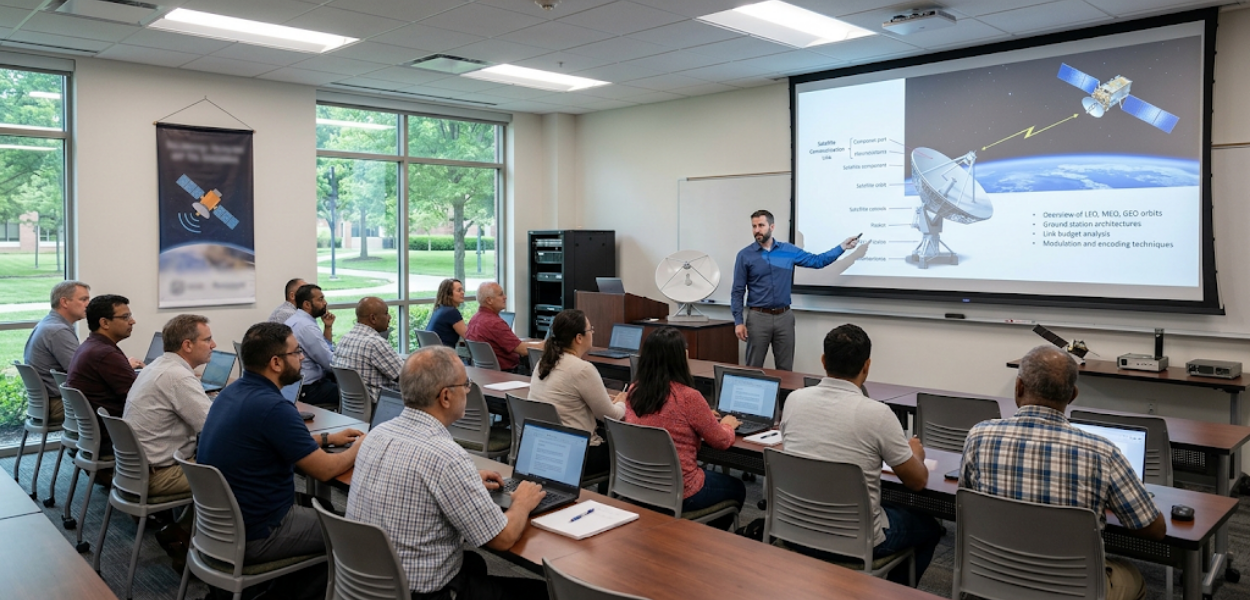
Training combines classroom instruction on orbital mechanics and frequency bands with hands-on labs using antenna equipment, spectrum analysers, and simulation software, typically delivered across 5 to 10 working days depending on technical depth.
A structured programme begins with foundational modules covering orbital types, including geostationary, medium Earth orbit, and low Earth orbit satellites. Learners then move to signal theory, covering modulation, frequency allocation, and the uplink and downlink process. This sequence matters because technicians who skip theoretical grounding often struggle to diagnose faults later.
Delivery formats vary by organisational need. Workshops suit teams requiring intensive hands-on practice with antenna alignment and signal testing equipment. Online modules suit distributed teams who need to complete theoretical content before attending a shorter in-person practical session. Hybrid learning combines both, reducing total time away from operational duties by 30 per cent to 40 per cent compared with fully in-person formats.
Assessments follow each module. Practical assessments require learners to calculate a link budget, configure a VSAT terminal, or interpret a satellite tracking readout. Simulation-based exercises let technicians practise fault scenarios, such as signal degradation from rain fade, without risking live infrastructure. Organisations evaluating this delivery model against the underlying technical concepts can review Satellite Communication Systems: Orbits, Transponders and Footprint Coverage Explained, which breaks down orbital mechanics, transponder function, and coverage footprints in more technical depth before an organisation commits to a specific implementation path.
What Are the Key Components of a Satellite Communication and Ground Stations Curriculum?
A complete curriculum covers orbital mechanics, transponder architecture, link budget analysis, VSAT terminal operation, ground station hardware, uplink and downlink procedures, and satellite tracking systems, supported by regulatory and spectrum management modules.
Orbital mechanics forms the first component. Learners study how geostationary orbit positioning at 35,786 kilometres above the equator allows a satellite to remain fixed relative to a ground point, while low Earth orbit satellites at 500 to 2,000 kilometres require tracking systems to maintain contact.
Transponder architecture is the second component. Trainees learn how a transponder receives an uplink signal, amplifies it, shifts its frequency, and retransmits it as a downlink signal. Understanding transponder bandwidth allocation determines how much data capacity a network can support.
Link budget analysis is the third component, and one of the most commercially significant. Technicians calculate signal loss across distance, atmospheric interference, and equipment gain to determine whether a proposed link will function reliably. An inaccurate link budget calculation is the most common cause of underperforming satellite networks in fields like maritime communication and remote broadcasting.
VSAT terminal operation, ground station antenna alignment, and satellite tracking software complete the practical skill set. Regulatory modules cover spectrum licensing requirements set by bodies such as the International Telecommunication Union, since unauthorised frequency use carries legal and financial penalties.
Learners building broader technical fluency alongside satellite-specific skills often pair this training with the Information Technology and Programming Courses, since ground station operations increasingly depend on network configuration, data handling, and software-driven monitoring tools rather than hardware alone.
What Measurable Benefits Do Organisations Gain From This Training?
Organisations report 25 per cent to 35 per cent reductions in signal downtime, 20 per cent faster fault resolution, and measurable improvements in first-time installation accuracy after structured satellite communication training compared with untrained technical teams.
Downtime reduction is the most direct financial benefit. Every hour of lost satellite connectivity in industries like maritime logistics or emergency broadcasting translates into delayed operations or compromised safety communication. Trained technicians identify signal degradation causes, such as antenna misalignment or atmospheric interference, faster than untrained staff, cutting average fault resolution time by 20 per cent.
Installation accuracy improves because technicians understand link budget requirements before deployment rather than adjusting equipment through trial and error on site. This reduces repeat site visits, which lowers travel and labour costs for organisations managing remote ground stations across multiple regions.
Workforce metrics also improve. Organisations that invest in structured technical training report higher retention among specialist engineering staff, since employees value skill development that increases their market value. Teams with certified satellite communication competency also build a stronger internal leadership pipeline, since senior technicians trained through structured programmes are better positioned to mentor junior staff and manage larger network deployments.
Which Teams and Industries Use Satellite Communication Training Most?
Telecommunications providers, defence contractors, maritime shipping companies, broadcasting networks, oil and gas operators, and emergency response agencies use satellite communication training to maintain connectivity where terrestrial infrastructure is unavailable or unreliable.
Telecommunications teams use this training to manage backhaul links connecting remote cell towers to core networks. Defence organisations require it for secure, mobile communication in field operations where fixed infrastructure does not exist. Maritime shipping companies train navigation and communication officers to maintain VSAT connectivity for vessel tracking, crew welfare communication, and regulatory reporting throughout ocean transit.
Broadcasting networks rely on ground station technicians to manage uplink transmission for live event coverage, particularly in regions without reliable fibre connectivity. Oil and gas operators train field engineers to maintain satellite links at remote extraction sites, where operational data must reach central monitoring systems continuously. Emergency response agencies train personnel to deploy portable satellite terminals rapidly during natural disasters, when terrestrial networks are frequently damaged or overloaded.
Departments within these organisations that benefit most include network operations centres, field engineering teams, IT infrastructure teams, and compliance departments responsible for spectrum licensing.
Why Do Many Satellite Communication Training Programmes Fail to Deliver ROI?
Generic training programmes fail because they teach satellite theory without equipment-specific practice, skip link budget calculation exercises, and provide no post-training assessment, leaving organisations unable to measure whether skills transferred to daily operations.
A common misconception is that theoretical knowledge of satellite orbits and frequency bands automatically translates into operational competence. It does not. A technician who can describe geostationary orbit positioning may still misalign a ground station antenna without structured hands-on practice using the specific hardware their organisation operates.
Another recurring problem is training that ignores an organisation's actual equipment and network architecture. Programmes built around generic case studies rather than an organisation's real VSAT terminals, transponder allocations, or regional coverage requirements produce staff who understand concepts in the abstract but cannot apply them to their employer's specific infrastructure.
Explore More Expert Insights:
Radar Systems and Signal Processing Training Courses
Digital Signal Processing for Communication Systems Training Courses
Lack of assessment compounds the problem. Training without a practical evaluation component, such as a scored link budget calculation or a supervised antenna installation, gives organisations no evidence of skill transfer. Without this evidence, businesses cannot calculate training ROI or identify which employees require additional support.
Finally, one-off training events without refresher modules lead to skill decay. Satellite communication technology evolves through updated frequency allocations, new satellite constellations, and changing regulatory requirements. Organisations that treat training as a single event rather than an ongoing programme see competency gaps re-emerge within 12 to 18 months.