
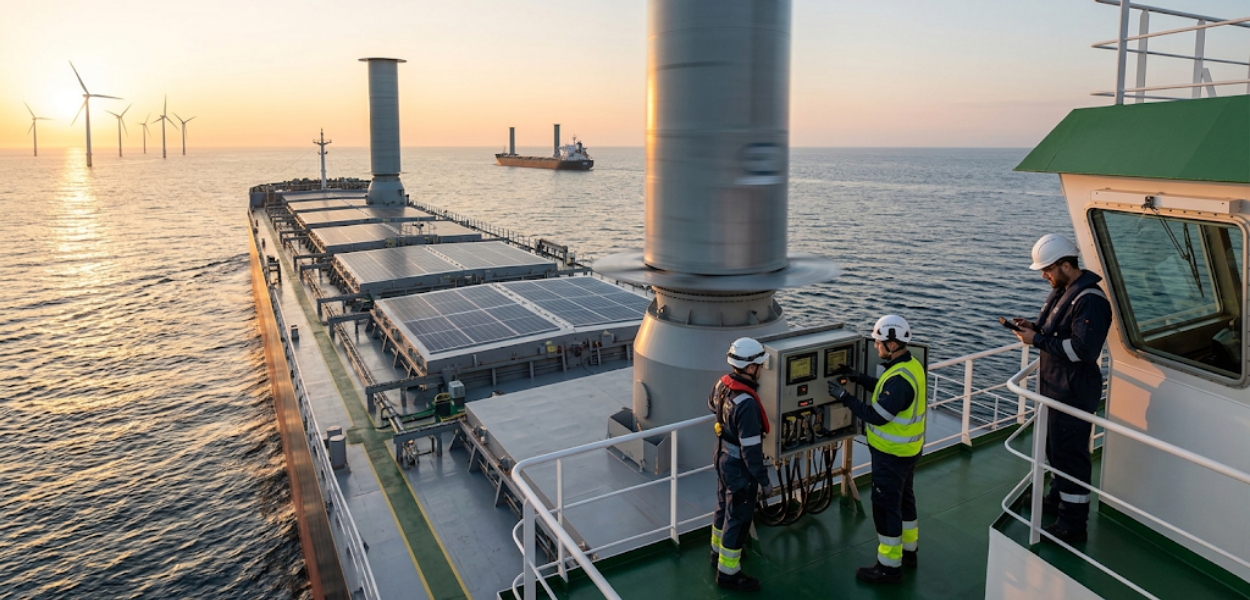
Green shipping technology refers to the technologies, operational methods, engineering systems, and energy solutions used to reduce greenhouse gas emissions from maritime transport. For organisations operating ships, ports, logistics networks, and supply chains, decarbonisation is a workforce challenge as much as an engineering challenge. Teams need practical knowledge of alternative fuels, vessel efficiency, emissions measurement, digital monitoring, energy management, and regulatory requirements.
Maritime decarbonisation changes how companies design vessels, manage fleets, select fuels, train technical employees, measure performance, and plan capital investment. The International Maritime Organisation has established a strategy for reducing greenhouse gas emissions from international shipping, creating a stronger requirement for organisations to develop internal capabilities rather than treating environmental performance as a separate compliance function.
For HR managers, L&D professionals, business owners, and operational leaders, the central issue is therefore skill readiness. A company cannot implement new propulsion systems or emissions-management processes effectively when employees lack the technical and operational skills required to use them. Corporate training connects green shipping technology with measurable workforce performance.
What Is Green Shipping Technology and Why Does It Matter to Businesses?
Green shipping technology combines cleaner fuels, efficient propulsion, digital monitoring, renewable energy, and improved vessel operations to reduce maritime emissions while maintaining safety, reliability, and commercial performance.
The maritime industry transports most global merchandise by sea, which makes shipping efficiency directly relevant to international supply chains. Green shipping technology addresses emissions produced by propulsion, auxiliary systems, cargo operations, and port activities.
Key technologies include alternative marine fuels, energy-efficient engines, battery systems, wind-assisted propulsion, shore power, hull optimisation, voyage optimisation, and digital emissions monitoring. Examples include methanol-powered vessels, battery-assisted ferries, wind-assisted cargo ships, and digital fleet-management systems.
The business impact extends beyond environmental reporting. Fuel represents a major operating cost for many vessels. Reducing fuel consumption improves cost control while lowering emissions. Digital monitoring also gives fleet managers more accurate operational data for maintenance, route planning, and performance analysis.
Corporate leaders therefore need employees who understand both the technology and its commercial implications. Engineering teams require technical competence. Procurement teams need fuel knowledge. Operations teams need efficiency-management skills. Finance teams need to understand capital expenditure and lifecycle costs.
How Does Green Shipping Technology Work in Corporate Maritime Operations?
Organisations implement green shipping through a sequence of emissions assessment, technology selection, workforce training, operational deployment, performance measurement, and continuous improvement across vessels, ports, logistics teams, and management functions.
The first stage is establishing an emissions baseline. Companies measure fuel consumption, vessel activity, voyage distances, engine performance, and greenhouse gas output. Common metrics include fuel consumption per nautical mile, carbon dioxide equivalent emissions, energy efficiency, and emissions per tonne of cargo transported.
The second stage identifies operational and technical opportunities. A fleet manager can compare slow steaming, hull optimisation, route planning, alternative fuels, propulsion upgrades, and digital monitoring. Each option has different infrastructure, training, safety, and investment requirements.
The third stage addresses workforce capability. Employees receive training through workshops, online modules, simulations, technical demonstrations, and assessments. Engineers can study propulsion systems. Vessel operators can practise fuel-efficiency procedures. Managers can analyse emissions dashboards and operational KPIs.
The fourth stage introduces the selected solution into daily operations. Employees follow standard operating procedures and use defined performance indicators. Managers monitor results through fleet dashboards, maintenance records, fuel reports, and emissions data.
The final stage is continuous improvement. Organisations compare actual performance with baseline results. Training content is updated when technology, regulations, operating procedures, or fleet requirements change.
This process creates a direct relationship between corporate learning and operational outcomes. Training is not treated as an isolated HR activity. It becomes part of the implementation system for maritime decarbonisation.
What Skills Do Employees Need to Implement Green Shipping Technology?
Employees need technical, operational, analytical, regulatory, and management skills to implement green shipping systems safely and measure their effect on fuel consumption, emissions, maintenance, vessel performance, and supply-chain efficiency.
Technical skills cover propulsion systems, alternative fuels, marine electrical systems, batteries, energy-management systems, and vessel efficiency. Engineers need to understand how new technologies interact with existing ship systems.
Operational skills focus on using technology during normal maritime activities. Crew members need procedures for fuel handling, energy optimisation, equipment monitoring, and emergency response. Port teams need knowledge of shore-side infrastructure and vessel connections.
Analytical skills allow employees to interpret operational data. Teams need to understand fuel-consumption trends, emissions measurements, equipment performance, and voyage data. Data literacy becomes increasingly important as ships use connected sensors and digital monitoring platforms.
Regulatory knowledge is another core capability. Employees need awareness of maritime environmental requirements, reporting processes, safety standards, and company-specific compliance procedures.
Management skills connect technical implementation with organisational priorities. Managers need to evaluate investment requirements, establish KPIs, allocate resources, identify skill gaps, and coordinate engineering, operations, procurement, finance, and HR teams.
A corporate learning programme should therefore avoid teaching green shipping as a single technical subject. The capability model should reflect the responsibilities of each department.
Which Training Components Make Green Shipping Learning Effective?
Effective corporate training combines technical knowledge, case-based learning, simulations, assessments, operational scenarios, digital tools, and workplace application so employees can transfer learning directly into maritime operations.
Workshops provide structured learning around technologies, regulations, and operational processes. They work well when employees need to discuss company-specific challenges with technical specialists.
Online modules support scalable knowledge development. Organisations with geographically distributed teams can deliver consistent content across vessels, offices, ports, and regional operations.
Case-based learning connects concepts with realistic business decisions. A case can require managers to compare alternative fuels based on infrastructure, cost, safety, vessel type, and emissions performance.
Simulations allow employees to practise decisions without disrupting real operations. A fleet-management simulation can present changes in fuel consumption, route conditions, vessel speed, and engine performance.
Role-play supports cross-functional collaboration. For example, an engineering manager, procurement specialist, finance manager, and operations leader can evaluate the same decarbonisation project from different organisational perspectives.
Assessments establish whether employees have developed measurable knowledge. These can include technical tests, scenario-based assessments, practical demonstrations, and KPI interpretation exercises.
The learning process becomes stronger when assessment results connect with workplace performance. If employees complete training on fuel efficiency, the organisation can subsequently monitor fuel-consumption indicators to determine whether operational behaviour changed.
How Should Organisations Measure the Results of Green Shipping Training?
Organisations should measure green shipping training through technical competency, operational KPIs, fuel efficiency, emissions performance, safety results, productivity, implementation speed, and financial return rather than attendance alone.
Training attendance measures participation, not capability. A stronger measurement model connects learning outcomes with business indicators.
Technical competency can be measured through assessment scores, practical demonstrations, and certification results. A defined pass threshold, such as 80%, creates a consistent competency standard.
Operational performance can be measured through fuel consumption per nautical mile, voyage efficiency, vessel energy use, equipment downtime, and maintenance performance.
Environmental performance can include greenhouse gas emissions per voyage, emissions per tonne of cargo, fuel-related carbon intensity, and progress against organisational reduction targets.
Financial measures include fuel-cost savings, maintenance-cost changes, implementation expenditure, and return on investment. ROI compares measurable financial benefits against the total cost of the training and implementation programme.
Safety indicators remain essential. New fuels and propulsion technologies introduce different handling, storage, maintenance, and emergency-response requirements. Training effectiveness therefore includes safe operating behaviour and incident prevention.
Employee capability also influences workforce planning. Organisations can track the percentage of technical employees who meet required competency standards and identify remaining skill gaps.
This creates a practical learning-performance cycle: assess skills, deliver training, apply knowledge, measure KPIs, identify gaps, and update the learning programme.
Where Is Green Shipping Technology Used Across Corporate Teams and Industries?
Green shipping technology applies across vessel operations, marine engineering, port management, logistics, procurement, fleet management, compliance, and supply-chain functions in industries such as manufacturing, energy, retail, automotive, and international trade.
Marine engineering teams work directly with propulsion, energy, fuel, electrical, and mechanical systems. Their training focuses on technical operation, maintenance, safety, and system integration.
Fleet management teams use operational data to improve vessel utilisation, routing, speed management, fuel consumption, and maintenance planning.
Port teams manage infrastructure supporting cleaner maritime operations. Shore power, alternative-fuel storage, charging infrastructure, and vessel-port coordination require specialised operational knowledge.
Procurement teams evaluate fuel suppliers, equipment vendors, technology providers, and infrastructure investments. Their decisions affect both operating costs and long-term decarbonisation capability.
Supply-chain teams need to understand how maritime emissions affect transportation planning and environmental reporting. Manufacturers, retailers, automotive companies, and energy businesses can integrate shipping performance into broader supply-chain strategies.
HR and L&D teams have a different responsibility. They identify emerging skills, map roles against competency requirements, develop training pathways, and measure workforce readiness.
Senior managers coordinate these functions. Their role involves balancing operational continuity, regulatory requirements, capital investment, workforce capability, and measurable environmental performance.
What Common Problems Prevent Organisations From Getting Value From Green Shipping Training?
Green shipping training loses business value when programmes remain generic, ignore role-specific skill gaps, lack practical application, use weak KPIs, or separate learning from the operational systems employees use every day.
A common problem is generic training. A marine engineer and an HR manager do not require the same depth of technical knowledge. Role-based learning produces clearer competency outcomes.
Another problem is focusing on theory without application. Employees can understand alternative fuels academically while still lacking the ability to apply fuel-management procedures during real operations. Case studies, simulations, and practical assessments reduce this gap.
Some organisations also measure attendance instead of performance. A training completion rate of 95% does not prove that fuel consumption, emissions, safety, or productivity improved.
Another issue is fragmented learning. When engineering, operations, procurement, and management teams receive disconnected training, implementation becomes slower. Cross-functional learning creates a shared understanding of technical and commercial requirements.
Technology selection can also create a skills mismatch. An organisation can invest in advanced monitoring systems while employees lack the analytical skills required to interpret the resulting data.
The solution is a competency-based learning model. Organisations define required capabilities for each role, assess existing skills, deliver targeted training, evaluate competency, and connect results with operational KPIs.
How Can Organisations Build a Workforce Ready for Maritime Decarbonisation?
Workforce readiness requires a structured capability framework linking maritime roles to technical skills, operational responsibilities, learning methods, competency assessments, and measurable performance indicators across the organisation.
The process starts with workforce mapping. Organisations identify roles affected by green shipping technology and document the capabilities required for each role.
A skills-gap assessment then compares current employee capability with future requirements. The assessment should cover technical knowledge, operational competence, digital literacy, regulatory awareness, and management skills.
The next step is learning-path design. Engineers can receive advanced technical modules. Operations teams can focus on efficiency and safety. Managers can study technology evaluation, investment decisions, and performance management.
At this stage, organisations evaluating specialised professional development can also explore Maritime Engineering Careers: Roles, Skills and Qualifications to understand how maritime engineering roles connect with the wider workforce capability structure.
Delivery should combine workshops, online learning, simulations, case-based exercises, assessments, and workplace projects. A blended model supports both knowledge acquisition and practical application.
Performance measurement follows implementation. Organisations can establish targets for competency scores, fuel efficiency, emissions performance, operational productivity, safety, and training ROI.
The final step is continuous capability development. Maritime technology continues to change, so workforce frameworks need scheduled reviews. A six-month review cycle provides a practical structure for checking technology changes, regulatory requirements, skill gaps, and operational results.
What Role Does Corporate Training Play in Green Shipping Decarbonisation?
Corporate training converts green shipping technology from an equipment investment into an organisational capability by preparing employees to operate systems, interpret data, follow procedures, manage risk, and improve measurable maritime performance.
Decarbonisation depends on people as well as technology. A new propulsion system requires trained engineers. A digital emissions platform requires data-literate employees. Alternative fuels require safe handling procedures. New operational strategies require managers who understand their financial and environmental effects.
This makes workforce development part of implementation planning. Training requirements should be considered alongside technology procurement, infrastructure development, operational redesign, and compliance planning.
The wider Logistics, Supply Chain & Shipping discipline provides the corporate context for understanding how maritime operations connect with transportation, procurement, inventory, distribution, and international trade.
For organisations, the objective is measurable capability. Employees need to perform defined tasks to established standards. Managers need reliable KPIs. HR and L&D teams need evidence that learning addresses strategic skill gaps.
Explore More Expert Insights:
Container Terminal Operations: How a Port Works, Step-by-Step
What Is Demand Planning? Forecasting Explained Simply
A practical green shipping workforce therefore combines maritime engineering knowledge, operational expertise, digital capability, environmental awareness, regulatory understanding, and cross-functional decision-making.
Green shipping technology is ultimately an organisational transformation challenge. Technology determines what ships can do, but workforce capability determines how effectively those systems are implemented, operated, measured, and improved.