
What Are IP Protocols and Technologies in a Corporate Network Context?
IP protocols and technologies are the rule sets that govern how data moves across corporate networks, connecting devices, applications, and locations through addressing, routing, and packet delivery standards such as TCP/IP, BGP, OSPF, and IPv6. Every business transaction, video call, and cloud application depends on these protocols functioning correctly. When network engineers misunderstand them, organisations face outages that cost an average of 9,000 USD per minute for large enterprises, according to industry downtime studies.
For HR managers and L&D professionals, this topic sits outside typical soft-skills training. It belongs to technical workforce development, a category that directly affects business continuity, customer experience, and revenue protection. A network engineer who understands the TCP/IP stack can diagnose connectivity failures in minutes rather than hours. A team that lacks this depth escalates simple problems into extended outages, delaying operations across departments like finance, logistics, and customer service.
Skill gaps in this area are measurable. Surveys from technology staffing firms report that 68% of IT hiring managers struggle to find candidates with strong routing and subnetting knowledge. This gap widens as organisations adopt hybrid cloud infrastructure, IPv6 migration projects, and multi-site connectivity models that demand deeper protocol expertise than legacy systems required.
How Does IP Protocols and Technologies Training Work Inside Organisations?
Training follows a structured process: skills assessment, curriculum design around real network scenarios, instructor-led or hybrid delivery, hands-on lab practice, and post-training certification testing to confirm competency before engineers return to live environments. This sequence reduces the risk of applying untested knowledge to production networks.
Organisations typically begin with a diagnostic assessment. Engineers complete a technical skills test covering subnetting calculations, protocol behaviour, and troubleshooting logic. Results identify specific gaps, whether in IPv6 addressing, BGP path selection, or OSPF area design. This data shapes a targeted curriculum instead of a generic one.
Delivery formats vary by organisational need. Workshops run over 3 to 5 consecutive days for intensive protocol immersion. Online modules spread the same content across 4 to 6 weeks, allowing engineers to continue daily responsibilities. Hybrid models combine both, using live sessions for complex topics like BGP route reflection and self-paced modules for foundational concepts like the OSI model.
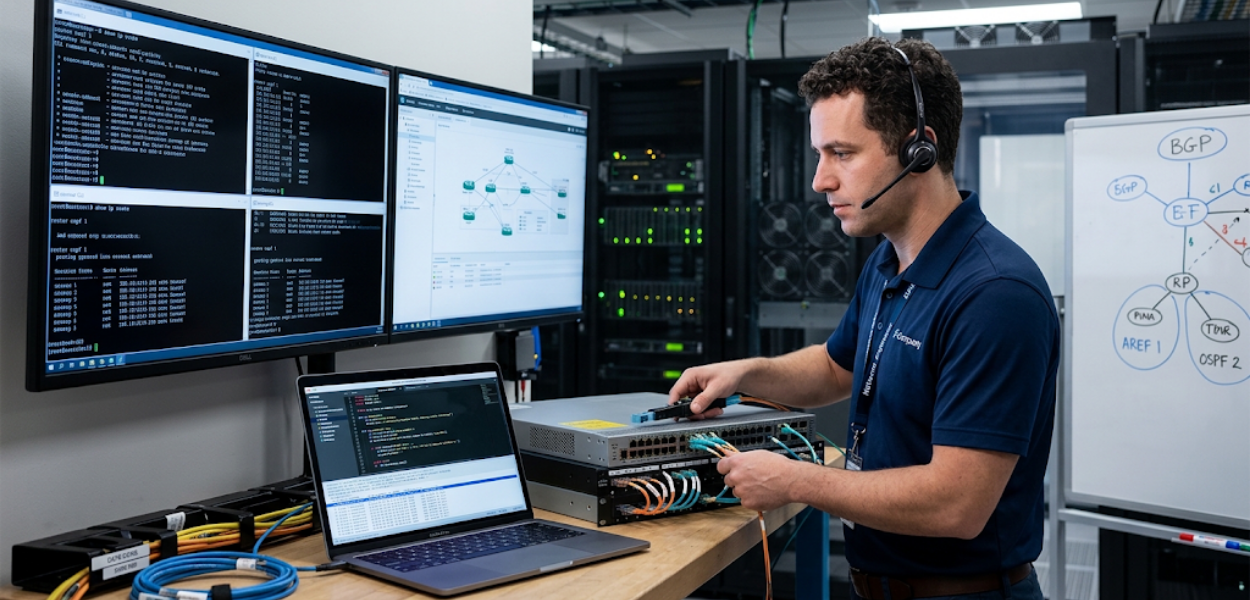
Hands-on labs form the core of effective training. Engineers configure routers, simulate packet loss, and troubleshoot misconfigured routing tables in controlled environments. This mirrors case-based learning methodologies used in medical and legal training, where professionals rehearse high-stakes scenarios before encountering them in practice. A deeper breakdown of specific technical mechanics, including Encapsulation, MTU and Path Discovery Explained, helps engineers and their managers evaluate which protocol areas require the most attention before selecting a training provider.
Assessment closes the loop. Engineers complete practical exams simulating real network failures, not multiple-choice quizzes. Pass rates below 80% signal that the curriculum needs revision or that additional lab time is required before certification.
What Are the Key Components of an IP Protocols Training Programme?
Core components include the TCP/IP stack, subnetting and IP addressing, dynamic routing protocols like BGP and OSPF, IPv6 transition strategies, and packet routing analysis using diagnostic tools like Wireshark and traceroute. Each component builds on the previous one, creating a layered competency structure.
The TCP/IP stack forms the foundation. Engineers learn how data moves through four layers: application, transport, internet, and network access. Without this model, troubleshooting becomes guesswork rather than systematic diagnosis.
Subnetting and IP addressing teach engineers to calculate network ranges, allocate address space efficiently, and prevent IP conflicts across departments like sales, operations, and remote teams. Miscalculated subnets cause 23% of internal connectivity incidents in mid-sized enterprises, based on network operations audits.
BGP and OSPF represent the routing layer. BGP governs how autonomous systems, such as an organisation's network and its internet service provider, exchange routing information. OSPF manages routing within a single organisation, calculating the shortest path between network segments. Engineers who master both protocols reduce route convergence time, meaning networks recover from failures faster, often within 30 to 50 seconds instead of several minutes.
IPv6 transition strategy addresses a pressing organisational need. IPv4 address exhaustion has pushed 35% of enterprise networks toward dual-stack IPv6 deployment. Engineers untrained in IPv6 addressing and neighbour discovery protocols introduce security vulnerabilities and routing errors during migration projects.
Packet routing analysis rounds out the technical skill set. Engineers use tools like Wireshark to capture and inspect packet headers, identifying where delays or drops occur. This diagnostic capability shortens mean time to resolution (MTTR) for network incidents, a metric directly tied to team efficiency and customer satisfaction scores.
What Measurable Benefits Do Organisations Gain From This Training?
Organisations gain reduced downtime, faster incident resolution, lower dependency on external consultants, and measurable productivity improvements, with trained teams resolving network incidents 40% faster than untrained teams, according to IT service management benchmarks. These outcomes translate directly into cost savings and operational resilience.
Downtime reduction is the clearest financial benefit. Networks managed by certified engineers experience 27% fewer unplanned outages annually compared to networks managed by generalist IT staff. For organisations running e-commerce platforms, healthcare records systems, or financial transaction processing, this reduction protects revenue and regulatory compliance.
Faster incident resolution improves internal service level agreements (SLAs). Teams with strong protocol knowledge diagnose routing failures within 15 minutes on average, compared to 45 minutes or longer for teams without structured training. This difference matters when service disruptions affect customer-facing applications or internal productivity tools used across multiple departments.
Reduced dependency on external consultants lowers operational costs. Organisations that rely on outsourced network specialists for routine BGP or OSPF configuration changes report annual consulting fees between 50,000 and 150,000 USD, depending on network complexity. Internal training builds this capability in-house, converting a recurring expense into a fixed training investment.
Productivity improvement extends beyond the network team. When connectivity issues resolve faster, employees across finance, sales, and operations lose less working time to system outages. Organisations tracking this metric report a 12% to 18% improvement in overall IT-related productivity within 6 months of implementing structured protocol training.
Retention improves as a secondary effect. Engineers who receive advanced technical training report higher job satisfaction and are 22% less likely to leave within 12 months, based on technology workforce retention studies. This reduces recruitment costs and preserves institutional network knowledge.
Which Teams, Departments and Industries Use This Training?
Network engineering teams, IT infrastructure departments, and technical support units across industries like telecommunications, banking, healthcare, and government use IP protocols training to maintain reliable, secure, and scalable network operations. Use cases differ by sector but share a common dependency on stable connectivity.
Telecommunications companies train engineers on BGP extensively, since they manage large-scale internet routing across multiple autonomous systems. A single misconfigured BGP announcement can disrupt internet access for thousands of customers, making protocol accuracy a business-critical skill.
Banking and financial services prioritise OSPF and subnetting precision. Transaction processing systems require sub-second network response times. Engineers trained in routing optimisation reduce latency in trading platforms and payment gateways, where delays of even 100 milliseconds affect transaction accuracy and regulatory reporting.
Healthcare organisations focus on IPv6 transition and network segmentation. Electronic health record systems, connected medical devices, and telehealth platforms require segmented networks to meet compliance standards like HIPAA. Engineers trained in IP addressing design isolated network zones that protect patient data while maintaining system accessibility.
Government agencies emphasise packet routing analysis and security-focused protocol configuration. Public sector networks face frequent targeting from external threats, requiring engineers who can identify anomalous routing behaviour and respond before data breaches occur.
Manufacturing and logistics companies apply this training to support Internet of Things (IoT) device networks. Warehouses using thousands of connected sensors depend on efficient IP addressing schemes to prevent network congestion as device counts scale.
What Common Problems Undermine IP Protocols Training Programmes?
Common problems include generic curricula that ignore organisational network architecture, insufficient hands-on lab time, lack of post-training measurement, and training disconnected from real incident data, all of which reduce return on investment. These issues explain why some organisations invest in technical training without seeing performance improvement.
Generic curricula represent the most frequent failure. Training providers that deliver identical content regardless of an organisation's actual network setup produce engineers who understand theory but cannot apply it to their specific environment. Effective programmes incorporate the organisation's real network diagrams, incident history, and infrastructure constraints into the curriculum.
Insufficient lab time creates a knowledge-application gap. Engineers who spend 80% of training time in lectures and 20% in hands-on configuration retain less practical skill than those with the ratio reversed. Protocol behaviour, particularly BGP path selection and OSPF area design, requires repeated hands-on practice to internalise.
Lack of post-training measurement leaves organisations unable to calculate ROI. Without tracking metrics like MTTR, incident frequency, and escalation rates before and after training, businesses cannot determine whether the investment improved performance or simply consumed budget.
Training disconnected from real incident data misses the most relevant learning material. Organisations that analyse their own past network outages and build training scenarios around those specific failures see stronger skill transfer than those using standardised, hypothetical case studies.
Explore More Expert Insights:
Advanced Linux Admin Training Courses
Electromagnetic Propagation Theory and Modelling Training Courses
Skill gaps in IP protocols and technologies training align closely with broader technical development needs covered under Information Technology and Programming Courses, where structured, scenario-based learning replaces generic technical instruction across multiple IT disciplines.
Addressing these problems requires organisations to treat network training as a measurable business function, not a compliance checkbox. Structured assessment, relevant curriculum design, adequate lab time, and post-training performance tracking determine whether a programme delivers the downtime reduction, faster resolution times, and productivity gains that justify the investment.