
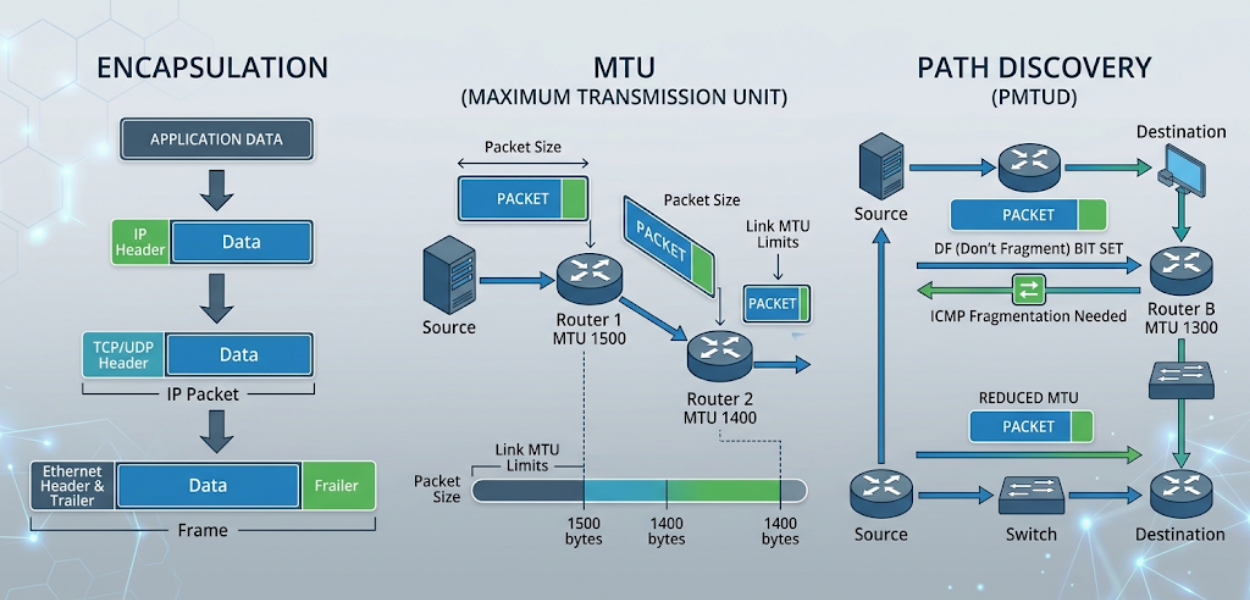
Every packet that moves across a corporate network passes through a sequence of technical decisions most employees never see. Encapsulation wraps data in headers. MTU limits determine whether a packet travels intact or gets broken apart. Path discovery mechanisms decide how routers find the most efficient route. These three concepts sit at the centre of network engineering competence, and they explain why so many operational slowdowns trace back to gaps in protocol-level understanding rather than hardware failure.
Organisations that treat these topics as optional technical trivia usually discover the cost later, through packet loss, VPN instability or failed IPv6 migrations. Teams that build structured knowledge around the TCP/IP stack avoid this pattern. For engineers building this foundation from the ground up, IP Protocols and Technologies for Network Engineers Training Courses provide the conceptual base that the rest of this article assumes. What follows explains encapsulation, MTU, path discovery, subnetting and routing protocols in the depth required to make informed training and hiring decisions.
What Is Encapsulation in the TCP/IP Stack and Why Does It Matter?
Encapsulation is the process of wrapping data with protocol-specific headers at each layer of the TCP/IP stack, from application data down to physical transmission, so devices along the path can interpret and forward it correctly. Every layer adds its own header. The application layer produces raw data. The transport layer wraps it with TCP or UDP headers, adding port numbers and sequencing information. The network layer wraps that segment with an IP header, adding source and destination addresses. The data link layer adds a frame header and trailer for physical delivery.
This layered structure exists so that each device on the path only needs to read the header relevant to its function. A switch reads the frame header. A router reads the IP header. A server reads the transport header. Nothing needs to interpret the full stack simultaneously. Encapsulation overhead is small in absolute terms, typically 20 bytes for an IPv4 header and 20 bytes for a TCP header, but it accumulates across VPN tunnels, VXLAN overlays and double-encapsulated traffic in cloud environments. Engineers who do not account for this overhead misconfigure MTU settings and cause silent packet drops that are difficult to diagnose without protocol-level knowledge.
Workforce data across enterprise IT teams consistently shows that encapsulation-related misconfigurations account for a measurable share of escalated network tickets, particularly in hybrid cloud deployments where multiple tunnelling protocols stack on top of each other. Teams without formal protocol training tend to solve these symptoms through trial and error rather than root-cause analysis, which extends downtime and increases dependency on senior staff for issues that should be resolvable at a junior level.
How Does Maximum Transmission Unit (MTU) Affect Network Performance?
MTU defines the largest packet size, in bytes, that a network interface can transmit without fragmentation, and mismatched MTU values between devices cause fragmentation, retransmission and measurable throughput loss across the connection. The standard Ethernet MTU is 1500 bytes. Jumbo frames extend this to 9000 bytes on networks configured to support them, reducing per-packet overhead for high-throughput applications such as storage replication and video transport.
When a packet exceeds the MTU of a link along its path, one of two things happens. IPv4 routers fragment the packet into smaller pieces, adding processing overhead and increasing the chance of packet loss, since losing one fragment forces retransmission of the entire original packet. IPv6 routers do not fragment packets at all. They drop oversized packets and return an ICMPv6 "Packet Too Big" message to the sender, placing the responsibility for correct sizing entirely on the source host.
MTU mismatches are a common cause of intermittent application failures, particularly with VPN tunnels, where the tunnel header consumes part of the available MTU budget without administrators adjusting the effective MTU downstream. A tunnel interface set to 1500 bytes with a 50-byte encapsulation overhead leaves only 1450 bytes for the original packet, and traffic that ignores this reduction fragments or fails silently depending on firewall configuration. Engineers troubleshoot this by testing with progressively smaller packet sizes using tools that disable fragmentation, isolating the exact point of failure along the path.
What Is Path MTU Discovery and How Does It Prevent Fragmentation?
Path MTU Discovery is a technique where a sending host determines the smallest MTU along the entire path to a destination by sending packets with the "don't fragment" flag set and adjusting size downward whenever a router returns a fragmentation-needed error. The process avoids the inefficiency of fragmentation entirely by finding the correct packet size before the bulk of data transmission begins.
The mechanism works as follows. A host sends a packet at its local interface MTU with the don't-fragment bit set. If a router along the path has a smaller MTU, it drops the packet and sends back an ICMP message indicating the maximum size it can forward. The sending host reduces its packet size accordingly and retries. This continues until the packet reaches the destination without triggering further errors, at which point the sender has established the effective path MTU.
Path MTU Discovery fails in environments where firewalls block ICMP messages, a common security misconfiguration. Without the ICMP response, the sending host never learns that a smaller MTU is required, and packets are dropped without explanation. This is one of the most frequently misdiagnosed network issues in enterprise environments, since the symptom, a connection that establishes but then hangs on data transfer, points engineers toward application-layer troubleshooting rather than the correct network-layer cause. Recognising this pattern quickly is a direct measure of practical protocol competence, distinct from certification-based theoretical knowledge.
How Do OSPF and BGP Handle Packet Routing Differently?
OSPF is a link-state interior gateway protocol that calculates the shortest path within a single autonomous system, while BGP is a path-vector exterior gateway protocol that manages routing decisions between autonomous systems based on policy rather than pure distance. The two protocols solve different problems and operate at different scales, and confusing their use cases is a common source of design errors in enterprise network architecture.
OSPF builds a complete map of the network topology within its area, using Dijkstra's algorithm to calculate the shortest path to every destination. It converges quickly, typically within seconds of a topology change, and is well suited to internal corporate networks with a defined, relatively stable structure. Areas are used to limit the size of the topology database each router must maintain, keeping convergence times manageable as the network grows.
BGP operates differently. It does not calculate shortest paths based on link cost. It selects routes based on a sequence of attributes, including AS path length, local preference and origin type, allowing network administrators to apply business policy to routing decisions rather than relying purely on technical efficiency. This is why BGP underpins the entire internet's routing structure, where thousands of autonomous systems need to exchange reachability information without any single entity controlling the topology.
Subnetting decisions interact directly with both protocols. Poor subnet planning increases the size of routing tables, slows OSPF convergence and complicates BGP route aggregation. Engineers who understand subnetting at a binary level design address plans that scale cleanly, while those relying on subnet calculators without underlying comprehension tend to create fragmented address spaces that require costly renumbering projects later.
Why Does IPv6 Change Encapsulation, MTU and Path Discovery Behaviour?
IPv6 removes router-level fragmentation entirely, mandates a minimum MTU of 1280 bytes, and shifts path MTU discovery responsibility fully onto the sending host, requiring engineers to rebuild MTU troubleshooting habits developed under IPv4. This is one of the most significant practical differences between the two protocol versions, and one that trips up engineers who assume IPv6 is simply IPv4 with longer addresses.
Under IPv4, routers along the path fragment oversized packets automatically, masking MTU mismatches at the cost of performance. Under IPv6, this safety net does not exist. Any router that receives a packet larger than the next-hop MTU drops it and returns an ICMPv6 error. If that error is blocked by a firewall, the connection stalls without any fragmentation to fall back on, making Path MTU Discovery not just useful but structurally necessary for IPv6 to function correctly across paths with variable MTU.
Header structure changes further complicate the picture. IPv6 headers are a fixed 40 bytes, larger than the minimum IPv4 header, but IPv6 removes several fields present in IPv4, including the header checksum, shifting error detection responsibility to lower and upper layers. Extension headers, used for options such as fragmentation and security, are chained rather than embedded, which changes how firewalls and intermediate devices need to parse and inspect traffic. Organisations migrating to IPv6 without accounting for these differences in their network engineering training see a disproportionate rise in support tickets during the transition period, most of which trace back to gaps in protocol-level understanding rather than IPv6 itself being unreliable.
How Should Organisations Build Network Engineering Capability Around These Protocols?
Organisations close protocol-level skill gaps most effectively through structured, scenario-based training that combines encapsulation, MTU behaviour, path discovery and routing protocol logic, rather than isolated certification study that tests recall without operational application. The distinction matters because certification exams reward memorised protocol behaviour, while production networks reward engineers who can diagnose why a specific packet failed on a specific path.
The skills gap in this area is measurable. Enterprise IT teams routinely report that junior and mid-level engineers can describe OSPF and BGP in interview settings but struggle to trace a live MTU-related fragmentation issue without escalation. This gap widens as networks add layers of tunnelling, overlay and cloud interconnection, each of which introduces its own encapsulation overhead and MTU constraints. Closing it requires training that moves beyond protocol definitions into applied diagnostic reasoning, using real packet captures and failure scenarios rather than slide-based theory.
For organisations evaluating how to build this capability at a senior level, Command IP Protocols and Technologies with the Depth Senior Network Engineers Are Hired For addresses the specific diagnostic depth that separates operational competence from theoretical familiarity. This depth is what hiring managers test for directly, since senior network engineering roles are evaluated on troubleshooting speed and root-cause accuracy rather than protocol recall alone.
Training investment in this area produces measurable returns. Teams with structured protocol training resolve MTU and encapsulation-related incidents faster, reducing mean time to resolution and lowering dependency on a small number of senior staff for issues that mid-level engineers should be able to handle independently. This has direct workforce planning implications for HR and learning teams, since network engineering roles are difficult to backfill externally, and internal skill development reduces both hiring risk and retention risk tied to concentrated technical knowledge.
Explore More Expert Insights:
Advanced Linux Admin: systemd Units, Namespaces and Kernel Tuning Explained
Electromagnetic Propagation: Fresnel Zones, Diffraction and Terrain Obstruction Explained
For organisations building broader technical capability across their IT function rather than a single protocol specialism, the Information Technology and Programming Courses catalogue provides the wider structure within which protocol-specific training fits, supporting workforce development plans that need to cover networking alongside systems administration, cloud infrastructure and software development skills.
Measuring the effectiveness of this training requires tracking outcomes beyond course completion. Ticket resolution time for network-layer issues, escalation rates to senior engineers, and the proportion of MTU or routing-related incidents resolved without external vendor support all indicate whether training has translated into operational capability. Organisations that track these metrics consistently find that scenario-based protocol training produces faster improvement in these figures than certification-focused study alone, because the training mirrors the diagnostic conditions engineers actually face on production networks.