
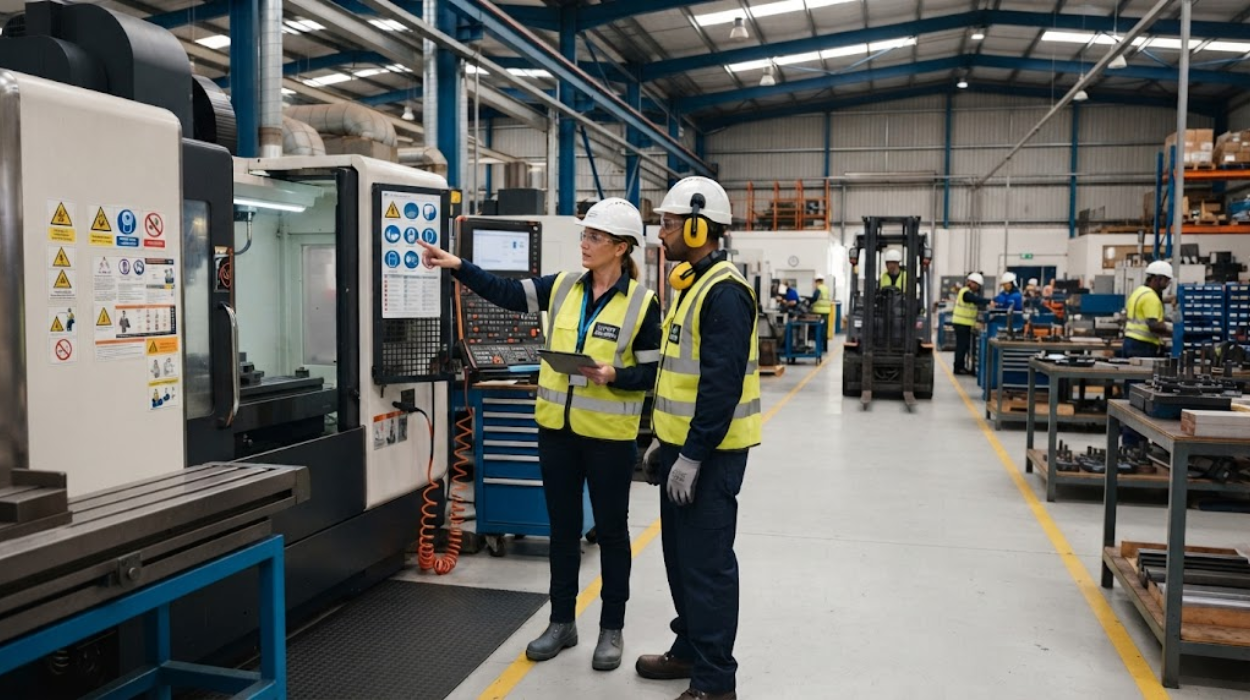
Workplace health and safety is the structured responsibility of an employer to identify hazards, control risks, protect employees, provide competent supervision, and maintain safe working conditions. It combines legal compliance, risk management, employee training, incident prevention, and measurable workplace performance.
What does workplace health and safety mean for employers?
Workplace health and safety means controlling workplace risks through legal compliance, hazard identification, employee competence, safe systems of work, supervision, emergency planning, and continuous monitoring to prevent injury, illness, property damage, and operational disruption.
Employers hold responsibility for establishing conditions that protect employees and other people affected by business activities. These responsibilities apply across industries such as construction, manufacturing, healthcare, logistics, hospitality, finance, and information technology.
Health and safety management starts with hazard identification. A hazard is anything with the potential to cause harm. Examples include exposed machinery, electrical equipment, hazardous substances, excessive noise, poor workstation design, fire risks, and unsafe manual handling.
Risk assessment determines the likelihood and potential severity of harm associated with each hazard. Employers use risk assessments to decide which controls are required, who is responsible for implementation, and how frequently controls require review.
A safe system of work translates risk controls into operational procedures. It defines how employees perform tasks safely, what equipment they use, which precautions apply, and what actions are required when conditions change.
Legal duties also include providing suitable information, instruction, training, and supervision. Training gives employees the knowledge and practical competence required to follow established procedures rather than treating health and safety as a document-only responsibility.
How should employers implement health and safety responsibilities?
Employers implement health and safety through a repeatable cycle of policy development, hazard identification, risk assessment, control implementation, employee training, supervision, incident monitoring, performance measurement, and periodic review across workplace operations.
The first stage is establishing organisational responsibility. Senior management defines accountability, allocates resources, and confirms who manages health and safety activities. Responsibility then moves through managers, supervisors, technical teams, and employees according to job requirements.
The second stage involves identifying workplace hazards. Organisations inspect physical environments, review work processes, analyse previous incidents, and consult employees who understand operational risks.
The third stage is risk assessment. Organisations assess hazards according to factors such as exposure frequency, number of people affected, potential severity, and existing control measures.
The fourth stage is selecting controls. Effective controls follow a structured hierarchy. Elimination removes the hazard. Substitution replaces it with a safer alternative. Engineering controls isolate people from hazards. Administrative controls change working procedures. Personal protective equipment provides the final layer of protection.
The fifth stage is competence development. Employees receive training that corresponds to their responsibilities. Managers require additional knowledge about risk ownership, reporting, supervision, investigations, and compliance monitoring.
Training delivery can use instructor-led workshops, online modules, hybrid learning, practical demonstrations, simulations, role-play, case-based learning, and formal assessments. The appropriate format depends on the complexity and risk level of the work.
The sixth stage is implementation. Managers integrate health and safety procedures into daily workflows rather than treating training as a separate administrative activity. Supervisors then observe whether employees apply the required controls correctly.
The final stage is review. Organisations examine incidents, near misses, audit findings, training results, absenteeism, corrective actions, and other performance indicators to determine whether controls remain effective.
What legal duties form the foundation of employer responsibility?
Employer duties centre on maintaining safe working conditions, controlling workplace risks, providing competent instruction and supervision, maintaining suitable equipment and systems, protecting employees and others, and reviewing safety arrangements when risks or operations change.
The exact legal requirements depend on jurisdiction and industry. In the United Kingdom, the Health and Safety at Work etc. Act 1974 establishes broad employer responsibilities for employee health, safety, and welfare.
Employers also manage specific risks through regulations covering areas such as workplace equipment, hazardous substances, manual handling, personal protective equipment, work at height, fire safety, and workplace conditions.
A written health and safety policy is an important management document for organisations with applicable employee thresholds and requirements. It normally defines organisational responsibilities, management arrangements, and operational controls.
Employers also have duties concerning consultation and communication. Employees need access to relevant safety information and procedures. Managers need clear reporting channels for hazards, incidents, and unsafe conditions.
Record keeping supports accountability. Organisations maintain appropriate records covering risk assessments, training, inspections, incidents, equipment checks, corrective actions, and other legally relevant activities.
Legal compliance therefore operates as an ongoing management process. A policy created once and left unchanged does not provide effective control when equipment, processes, staffing, premises, or operational risks change.
What are the key components of an effective workplace health and safety system?
An effective system combines governance, risk assessment, control measures, competence management, emergency procedures, incident reporting, inspections, audits, documentation, employee consultation, and performance indicators within one integrated management structure.
Governance establishes who owns health and safety decisions. Senior leaders provide resources and accountability. Managers convert organisational requirements into departmental procedures.
Risk management identifies hazards and establishes controls. Risk registers provide structured records of identified hazards, responsible owners, control measures, review dates, and residual risk.
Competence management ensures employees possess the knowledge and practical capability required for their roles. Competence includes technical knowledge, procedural understanding, practical skills, judgement, and appropriate supervision.
Emergency preparedness covers foreseeable events such as fires, chemical releases, equipment failures, medical emergencies, and workplace evacuations. Emergency procedures define responsibilities, communication methods, evacuation arrangements, and response actions.
Incident management covers accidents, near misses, unsafe conditions, and occupational health events. Investigation focuses on immediate causes and underlying organisational causes rather than simply assigning blame.
Workplace inspections provide direct evidence about operating conditions. Audits assess whether management systems and procedures meet defined requirements.
Performance measurement converts health and safety activity into measurable information. Relevant KPIs include incident frequency, lost-time injury frequency, near-miss reporting, corrective-action closure rates, training completion, inspection completion, and audit findings.
Training records provide evidence that required instruction has been delivered. Assessment results provide additional evidence about knowledge retention and competence.
How does health and safety training support organisational performance?
Health and safety training improves organisational performance by developing employee competence, reducing unsafe practices, strengthening risk controls, supporting regulatory compliance, improving operational consistency, and providing measurable evidence that safety responsibilities are understood and applied.
Effective training begins with a skills-gap analysis. A skills gap is the difference between the competence required for a role and the competence currently demonstrated by employees.
For example, a facilities department might identify gaps in risk assessment, contractor management, maintenance safety, emergency procedures, or equipment control. Training objectives then address these specific requirements.
Case-based learning connects legal principles with workplace decisions. A maintenance team can analyse an equipment failure, identify contributing hazards, select appropriate controls, and evaluate the resulting corrective actions.
Simulation provides controlled practice for higher-risk situations. Employees can rehearse emergency procedures, permit-to-work processes, evacuation responsibilities, or incident reporting without exposure to the actual workplace hazard.
Role-play develops communication and decision-making skills. Supervisors can practise responding to unsafe behaviour, conducting toolbox discussions, or communicating corrective actions.
Assessments provide measurable evidence. Organisations can compare pre-training and post-training scores, practical assessment results, incident indicators, and audit findings to evaluate learning effectiveness.
The strongest approach connects learning outcomes to operational KPIs. Training completion alone demonstrates participation. Reduced repeat incidents, improved corrective-action closure, stronger inspection results, and higher assessment scores provide stronger evidence of organisational impact.
Which departments and industries use workplace health and safety training?
Health and safety training applies across operational, technical, managerial, and support functions, with learning requirements adjusted to workplace hazards, legal duties, job responsibilities, equipment, processes, and industry-specific operating conditions.
Facilities management teams manage risks involving buildings, contractors, maintenance activities, electrical systems, mechanical equipment, fire safety, access control, and emergency response.
Engineering and maintenance departments require competence in safe equipment operation, isolation procedures, machinery risks, maintenance planning, and technical work controls.
Construction teams address risks such as work at height, temporary works, machinery, excavation, lifting operations, site traffic, and construction materials.
Manufacturing organisations manage machinery, production processes, hazardous substances, manual handling, noise, and workplace ergonomics.
Healthcare organisations manage biological hazards, manual handling, clinical environments, infection risks, equipment, and emergency procedures.
Office-based organisations also require structured controls. Ergonomics, fire safety, electrical equipment, emergency arrangements, lone working, and workplace stress form part of broader occupational health and safety management.
Managers and team leaders require a different learning focus from frontline employees. Their responsibilities include supervision, risk ownership, incident response, corrective actions, communication, and performance monitoring.
The course context of Facilities Management, Maintenance & Engineering connects health and safety responsibilities with technical workplace environments where building systems, maintenance operations, engineering activities, and facilities services intersect.
What health and safety training problems prevent organisations from achieving results?
Ineffective health and safety training usually results from generic content, weak needs analysis, passive delivery, poor assessment, limited workplace application, incomplete management involvement, and failure to connect learning outcomes with operational performance indicators.
Generic training treats employees with different responsibilities as if they face identical risks. A finance employee, maintenance engineer, site supervisor, and facilities manager require different competencies.
Another problem is focusing on attendance rather than competence. An attendance certificate confirms participation but does not demonstrate that employees can identify hazards, apply controls, or respond correctly to workplace situations.
Passive delivery also limits practical application. Employees who only read policies or watch presentations receive less opportunity to practise risk assessment, emergency response, incident investigation, or supervisory communication.
Weak measurement creates another problem. Organisations that track only training completion cannot determine whether learning changed workplace behaviour or reduced operational risk.
Management involvement also affects implementation. If managers do not reinforce procedures, employees receive inconsistent signals about operational priorities.
A stronger system starts with defined competencies and measurable outcomes. Training objectives should correspond to actual job requirements, while assessments should test knowledge and practical application.
Organisations evaluating external learning options can examine health and safety courses in London when moving from general awareness toward structured training evaluation, delivery formats, course content, and accreditation requirements.
How should organisations measure the impact of health and safety training?
Organisations measure training impact by connecting learning data with workplace indicators such as assessment scores, incident rates, near-miss reporting, audit findings, corrective-action completion, compliance results, and operational safety performance.
Learning KPIs measure what participants learned. Examples include assessment scores, practical assessment results, knowledge-retention scores, and training completion rates.
Behavioural KPIs measure workplace application. Examples include inspection quality, correct procedure adherence, hazard reporting, safe-system compliance, and supervisor observations.
Operational KPIs measure organisational outcomes. Examples include lost-time injuries, incident frequency, near misses, equipment damage, corrective-action closure time, and safety audit findings.
ROI measures the financial relationship between training investment and measurable business outcomes. Organisations can compare training costs with quantified savings from reduced incidents, lower disruption, improved productivity, and reduced corrective-action costs.
Explore More Expert Insights:
What Is BIM? Building Information Modelling for Non-Engineers
Maintenance and Reliability Management: Best-Practice Framework
The measurement period also matters. Immediate assessment results show learning. Three-month and six-month workplace indicators provide stronger evidence of behavioural and operational change.
A practical evaluation model therefore connects four levels: participation, learning, behaviour, and business impact. This creates a clearer relationship between workforce development and organisational performance.