
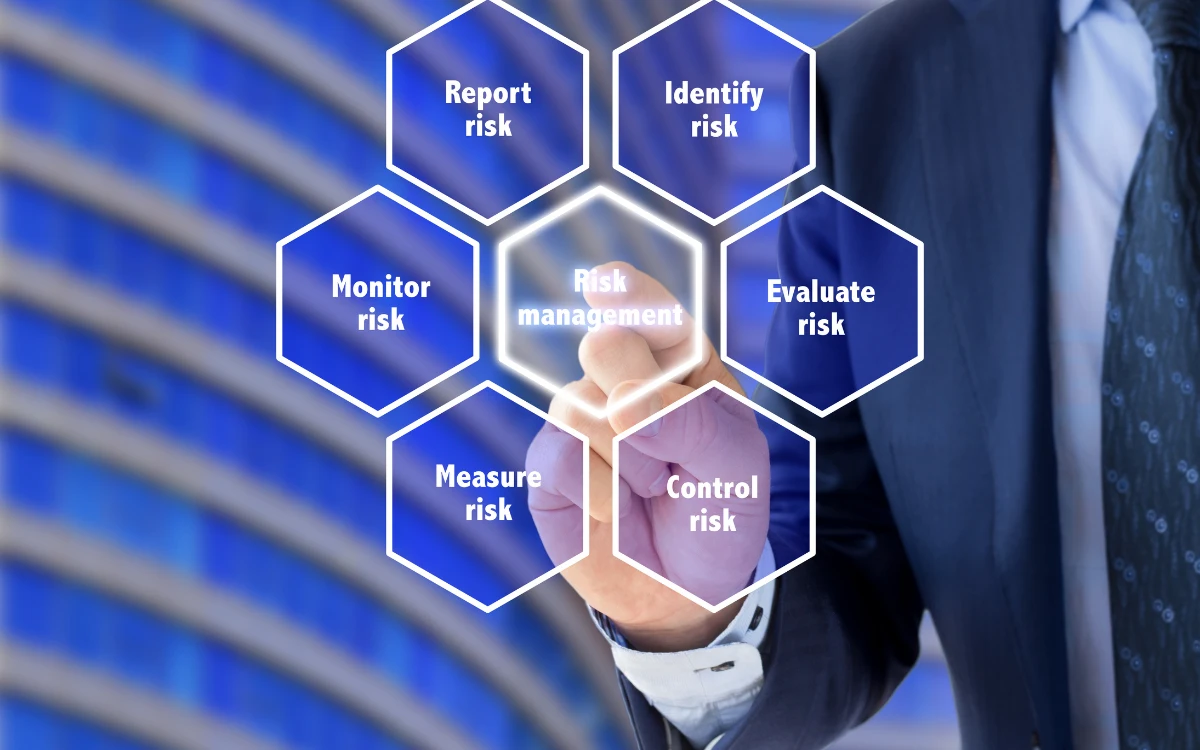
Composite Risk Management is a structured method for identifying hazards, assessing likelihood and impact, selecting controls, implementing actions, and monitoring results. In organisations, it connects risk decisions with operational objectives, employee capability, resource allocation, compliance requirements, business continuity, and measurable performance outcomes.
Composite Risk Management (CRM) is a systematic approach to recognising and controlling risks before they create operational, financial, safety, compliance, or reputational consequences. The method creates a consistent decision process rather than relying on individual judgement.
The composite risk management meaning becomes clearer when viewed through a workplace context. A business identifies an activity, examines what can go wrong, assesses the seriousness of the outcome, determines how likely the event is, and establishes controls that reduce exposure.
CRM applies to routine operations and complex projects. Examples include implementing new software, managing construction activities, operating healthcare facilities, protecting financial data, transporting goods, and introducing new manufacturing equipment.
The approach also supports workforce development. Employees need the ability to recognise hazards, interpret risk information, apply controls, communicate escalation requirements, and review whether controls actually work. These capabilities form part of professional risk management training.
For HR and L&D teams, CRM therefore represents both a management framework and a competency area. Training translates the framework into observable workplace behaviours. Assessments then determine whether employees can apply risk principles to realistic business situations.
The business impact extends beyond risk reduction. Consistent risk decisions improve resource allocation because managers can prioritise controls according to exposure. They also create stronger accountability because risk ownership, mitigation actions, and review responsibilities become explicit.
How does Composite Risk Management work in a corporate environment?
Composite Risk Management works through a repeatable sequence: identify hazards, assess initial risk, develop controls, determine residual risk, implement controls, supervise execution, and review outcomes. Corporate training converts each stage into practical decisions employees apply within actual operational environments.
The first stage identifies the activity and its associated hazards. A hazard is a condition, action, substance, process, or situation that can cause harm or loss. Examples include equipment failure, cyber vulnerabilities, unsafe procedures, supplier disruption, and regulatory non-compliance.
The second stage evaluates the initial risk. Risk represents the relationship between the probability of an unwanted event and the consequences that result from it. Organisations normally assess likelihood and impact using defined scales.
The third stage establishes controls. Controls are measures designed to eliminate hazards or reduce their likelihood or consequences. Examples include engineering controls, process changes, employee training, access restrictions, quality checks, protective equipment, and contingency arrangements.
The fourth stage determines residual risk. Residual risk is the level of exposure that remains after controls are applied. This distinction is important because implementing a control does not automatically eliminate the underlying risk.
The fifth stage involves implementation. Managers assign responsibilities, allocate resources, establish deadlines, communicate procedures, and monitor execution. Risk management becomes operational when controls appear in daily workflows rather than remaining inside a policy document.
The sixth stage involves supervision and review. Teams collect evidence about incidents, near misses, control performance, audit findings, process deviations, and operational KPIs. The results establish whether the controls achieve their intended purpose.
Training programmes mirror this sequence. A workshop introduces the methodology. Case-based exercises demonstrate application. Simulations reproduce operational decisions. Role play develops communication and escalation skills. Assessments test whether participants can identify, score, control, and review risk independently.
A structured programme also begins with employee skill-gap analysis. L&D professionals examine existing competency levels before defining learning objectives. This prevents generic training from being delivered to employees whose responsibilities require different risk capabilities.
Delivery can use classroom workshops, online modules, facilitated case studies, virtual simulations, or hybrid learning. The format depends on workforce location, role complexity, operational risk, and the amount of practical application required.
What does a Composite Risk Management chart show?
A composite risk management chart represents the movement from hazard identification to risk assessment, control selection, residual-risk evaluation, implementation, supervision, and review. It gives teams a shared visual structure for making consistent risk decisions across business activities and operational contexts.
A composite risk management chart normally illustrates the relationship between the stages of the methodology. Its purpose is not simply visual presentation. It creates a common decision language for employees, supervisors, managers, and risk professionals.
The chart begins with identifying hazards. Each hazard is connected to a potential unwanted outcome. The team then evaluates likelihood and impact using the organisation's approved criteria.
The next stage connects the assessment to a risk level. A risk matrix frequently provides this visual relationship. For example, a five-level likelihood scale combined with a five-level consequence scale creates 25 possible assessment combinations.
The chart then moves towards control selection. Controls address the causes or consequences identified during assessment. Strong controls target the source of the risk rather than depending entirely on employee behaviour.
The resulting risk level is reassessed after controls are selected. This creates the residual-risk assessment. Managers then compare the residual exposure with the organisation's risk tolerance and decision authority.
The final part of the chart represents implementation, supervision, and review. This ensures that risk management does not stop when a risk score is recorded.
For corporate learning, the chart functions as a practical learning aid. Trainers can provide a workplace scenario and ask participants to move through each stage. Employees then learn the relationship between assessment, control decisions, accountability, and business outcomes.
The chart also supports standardisation. A finance team, engineering team, and IT team can use the same underlying process while applying different hazards and controls to their respective environments.
How does a risk matrix support Composite Risk Management decisions?
A risk matrix converts likelihood and impact assessments into a defined risk level. It helps teams prioritise exposure, compare hazards consistently, determine control requirements, establish escalation thresholds, and communicate decisions using shared criteria across departments, projects, and operational activities.
A risk matrix is a decision-support tool that combines two dimensions: likelihood and impact. Likelihood describes the probability or frequency of an event. Impact describes the severity of its consequences.
A common corporate model uses five likelihood levels and five impact levels. The resulting matrix contains 25 assessment cells. Each cell represents a defined combination of probability and consequence.
The organisation assigns risk categories to those combinations. A low-likelihood, low-impact event receives a different classification from a high-likelihood, high-impact event.
The value of the matrix depends on consistent definitions. Employees need clear descriptions for each likelihood and impact level. Without standard criteria, two departments can score the same risk differently.
Training therefore needs to cover scoring methodology rather than simply presenting the matrix. Participants need to examine evidence, distinguish between frequency and severity, identify relevant assumptions, and justify their scores.
For example, a software team assessing a system outage needs to separate the probability of failure from its business consequence. A highly disruptive outage with low probability requires a different response from a minor outage that occurs frequently.
The risk matrix also supports prioritisation. When teams identify 20 hazards, the matrix helps managers determine which exposures require immediate control activity and which require routine monitoring.
The next stage of learning focuses on scoring consistency. A detailed guide to Evaluating likelihood and impact through a risk matrix helps readers move from general awareness of CRM towards the practical evaluation of risk scores.
What components should Composite Risk Management training include?
Effective Composite Risk Management training combines risk concepts, hazard identification, likelihood and impact assessment, risk matrices, control selection, residual-risk evaluation, communication, monitoring, documentation, and performance measurement. Learning activities connect these components with realistic workplace decisions and defined competency outcomes.
The first component is risk terminology. Employees need consistent definitions for hazard, risk, control, likelihood, impact, residual risk, risk owner, risk tolerance, and mitigation.
The second component is hazard identification. Participants examine operational processes and identify conditions that create exposure. Case-based learning helps employees recognise hazards that are not immediately visible.
The third component is risk assessment. Training develops the ability to evaluate likelihood and impact using organisational criteria. Participants practise distinguishing evidence-based assessments from assumptions.
The fourth component is control selection. Employees learn how to choose controls that address specific causes and consequences. Training also examines control effectiveness because a control that exists on paper does not automatically reduce exposure.
The fifth component is residual-risk assessment. Participants reassess exposure after controls are introduced. This develops an understanding of how mitigation changes risk rather than simply documenting mitigation activity.
The sixth component is risk communication. Managers need to communicate risk information to executives, operational teams, suppliers, auditors, and other stakeholders. Role play develops escalation, reporting, and decision-making behaviours.
The seventh component is monitoring. Participants learn to connect risk controls with indicators such as incident frequency, control completion rates, audit findings, downtime, compliance deviations, and corrective-action closure rates.
The eighth component is assessment. Knowledge tests measure conceptual understanding. Practical assessments measure application. Scenario exercises measure whether employees can make defensible risk decisions under realistic conditions.
Training duration depends on scope. A focused awareness programme can use short online modules. A role-specific programme requires workshops and assessments. Advanced programmes require simulations, case analysis, practical exercises, and workplace projects.
How do organisations implement Composite Risk Management training effectively?
Organisations implement Composite Risk Management training by defining business risks, mapping employee skill gaps, setting competency objectives, selecting delivery methods, practising workplace scenarios, assessing performance, and measuring post-training application through operational KPIs, control effectiveness, compliance, and productivity indicators.
Implementation begins with a business needs analysis. HR, L&D, risk, compliance, and operational leaders identify the risks that employees need to manage.
The organisation then maps roles against required competencies. A frontline employee does not require the same depth of risk analysis as a project manager, department head, internal auditor, or senior risk professional.
Learning objectives are then defined in observable terms. Instead of stating that employees will "understand risk", an objective specifies that participants will identify hazards, score likelihood and impact, select controls, calculate residual exposure, and document decisions.
Delivery methods are selected according to the learning objective. Online modules suit terminology and foundational concepts. Workshops suit discussion and case analysis. Simulations suit complex decision-making. Hybrid learning combines knowledge acquisition with facilitated practice.
Real organisational scenarios increase relevance. A finance department can assess payment fraud. An IT team can analyse data-access risks. A healthcare organisation can examine patient-safety hazards. A manufacturing team can evaluate equipment and process risks.
Assessment follows learning activities. Pre-training assessments establish baseline competency. Practical exercises measure application during training. Post-training assessments measure knowledge retention and decision quality.
Workplace transfer is the critical implementation stage. Managers observe whether employees use the CRM process during meetings, project planning, incident reviews, audits, and operational decisions.
L&D teams then measure outcomes. Useful indicators include training completion, assessment scores, control implementation rates, incident frequency, audit non-conformities, corrective-action closure time, operational downtime, and risk-review completion.
ROI analysis connects training costs with measurable business outcomes. For example, an organisation can compare training expenditure against reductions in avoidable incidents, downtime, rework, compliance failures, or operational losses.
What benefits does Composite Risk Management create for organisations and teams?
Composite Risk Management improves organisational consistency by giving teams a common risk language, structured assessment method, defined control responsibilities, and measurable review process. Its organisational value appears through stronger decision quality, faster escalation, improved compliance, operational resilience, and better resource prioritisation.
The first organisational benefit is decision consistency. Employees use the same assessment logic instead of applying unrelated personal interpretations.
The second benefit is stronger accountability. Risk ownership becomes explicit because managers assign responsibility for controls, monitoring, and corrective actions.
The third benefit is improved operational efficiency. Early identification of hazards reduces disruption caused by avoidable failures. Teams spend resources on prioritised exposures rather than treating every risk as equally urgent.
The fourth benefit is improved compliance. Structured risk assessment creates evidence that organisations identify hazards, apply controls, and review effectiveness. This supports internal governance and external audit requirements.
The fifth benefit is workforce capability. Employees develop transferable competencies in analytical thinking, decision-making, communication, problem-solving, and operational control.
The sixth benefit is leadership development. Managers learn to evaluate exposure, balance operational objectives with risk tolerance, allocate resources, and communicate decisions. These capabilities contribute to a stronger leadership pipeline.
The seventh benefit is organisational resilience. Teams that regularly identify and control operational exposure are better positioned to respond to disruption. Business continuity becomes connected with everyday risk management rather than treated as a separate activity.
The impact becomes measurable when organisations establish baseline and post-training indicators. A department can compare incident rates, control completion, audit findings, downtime, and corrective-action closure before and after implementation.
Explore More Expert Insights:
QA Engineer Skills in 2026: The Complete Competency Checklist
What Is the Best Way to Ensure Quality? Proven Approaches
Where can Composite Risk Management be applied across corporate teams and industries?
Composite Risk Management applies wherever organisations face identifiable operational exposure. Corporate applications include IT security, finance, healthcare, manufacturing, construction, logistics, procurement, facilities, engineering, and project management, with each function adapting hazards, controls, scoring criteria, and performance measures.
Project teams use CRM to assess schedule, resource, supplier, technical, safety, and delivery risks. Managers integrate assessments into project planning and review meetings.
IT departments apply the methodology to cybersecurity, system availability, data access, software deployment, infrastructure, and third-party technology risks.
Finance teams apply it to fraud exposure, payment processes, credit controls, financial reporting, and regulatory obligations.
Healthcare organisations use risk assessment for patient safety, clinical processes, infection control, equipment, staffing, and facility operations.
Manufacturing teams assess machinery, production processes, maintenance, quality, supply chains, and workplace safety. Controls then become part of standard operating procedures.
Procurement teams evaluate supplier dependency, contract performance, delivery disruption, quality failures, and financial exposure.
Facilities teams assess building systems, maintenance activities, energy infrastructure, emergency procedures, contractors, and critical assets.
Human resources and L&D teams also use CRM principles when implementing workforce programmes. Training projects involve risks related to compliance, operational disruption, data security, adoption, and competency gaps.
The training approach changes according to role and industry. A technical team requires technical scenarios. Senior managers require strategic risk decisions. Operational employees require practical control application.
This industry relevance prevents training from becoming a generic theoretical exercise. Employees work with situations that resemble the conditions in which they make decisions.
What common problems reduce the effectiveness of Composite Risk Management training?
Composite Risk Management training loses effectiveness when programmes rely on generic content, theoretical explanations, inconsistent scoring criteria, weak assessments, limited workplace practice, poor management involvement, or missing performance measures that prevent organisations from connecting learning with operational results.
One common problem is generic training. A standard presentation does not address the different risks faced by a bank, manufacturer, hospital, or technology company.
Another problem is excessive focus on terminology. Employees can memorise definitions without demonstrating practical competence. Scenario-based assessment provides stronger evidence of capability.
Inconsistent scoring creates another problem. When departments interpret likelihood and impact differently, risk rankings become unreliable. Standard definitions and calibration exercises improve consistency.
Weak control selection also reduces effectiveness. Teams sometimes document controls without assessing whether those controls address the actual cause of the risk.
Training without workplace application creates another gap. Employees need opportunities to apply CRM during projects, audits, operational reviews, and incident investigations.
Lack of management involvement limits transfer. Managers need to reinforce the methodology through meetings, approvals, performance reviews, and operational decisions.
The absence of KPIs creates an ROI problem. Completion rates alone demonstrate participation, not business impact. Organisations need indicators that measure competency and operational change.
Effective programmes therefore connect learning objectives with business requirements. Practical exercises reproduce real engineering, operational, financial, technical, or managerial conditions. Assessments measure observable competency. Post-training metrics demonstrate whether the organisation achieved measurable risk improvement.