
What does becoming a tour guide involve in a professional tourism environment?
Becoming a tour guide involves developing destination knowledge, communication skills, customer service, cultural awareness, safety practices, and operational skills required to lead visitors effectively while meeting tourism, legal, and organisational standards.
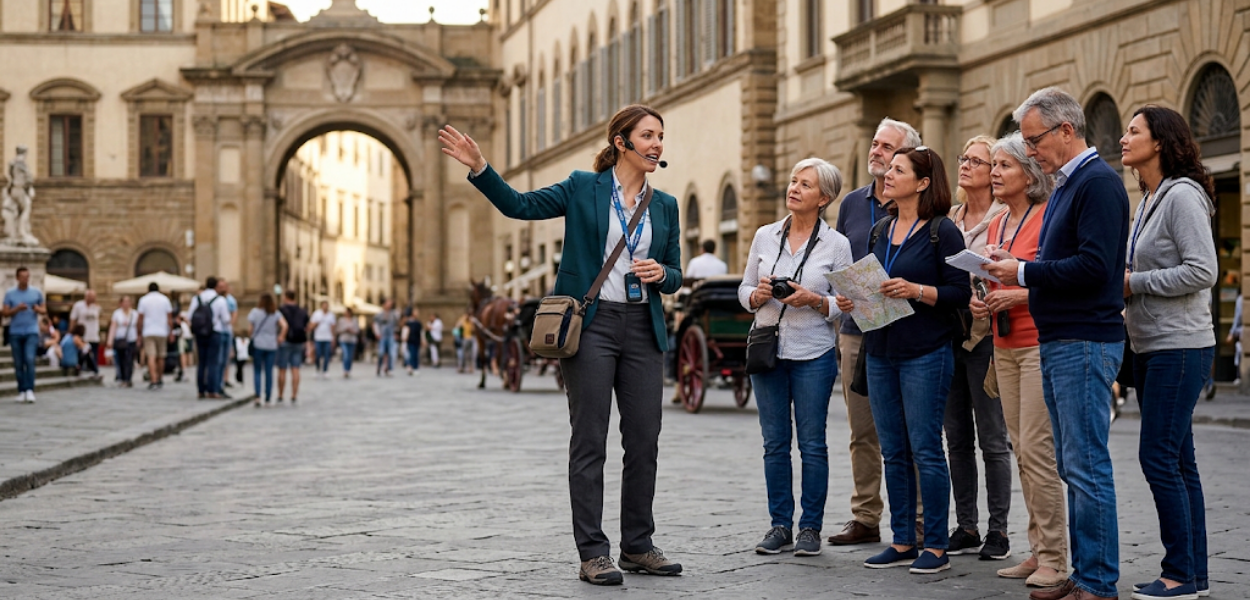
A tour guide is a professional who leads visitors through destinations, attractions, cultural sites, natural environments, museums, events, or organised travel experiences. The role combines knowledge delivery with visitor management, communication, scheduling, safety, and service quality.
In a business environment, tour guiding is part of the wider tourism and hospitality service chain. Tour operators, hotels, destination management companies, museums, cruise operators, travel agencies, and event organisations depend on guides to deliver consistent visitor experiences.
The role therefore requires more than memorising facts about destinations. A professional tour guide interprets information for different audiences, manages groups, handles questions, follows schedules, responds to operational problems, and maintains professional conduct.
Organisations assess these capabilities through practical indicators. Examples include visitor satisfaction scores, complaint rates, punctuality, repeat bookings, safety incidents, customer reviews, and adherence to planned itineraries.
Training provides a structured way to close gaps between existing employee capabilities and the standards required for professional guiding. It also creates consistent service practices across teams operating in different destinations.
Which skills do organisations need when developing professional tour guides?
Professional tour guides need destination knowledge, public speaking, interpersonal communication, customer service, cultural competence, group management, problem-solving, time management, safety awareness, and digital skills supported by practical assessment.
Destination knowledge forms the foundation of guiding. It includes local history, geography, architecture, culture, traditions, attractions, transport systems, and relevant regulations. Guides need accurate information and must distinguish verified facts from assumptions or unsupported claims.
Communication skills determine how effectively information reaches visitors. A guide needs clear speech, appropriate vocabulary, active listening, questioning techniques, and audience adaptation. Groups such as families, corporate travellers, international tourists, school groups, and specialist visitors require different communication approaches.
Customer service skills are equally important. Guides interact directly with customers and represent the service standards of the organisation. Training therefore covers professional etiquette, complaint handling, service recovery, accessibility awareness, and appropriate responses to difficult situations.
Group management involves controlling movement, maintaining attention, monitoring attendance, and managing different visitor needs. A guide working with 30 people requires different coordination techniques from a guide handling a private group of 4 people.
Cultural competence enables guides to communicate appropriately across different backgrounds. It covers cultural differences, respectful behaviour, local customs, inclusive communication, and avoidance of stereotypes.
Digital capability has also become part of modern guiding. Relevant tools include digital maps, booking systems, mobile communication platforms, translation applications, electronic tickets, visitor management systems, and digital information resources.
How is tour guide training implemented inside organisations?
Organisations implement tour guide training by identifying skill gaps, defining performance standards, selecting delivery methods, providing practical learning, assessing competence, and measuring workplace performance against agreed tourism service KPIs.
The first stage is a skills-gap analysis. This compares the current capability of guides with the standards required for their roles. For example, an organisation can assess communication, destination knowledge, safety procedures, group control, and customer service separately.
The second stage defines learning objectives. Objectives need measurable outcomes. Instead of stating that employees will understand customer service, the objective can require employees to resolve visitor complaints using a defined service-recovery procedure within 5 minutes.
The third stage selects the delivery format. Organisations use classroom workshops, online modules, field-based sessions, hybrid learning, coaching, and supervised practical assignments.
Workshops are useful for communication, customer service, and group-management exercises. Online modules are suitable for destination knowledge, organisational policies, compliance requirements, and theoretical content. Hybrid learning combines digital knowledge development with practical sessions.
The fourth stage uses active learning. Case-based learning presents realistic tourism problems for employees to analyse. Simulations reproduce situations such as delayed transport, lost visitors, overcrowded attractions, or itinerary changes. Role-play allows guides to practise communication and complaint handling.
The fifth stage is assessment. Knowledge tests measure factual understanding. Observation checklists measure practical behaviour. Scenario assessments evaluate decision-making. Supervisors can also evaluate performance during actual tours.
The final stage measures workplace outcomes. Relevant KPIs include visitor satisfaction, customer complaints, punctuality, booking conversion, repeat business, safety incidents, and service-quality ratings.
What should a structured tour guide training programme contain?
A structured programme should combine tourism knowledge, guiding techniques, communication, customer service, cultural awareness, safety, operational procedures, technology, practical simulations, and assessments linked to measurable workplace performance.
Destination and tourism knowledge
Employees learn how destinations operate within the tourism ecosystem. Content covers attractions, historical resources, cultural assets, visitor flows, transportation, accommodation, local services, and destination-specific requirements.
Guiding and interpretation techniques
Guiding techniques explain how professionals convert information into useful visitor experiences. Interpretation means presenting cultural, historical, environmental, or geographical information in a way that connects with a particular audience.
Training can include storytelling structures, questioning techniques, visual explanation, route planning, and audience engagement.
Communication and presentation
Public speaking exercises develop voice control, clarity, structure, pacing, and professional body language. Role-play provides measurable practice because trainers can assess whether a guide communicates information accurately within a defined time.
Customer service and complaint management
Guides learn how to identify customer needs and respond to complaints. Training can use scenarios involving dissatisfaction with schedules, accommodation, transport, attractions, food services, or accessibility.
Safety and risk management
Risk management identifies hazards before and during tours. Examples include extreme weather, overcrowding, traffic, unfamiliar terrain, medical emergencies, and separation from group members.
Guides require clear escalation procedures and knowledge of organisational safety protocols.
Technology and operational tools
Modern guiding uses digital systems for reservations, navigation, communication, ticketing, visitor information, and itinerary management. Training should reflect the actual tools used by the organisation.
Practical assessment
Practical assessment confirms whether employees can apply knowledge under realistic conditions. A field exercise can require a guide to deliver a 20-minute tour segment, manage visitor questions, maintain schedule control, and respond to a simulated disruption.
When organisations are comparing curriculum depth and deciding which learning areas deserve greater emphasis, resources such as tourism course subjects and skills help connect the broader career requirements with specific training content.
How do organisations measure the business impact of tour guide training?
Organisations measure training impact through operational, customer, financial, and workforce KPIs such as satisfaction scores, complaints, punctuality, safety incidents, productivity, repeat bookings, staff retention, and training ROI.
Training ROI means comparing measurable financial benefits with the cost of training. A simple calculation is:
Training ROI = Net Training Benefit ÷ Training Cost × 100
For example, if improved guide performance generates £20,000 in additional measurable benefit from repeat bookings and reduced service costs, while training costs £5,000, the calculated ROI is 300%.
Customer satisfaction is another important indicator. Organisations can compare pre-training and post-training visitor scores. If average satisfaction rises from 78% to 88%, the organisation has a measurable service-quality improvement.
Complaint rates provide another operational measure. A reduction from 12 complaints per 1,000 visitors to 7 complaints represents a 41.7% decrease.
Productivity can be assessed through indicators such as tours completed per guide, itinerary adherence, administrative time, and average group-handling time.
Safety performance should be tracked separately. Organisations can monitor reportable incidents, procedural compliance, emergency response performance, and completion of safety checks.
Employee retention also provides workforce evidence. Consistent development can support career progression and create a stronger internal talent pipeline for senior guiding, operations, destination management, and supervisory roles.
Where can tour guide training be applied across organisations and industries?
Tour guide training applies to tour operators, travel agencies, hotels, museums, heritage organisations, destination companies, cruise businesses, event teams, cultural attractions, and corporate travel operations.
Tour operators use trained guides to deliver scheduled excursions and multi-day travel programmes. Their priorities include itinerary accuracy, customer satisfaction, group control, and service consistency.
Hotels can develop employees who support local experiences, excursions, concierge services, and destination activities. Training helps employees communicate local information accurately while maintaining hospitality standards.
Museums and heritage organisations use guiding and interpretation skills to explain historical and cultural resources. Their teams require strong storytelling, accessibility awareness, and audience-specific communication.
Cruise operators manage large and diverse visitor groups across multiple destinations. Guides require strong coordination, time management, safety awareness, and multilingual communication practices.
Event organisations use related skills when managing conferences, cultural festivals, exhibitions, sporting events, and destination-based programmes. Employees coordinate visitor movement, provide information, and respond to operational changes.
Destination management companies coordinate multiple tourism services. Their employees need knowledge of attractions, suppliers, transportation, schedules, local regulations, and visitor expectations.
Corporate travel departments also use similar competencies when managing executive visits, international delegations, incentive travel, and business events.
These applications demonstrate why guiding skills belong within broader workforce-development strategies rather than being treated as a narrow job-specific capability.
What are the common problems with tour guide training programmes?
Common problems include generic content, insufficient practical assessment, weak connection to workplace KPIs, outdated destination information, limited safety training, inconsistent delivery, and failure to evaluate performance after training.
Generic programmes are one of the main problems. A guide working in a museum has different requirements from one leading adventure tourism groups. Training should reflect the actual operating environment.
Another problem is excessive theoretical learning. Employees can memorise destination information without demonstrating effective guiding behaviour. Practical simulations and supervised tours provide stronger evidence of competence.
Weak measurement also limits organisational value. Attendance does not prove performance improvement. Organisations need before-and-after indicators linked to service quality, productivity, customer satisfaction, and operational performance.
Outdated content creates another risk. Tourism destinations change through new attractions, regulations, transportation arrangements, technology, and visitor-management policies. Training materials require scheduled reviews.
Inconsistent delivery affects service standards. If different trainers teach different approaches to complaints, safety, or visitor communication, customers receive inconsistent experiences.
Training also fails when there is no post-course reinforcement. Supervisory observation, coaching, refresher modules, and periodic assessments help transfer learning into daily work.
How should businesses choose the right professional development approach for tour guides?
Businesses should select training according to role requirements, employee skill gaps, operational risks, delivery needs, assessment requirements, and KPIs rather than choosing programmes based only on course length or theoretical content.
The first consideration is the job profile. Organisations should identify what guides actually do, which decisions they make, and where performance failures occur.
The second consideration is the skill gap. If employees have strong destination knowledge but weak presentation skills, communication and practical delivery should receive greater training attention.
The third consideration is operational risk. Safety-critical roles require stronger practical assessment and supervised application than low-risk informational roles.
The fourth consideration is delivery format. Online learning works well for knowledge-based modules. Workshops support interaction and practice. Field training provides direct observation. Hybrid learning combines these methods into one development pathway.
The fifth consideration is assessment. A programme should specify how competence is measured. Written tests alone are insufficient for roles requiring communication, group management, and real-time decision-making.
The sixth consideration is business measurement. Each learning objective should connect to at least one workplace indicator. This creates a clear relationship between employee development and organisational performance.
A structured Hospitality, Tourism and Events learning pathway can therefore be evaluated according to its coverage of operational knowledge, service delivery, communication, safety, practical application, and measurable outcomes rather than course duration alone.
What career pathways can professional tour guide skills support?
Professional tour guide skills support progression into senior guiding, tour operations, destination management, visitor experience, hospitality supervision, event coordination, travel services, and other tourism-related operational roles.
Tour guiding develops transferable capabilities that organisations use across tourism and hospitality functions.
A guide can progress towards senior guiding responsibilities involving complex itineraries and larger groups. Experienced professionals can also move into tour operations, where they coordinate suppliers, schedules, transportation, accommodation, and customer requirements.
Destination management provides another pathway. Professionals in this area coordinate tourism experiences across attractions, suppliers, public organisations, and local businesses.
Visitor experience roles focus on improving the complete customer journey. Relevant responsibilities include service standards, visitor feedback, accessibility, information delivery, and experience design.
Event coordination uses similar skills in scheduling, communication, visitor management, supplier coordination, and operational problem-solving.
Explore More Expert Insights:
Fleet Controller vs Fleet Manager: Roles and Progression
Green Shipping Technology: How the Maritime Industry Decarbonises
For organisations, these pathways support internal mobility. A structured skills framework allows managers to identify employees ready for additional responsibility and build a measurable workforce-development pipeline.
Professional development therefore needs to address both immediate role performance and the broader capability requirements of the tourism workforce.