
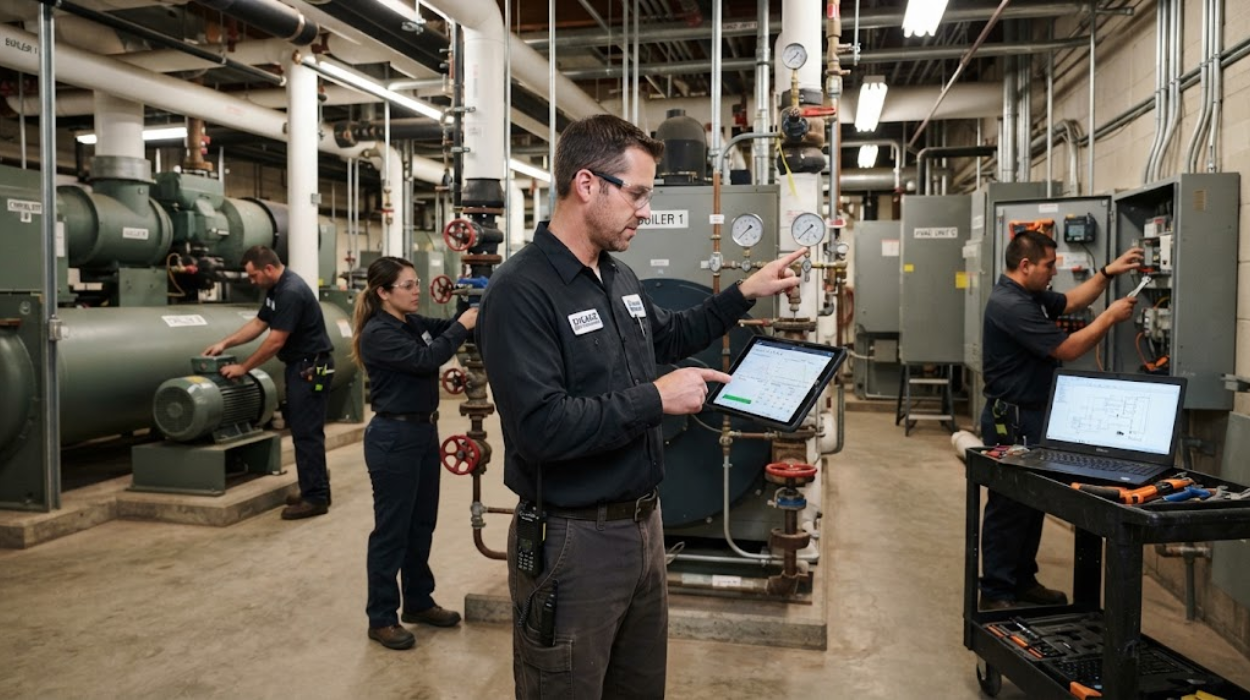
Building maintenance is the planned management of physical assets, systems, equipment, and facilities that support daily business operations. It includes preventive maintenance, predictive maintenance, and corrective maintenance. Each approach controls different operational risks, maintenance costs, equipment failures, and workplace disruptions.
For organisations, maintenance is a workforce capability as well as a technical function. Facilities managers, maintenance engineers, technicians, supervisors, and operations teams need defined procedures, technical knowledge, safety awareness, and performance measures. Effective maintenance programmes connect asset condition with business continuity, workplace safety, energy performance, regulatory compliance, and operational productivity.
What is building maintenance in a corporate environment?
Building maintenance is the systematic inspection, servicing, monitoring, repair, and improvement of facilities and assets to maintain safe, reliable, compliant, and productive workplaces. It covers buildings, electrical systems, HVAC equipment, plumbing, fire protection, lifts, structures, and supporting infrastructure.
Maintenance buildings include the physical spaces and technical systems used by organisations to conduct business. Examples include offices, hospitals, hotels, manufacturing sites, warehouses, schools, data centres, and commercial properties. Each environment has different asset criticality, operating conditions, safety requirements, and maintenance schedules.
A corporate maintenance programme starts with an asset register. The register identifies equipment, location, specifications, operating condition, service history, and criticality. Criticality ranks assets according to their effect on safety, operations, revenue, compliance, and customer service.
Maintenance teams then establish work procedures for inspection, servicing, repair, testing, and reporting. These procedures define responsibilities and establish consistent standards across departments and sites.
The workforce requires practical competencies to execute these activities. Skill gaps in electrical maintenance, mechanical systems, HVAC operation, safety controls, fault diagnosis, documentation, and maintenance planning create operational weaknesses.
Training addresses these gaps through structured learning. Workshops, online modules, hybrid learning, case-based exercises, simulations, role-play, technical demonstrations, and assessments provide different methods for developing maintenance capability.
How do preventive, predictive, and corrective maintenance work?
Preventive maintenance uses planned activities to reduce failure probability, predictive maintenance uses condition data to identify developing faults, and corrective maintenance restores equipment after a defect or failure has occurred. Organisations combine all three according to asset criticality and operating requirements.
Preventive maintenance is performed at planned intervals. A maintenance team services equipment according to time, operating hours, usage levels, manufacturer instructions, or regulatory requirements. Examples include changing air-conditioning filters every 3 months, testing fire alarms monthly, and inspecting electrical panels annually.
Predictive maintenance uses measurable equipment conditions to identify deterioration. Technicians collect information through vibration analysis, thermal imaging, oil analysis, pressure readings, energy monitoring, or sensor data. A change in operating condition triggers investigation before a serious failure occurs.
Corrective maintenance responds to identified defects or failures. The process starts when an inspection, employee report, monitoring system, or operational event identifies a problem. The team diagnoses the fault, isolates hazards, completes the repair, tests the asset, and records the result.
These approaches work as an integrated maintenance strategy. Preventive maintenance controls known deterioration patterns. Predictive maintenance identifies condition-based risks. Corrective maintenance resolves unexpected or unavoidable defects.
The choice depends on asset criticality and failure consequences. A hospital's emergency power system requires tighter controls than a non-critical storage-room light. Maintenance planning therefore connects technical decisions with business priorities.
What are the key components of an effective maintenance programme?
An effective maintenance programme combines asset management, maintenance planning, work-order control, technical competencies, safety procedures, condition monitoring, documentation, performance measurement, and continuous improvement within a defined operational framework.
Asset management provides the foundation. Teams classify equipment according to function, condition, replacement value, operational importance, and failure consequences.
Maintenance planning converts asset information into scheduled activities. Planners define task frequency, labour requirements, spare parts, tools, permits, safety controls, and expected completion times.
Work-order management controls the execution process. A typical work order identifies the asset, problem, priority, assigned technician, required resources, completion status, and maintenance history.
Safety procedures protect employees, contractors, visitors, and assets. Controls include isolation procedures, permit-to-work systems, electrical safety, working-at-height requirements, confined-space controls, fire safety, and personal protective equipment.
Condition monitoring supports predictive maintenance. Data from inspections and sensors provides evidence about asset health and deterioration.
Documentation supports accountability. Maintenance records show what was inspected, what was repaired, which parts were replaced, who completed the work, and when the activity occurred.
Training connects these systems to employee capability. Case-based learning allows employees to analyse realistic maintenance failures. Simulations reproduce technical scenarios without disrupting operational assets. Role-play develops communication between technicians, supervisors, contractors, and facilities managers. Assessments measure whether employees understand procedures and can apply them correctly.
How should organisations implement building maintenance training?
Organisations should begin with a skills and maintenance-gap assessment, define measurable learning objectives, select practical delivery methods, apply workplace-based exercises, assess competence, and measure post-training performance against agreed maintenance KPIs.
The first stage identifies existing capability. HR, L&D, facilities, engineering, and operations leaders review maintenance records, audit findings, incident reports, equipment failures, recurring defects, and employee competency data.
The second stage defines learning requirements. A maintenance engineer requires different technical competencies from an FM supervisor or procurement manager. Learning objectives therefore correspond to job responsibilities.
The third stage selects the delivery format. Workshops suit collaborative problem-solving and technical discussion. Online modules provide structured theoretical learning. Hybrid learning combines digital preparation with instructor-led application. On-site sessions provide direct exposure to workplace systems.
The fourth stage applies practical methodologies. Employees analyse maintenance case studies, complete fault-diagnosis exercises, participate in simulations, and practise maintenance planning. Assessments then test technical understanding and decision-making.
The fifth stage transfers learning into workplace procedures. Employees apply inspection schedules, work-order processes, risk controls, condition-monitoring techniques, and reporting standards within their operational environment.
The sixth stage measures results. L&D teams compare relevant KPIs before and after training. Useful indicators include planned maintenance compliance, mean time to repair, equipment downtime, repeat failures, maintenance backlog, response time, safety incidents, and maintenance cost per asset.
When organisations move from basic maintenance awareness to structured reliability management, a broader framework becomes relevant. A useful next step is a maintenance and reliability management best-practice framework, because it addresses the transition from individual maintenance activities to a coordinated management approach.
What benefits does structured maintenance training produce for organisations?
Structured maintenance training improves procedural consistency, technical decision-making, safety control, asset reliability, work-order quality, and maintenance planning while giving organisations measurable indicators for evaluating workforce performance and operational efficiency.
Improved technical capability reduces errors during inspection, diagnosis, servicing, and repair. Employees follow defined procedures rather than relying on inconsistent individual practices.
Better planning improves resource allocation. Maintenance teams can schedule labour, tools, spare parts, contractors, and equipment access before work begins.
Safety performance also depends on competence. Employees who understand isolation procedures, risk assessment, permit systems, and emergency controls execute maintenance activities with greater procedural consistency.
Maintenance data improves management decisions. Accurate work orders and asset histories reveal recurring faults, inefficient processes, excessive downtime, and replacement requirements.
Reliability improves when organisations address root causes instead of repeatedly treating symptoms. Root-cause analysis identifies why failures occur and establishes corrective actions that prevent recurrence.
Financial performance is measured through maintenance-related indicators. Organisations can track unplanned downtime, overtime, spare-parts consumption, contractor expenditure, repair frequency, and asset replacement costs.
The workforce also benefits at an organisational level. Clear competency frameworks support role development, succession planning, technical leadership, and internal mobility. L&D teams can connect maintenance competencies with broader workforce development strategies.
Where is building maintenance training applied across organisations?
Building maintenance training applies across facilities, engineering, operations, health and safety, procurement, property management, and leadership teams in industries such as healthcare, hospitality, manufacturing, education, finance, logistics, energy, and commercial real estate.
Facilities teams use maintenance training to manage buildings and technical services. Their responsibilities include planned maintenance, contractor coordination, compliance monitoring, asset records, and service performance.
Engineering teams focus on equipment reliability and technical systems. Their work includes mechanical systems, electrical infrastructure, HVAC, pumps, generators, control systems, and specialised equipment.
Operations teams require maintenance knowledge because equipment availability affects production and service delivery. Manufacturing sites, warehouses, logistics facilities, and data centres depend on reliable infrastructure.
Health and safety teams interact with maintenance activities through risk assessments, safety inspections, incident prevention, and regulatory controls.
Procurement teams also require maintenance knowledge when selecting service providers, spare parts, maintenance contracts, and technical suppliers. Understanding maintenance requirements improves specification and supplier evaluation.
Senior managers use maintenance KPIs to evaluate operational risk and investment priorities. Maintenance performance becomes part of wider business planning when asset failures affect customers, production, revenue, compliance, or reputation.
What common problems reduce the effectiveness of building maintenance?
Common maintenance problems include reactive-only practices, incomplete asset records, inconsistent procedures, insufficient technical skills, weak KPI measurement, poor contractor control, inadequate documentation, and training programmes that lack practical workplace application.
Reactive-only maintenance creates operational pressure. Teams respond after failures instead of controlling predictable deterioration. This approach increases emergency work, downtime, overtime, and disruption.
Incomplete asset records weaken planning. Without accurate information about equipment condition, service history, and criticality, managers cannot establish reliable maintenance priorities.
Generic training creates another problem. A programme that ignores organisational assets, job responsibilities, safety procedures, and operational conditions does not address actual competency gaps.
Training without assessment also limits accountability. Attendance does not demonstrate competence. Organisations need assessments, practical exercises, workplace observations, and KPI comparisons to establish whether learning transferred into performance.
Weak KPI selection creates misleading conclusions. Counting completed training hours does not show maintenance improvement. Operational indicators such as downtime, repeat failures, planned-maintenance compliance, and mean time to repair provide stronger evidence.
Poor contractor management introduces additional risk. Organisations need clear scopes, competency requirements, safety expectations, service-level measures, reporting standards, and performance reviews.
The solution begins with alignment between workforce capability and maintenance objectives. L&D teams, facilities managers, engineering leaders, HR professionals, and business decision-makers need a shared definition of competence and measurable performance.
How can organisations measure maintenance training outcomes?
Maintenance training outcomes should be measured through competency assessments and operational KPIs, including maintenance compliance, downtime, repair time, repeat failures, backlog, safety performance, cost efficiency, and workforce productivity.
The first measurement level is learning. Assessments determine whether employees understand maintenance principles, procedures, terminology, safety controls, and decision-making frameworks.
The second level is application. Supervisors observe whether employees apply inspection procedures, work-order standards, fault-diagnosis methods, and safety controls correctly.
The third level is operational performance. Organisations compare KPIs before and after implementation. For example, planned maintenance compliance can be measured as the percentage of scheduled tasks completed within the defined period.
Mean time to repair measures the average time required to restore an asset after failure. Repeat failure rates identify assets that experience recurring problems after maintenance.
Maintenance backlog measures outstanding work. A persistent backlog indicates insufficient capacity, weak prioritisation, poor planning, or ineffective resource allocation.
Training ROI connects financial investment with measurable operational results. Organisations compare training costs with quantifiable improvements such as reduced downtime, lower emergency repair expenditure, fewer repeat failures, and improved productivity.
The strongest measurement approach combines learning evidence with operational evidence. This creates a direct connection between employee capability, maintenance execution, asset reliability, and business performance.
How does maintenance training support long-term workforce development?
Maintenance training supports workforce development by establishing technical competency frameworks, standardising operational knowledge, strengthening supervisory capability, supporting succession planning, and creating measurable development pathways for facilities and engineering teams.
A competency framework defines the knowledge and skills required for each maintenance role. Technical competencies can include electrical systems, mechanical maintenance, HVAC, asset management, safety, diagnostics, and maintenance planning.
Supervisory competencies include scheduling, resource allocation, contractor management, reporting, communication, risk control, and KPI analysis. Leadership capability becomes important when maintenance teams operate across multiple sites or departments.
Standardised learning reduces knowledge variation between employees and locations. Organisations can use common procedures, assessments, and performance standards across facilities.
Succession planning also benefits from structured competency data. Managers can identify employees who demonstrate readiness for higher technical or supervisory responsibilities.
Explore More Expert Insights:
FM Tender Review: Roles, Competencies and Evaluation Criteria
Health and Safety in Facilities Management: Duties and Standards
Long-term development requires continuous assessment. Maintenance technologies, monitoring systems, energy requirements, regulatory expectations, and organisational assets change over time. Training programmes therefore need regular review against operational requirements.
A practical corporate approach connects learning design with maintenance strategy. The result is a workforce that understands not only how to complete maintenance tasks, but also how those tasks influence reliability, safety, cost, compliance, and business continuity.