
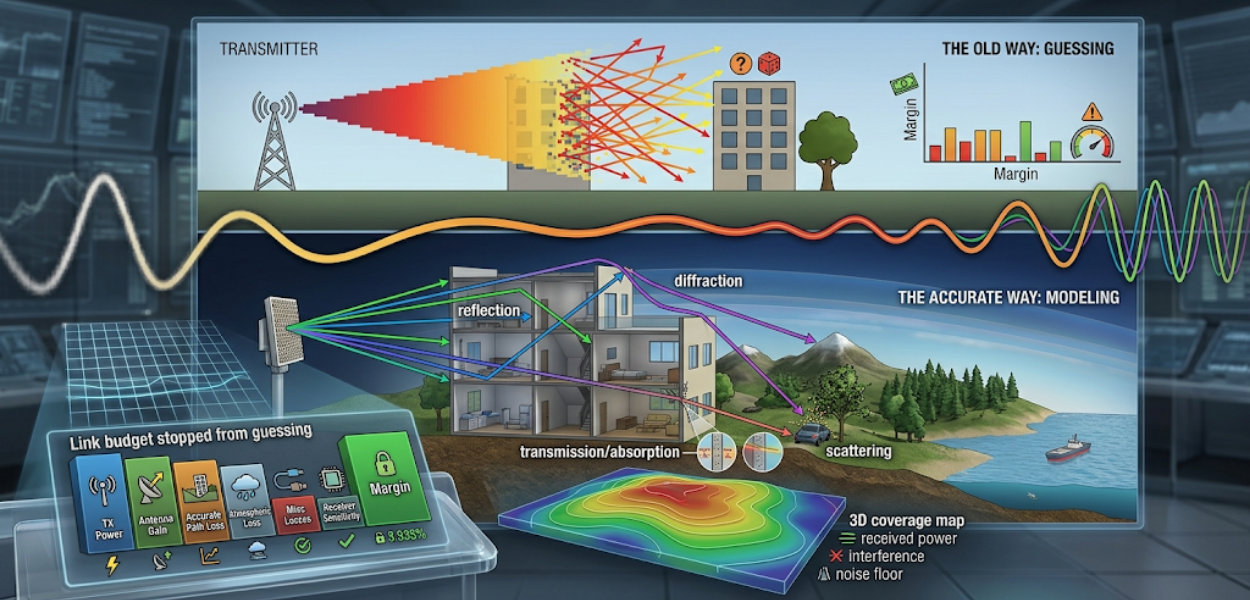
What is the course and what problem does it solve?
This course addresses a specific technical gap: engineers and technicians who calculate link budgets from rule-of-thumb assumptions rather than validated propagation models, producing unreliable network performance predictions. The British Academy for Training and Development designed this programme to close that gap through structured, specification-based instruction.
Radio frequency planning depends on accurate prediction of how signals travel between transmitter and receiver. When link budgets are built on approximations rather than sound electromagnetic theory, the consequences appear later: dropped coverage, unexpected interference, and redesign costs. Many technical teams inherit spreadsheet templates without understanding the physics behind the numbers. This creates a recurring workplace problem — decisions get made on inherited assumptions rather than first-principles calculation.
Readers who have already reviewed foundational theory through the Electromagnetic Propagation Theory and Modelling Training Courses article will recognise this course as the applied, decision-stage extension of that groundwork. Where the earlier article introduces concepts, this programme trains participants to apply them under real project constraints.
The course sits within the British Academy for Training and Development's wider Information Technology and Programming Courses portfolio. It is built for engineers, network planners, and technical leads who need to justify design decisions with calculation rather than convention. Organisations enrol staff in this course when link-budget errors have already caused measurable operational cost, or when a technical team is being upskilled ahead of a network expansion.
Why is the course structured this way?
The curriculum follows a deliberate sequence: physical principles first, propagation mechanisms second, calculation methods third, and applied link-budget scenarios last, so participants build calculation confidence on a verified theoretical base. This sequencing reflects how the British Academy for Training and Development structures all of its technical programmes.
Skipping foundational theory to reach calculation shortcuts produces technicians who can operate software tools but cannot diagnose why a prediction is wrong. This course avoids that shortcut. Participants begin with Maxwell's equations as the governing framework for electromagnetic wave behaviour, because every subsequent propagation mechanism — reflection, refraction, diffraction — derives from that same physical basis.
Once the theoretical grounding is established, the course introduces free space path loss as the baseline model, then layers in real-world deviations: multipath interference, terrain obstruction, and atmospheric refraction. Each module builds directly on the one before it. This progression mirrors the logic covered in the Electromagnetic Propagation: Fresnel Zones, Diffraction and Terrain Obstruction Explained article, which readers evaluating course structure and depth are encouraged to review before enrolling.
The final module sequence addresses Fresnel zone clearance calculations and wave polarisation effects, both of which directly affect link margin. Participants who understand these mechanisms in sequence, rather than as isolated facts, are able to trace an unexpected link performance result back to its physical cause. This diagnostic capability is the stated outcome of the British Academy for Training and Development's design approach.
What will participants learn?
Participants gain measurable competency across four skill areas: electromagnetic theory application, propagation loss calculation, obstruction and interference analysis, and link budget construction with documented assumptions. Each area maps to a distinct module within the British Academy for Training and Development curriculum.
Module 1: Electromagnetic Theory Foundations. Participants review Maxwell's equations in applied form, focused on how they govern wave propagation rather than abstract field theory. This module establishes the vocabulary and mathematical basis used throughout the remainder of the course.
Module 2: Free Space Path Loss and Deviation Factors. Participants calculate baseline path loss and then identify which environmental factors — terrain, foliage, structures, atmospheric conditions — will cause real-world results to diverge from the free space model. This module also introduces refraction and how atmospheric conditions bend signal paths over distance.
Module 3: Multipath and Fresnel Zone Analysis. Participants learn to calculate Fresnel zone clearance requirements and assess multipath risk along a given link path. This module includes terrain profile analysis, a skill directly applicable to fixed wireless and point-to-point link planning.
Module 4: Wave Polarisation and Link Optimisation. Participants examine how polarisation choice affects interference rejection and signal integrity, then apply this knowledge to optimise antenna orientation and configuration decisions.
Module 5: Applied Link Budget Construction. Participants build complete link budgets from scratch, documenting every assumption and calculation input. This module is assessed through a practical simulation exercise rather than a written test.
A network operations manager, for example, might send a team of four field engineers through this course ahead of a rural broadband rollout. On completion, those engineers are expected to independently validate vendor-supplied coverage predictions rather than accepting them without technical review. This is the kind of workplace application the British Academy for Training and Development designs its technical courses to support.
How is the course delivered?
Training is delivered through a hybrid format combining structured online modules with live instructor-led sessions, supported by simulation-based practical exercises and downloadable calculation templates. The British Academy for Training and Development offers this format to accommodate both individual professionals and organisational cohorts.
Online modules cover the theoretical content — electromagnetic principles, propagation mechanisms, and calculation methodology — allowing participants to progress at a controlled pace before live sessions. Live instructor-led sessions focus on applied problem-solving: reviewing calculation errors, working through terrain-based case studies, and answering technical questions specific to participants' own project contexts.
The course duration is structured across five weeks, with each module allocated one week for content review and exercise completion. Organisations enrolling multiple staff can request onsite delivery for the live session component, which allows instructors to work directly with a team's existing project data during the applied modules.
Corporate cohorts, such as an entire radio frequency planning department, typically complete the course together on a shared schedule. This allows the applied link-budget module to be built around a live or recent project from that department, increasing the direct transferability of the training to ongoing work. The British Academy for Training and Development supports this kind of cohort customisation as a standard part of corporate enrolment.
What results can be expected?
Participants demonstrate independent link-budget construction competency by course completion, verified through a graded practical simulation, with organisations typically reporting reduced design revision cycles on subsequent projects. This outcome reflects the applied, calculation-focused structure the British Academy for Training and Development built into the course.
The most direct measurable outcome is calculation accuracy. Participants who previously relied on default software assumptions are assessed on their ability to identify when a model's default parameters do not fit a given terrain or environment, and to adjust the calculation accordingly. This shifts a technician's role from tool operator to technical validator.
A second outcome concerns documentation quality. Because the applied module requires participants to document every assumption in their link budget, teams that complete this training as a group tend to produce more consistent, auditable design documentation across projects. This matters for organisations that need to justify network design decisions to regulators, clients, or internal review boards.
A third outcome is diagnostic speed. Engineers trained to trace propagation issues back to their physical cause — whether that is Fresnel zone obstruction, multipath interference, or polarisation mismatch — typically resolve unexpected performance issues faster than those working from empirical trial and error. For a network operations team, this translates into fewer field visits and shorter fault resolution timelines.
Organisations that have sent leadership or senior engineering staff through the British Academy for Training and Development's technical programmes report that this diagnostic capability also improves internal knowledge transfer, since trained staff are better equipped to explain design decisions to newer team members.
How does enrolment work?
Enrolment requires a foundational understanding of basic electrical and wave theory, completed either through prior technical education or the academy's preparatory materials, followed by registration through the course platform and cohort scheduling. The British Academy for Training and Development manages this process directly.
Individual professionals can register independently, selecting from scheduled cohort start dates published on the course platform. Corporate applicants — HR teams enrolling technical departments, or engineering managers enrolling their own staff — can request a dedicated cohort with a start date aligned to project timelines.
Entry does not require a formal engineering qualification, but participants without prior exposure to wave theory are advised to complete the academy's introductory materials before starting Module 1, since the course assumes basic familiarity with electromagnetic concepts. This eligibility standard keeps the course focused on applied calculation rather than remedial theory.
On completion of all five modules and the graded practical simulation, participants receive a certificate of completion from the British Academy for Training and Development, documenting the specific competencies assessed. HR teams building technical training records for compliance or promotion pathways can use this certification as a documented skill milestone.
Explore More Expert Insights:
Master RF Circuit and System Design with The British Academy for Training and Development in London and Dubai
Optimise Wireless Communication Systems That Hold Performance Under Real Network Load
Organisations that regularly deploy engineering staff into radio frequency planning roles can also establish a recurring enrolment arrangement, allowing new hires or promoted staff to complete this course as part of a standard onboarding pathway rather than as a one-off training event. Technical leads or HR representatives ready to proceed can apply for course access through the Information Technology and Programming Courses page.