
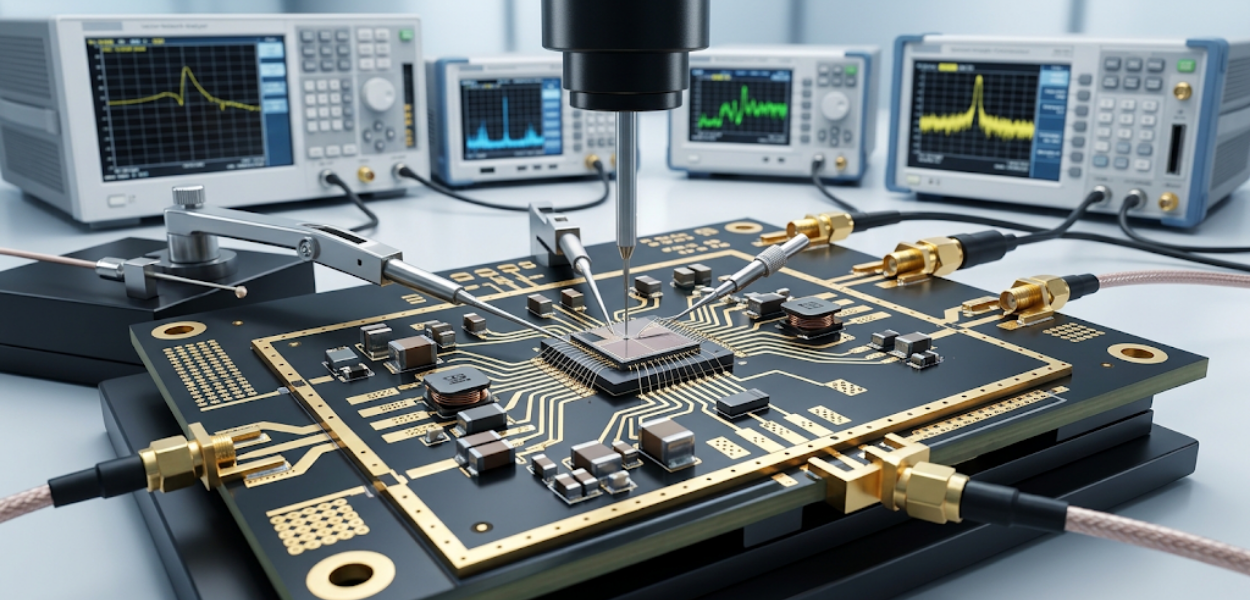
RF circuit and system design is the structured process of designing, analysing, testing, and optimising radio-frequency electronic systems. In corporate environments, this capability supports wireless communications, telecommunications, aerospace, defence, automotive electronics, satellite systems, medical devices, and industrial connectivity.
For organisations, RF design training addresses technical skill gaps that affect product development, system reliability, testing accuracy, and engineering productivity. Employees learn how circuit-level decisions influence complete RF systems. The training connects theoretical principles with practical design workflows, measurement methods, simulation techniques, and engineering performance requirements.
Why do organisations need RF circuit and system design skills?
Organisations need RF design skills to reduce engineering errors, improve wireless system performance, shorten development cycles, and build consistent technical capabilities across engineering, testing, research, and product development teams.
RF systems operate across high-frequency electrical environments where small design errors affect signal quality, impedance matching, gain, noise, and power efficiency. Engineers therefore require a structured understanding of how individual RF components interact within complete systems.
A corporate skills gap often appears when engineers understand individual components but lack system-level design knowledge. For example, an engineer can understand an amplifier while lacking practical experience with cascaded gain, noise figure, impedance matching, transmission lines, and measurement interpretation.
Training addresses this gap by connecting circuit theory with system implementation. It establishes a common technical framework for engineers working across research and development, product engineering, testing, manufacturing, quality assurance, and technical management.
The business impact is measurable through indicators such as design iteration time, prototype failure rates, testing efficiency, first-pass success rates, development costs, and product performance against technical specifications.
How does RF circuit and system design training work in corporate environments?
Corporate RF training follows a structured sequence covering fundamentals, circuit analysis, system modelling, simulation, measurement, practical exercises, assessment, and workplace application against defined engineering requirements and performance indicators.
The process starts with a skills-gap assessment. L and D teams and technical managers identify existing knowledge across areas such as RF fundamentals, circuit analysis, measurement equipment, simulation software, transmission lines, and system architecture.
Training objectives then connect directly to workplace responsibilities. A research team developing wireless hardware requires deeper design and simulation capability. A testing team requires stronger measurement and troubleshooting skills. A technical manager requires system-level understanding for reviewing engineering decisions.
Delivery can use instructor-led workshops, online modules, practical laboratories, hybrid learning, simulations, and case-based exercises. Each format serves a different learning requirement.
Workshops provide direct technical explanation and guided problem-solving. Online modules provide structured theory and repeatable learning. Hybrid learning combines technical instruction with practical exercises. Simulations allow employees to test circuit behaviour without immediately building physical prototypes.
Assessment should measure applied competence rather than simple knowledge recall. Suitable measures include design exercises, calculation accuracy, simulation results, measurement interpretation, troubleshooting tasks, and technical assessments.
The implementation cycle normally follows five stages:
Stage 1: Skills assessment
The organisation identifies current competencies and technical gaps across relevant roles.
Stage 2: Learning design
Training content is mapped to engineering responsibilities, product requirements, and expected technical outcomes.
Stage 3: Practical delivery
Employees work through calculations, simulations, circuit examples, measurement scenarios, and system-level cases.
Stage 4: Workplace application
Learners apply the methods to real engineering tasks, product development activities, testing processes, or system reviews.
Stage 5: Performance measurement
Managers compare technical performance indicators before and after training, including error rates, development time, testing efficiency, and design quality.
Which technical components should RF circuit and system design training include?
Effective RF training combines S-parameters, impedance matching, Smith charts, amplifiers, mixers, transmission lines, VSWR, noise, gain, frequency response, simulation, measurement, and system-level design methods.
S-parameters describe how RF networks respond to incident and reflected signals. They provide engineers with a practical framework for analysing input reflection, output reflection, forward transmission, and reverse transmission.
The Smith chart is a graphical tool used to analyse complex impedance and admittance relationships. Engineers use it for impedance matching, transmission-line analysis, and visualising changes caused by reactive components.
A low noise amplifier is an RF amplifier designed to increase signal strength while adding minimal noise. It is particularly important at the receiving stage of communication systems where weak signals require amplification without significantly degrading signal quality.
Mixers combine or translate frequencies. They support frequency conversion in receivers, transmitters, radar systems, satellite communications, and other RF architectures.
Transmission lines carry high-frequency signals between components. Their electrical behaviour differs from simple low-frequency wiring because impedance, reflections, propagation delay, and signal wavelength become important.
VSWR, or Voltage Standing Wave Ratio, indicates the relationship between forward and reflected waves on a transmission line. A high VSWR indicates greater impedance mismatch and increased reflected power.
Training also needs to connect these components. Engineers should understand how a transmission line affects an amplifier input, how impedance matching influences power transfer, and how component selection affects complete system performance.
How are RF design tools and methods applied to workplace projects?
RF design methods are applied through specification analysis, architecture development, component selection, circuit modelling, simulation, prototype testing, measurement, troubleshooting, optimisation, and final verification against defined system requirements.
A typical workplace project begins with system specifications. These define operating frequency, bandwidth, gain, noise requirements, input and output impedance, power levels, sensitivity, linearity, and environmental constraints.
Engineers then develop an architecture that connects functional blocks. A receiver, for example, can include an antenna interface, filter, low-noise amplifier, mixer, intermediate-frequency stage, and baseband interface.
Each block requires technical analysis. Engineers evaluate gain, noise contribution, impedance matching, frequency response, and power requirements.
Simulation provides an intermediate validation stage before physical prototyping. Engineers model circuits, examine frequency responses, identify mismatches, and compare alternative component configurations.
Practical measurement then validates the design. Laboratory equipment such as vector network analysers, spectrum analysers, signal generators, oscilloscopes, and power meters supports measurement of RF performance.
Training should therefore include case-based learning and simulation exercises. Employees can analyse a circuit, identify a performance problem, modify the design, simulate the result, and compare it against a defined specification.
This approach creates a direct connection between learning and engineering work. It also gives managers measurable evidence of technical competence.
What benefits does RF design training create for engineering teams?
RF design training improves technical consistency, troubleshooting capability, design accuracy, testing efficiency, cross-functional communication, and system-level decision-making across engineering teams involved in wireless and high-frequency technologies.
The first organisational benefit is improved technical consistency. Employees use common terminology, calculation methods, design procedures, and measurement principles.
The second benefit is stronger troubleshooting. Engineers can trace performance problems from system-level symptoms to individual circuit blocks.
The third benefit is improved design efficiency. Engineers who understand system interactions can identify unsuitable configurations earlier and reduce unnecessary prototype iterations.
Training also supports better collaboration between engineering functions. RF designers, hardware engineers, test engineers, manufacturing teams, quality specialists, and project managers can work from shared technical requirements.
Productivity can be measured through indicators such as average design-cycle duration, number of prototype revisions, testing hours per project, first-pass validation rate, and defect recurrence.
For example, a telecommunications company can measure how quickly engineering teams identify RF performance issues during product testing. An aerospace organisation can track compliance with defined system specifications. An automotive electronics manufacturer can monitor validation failures associated with wireless modules.
Training outcomes should remain connected to operational metrics rather than course completion alone.
Where can organisations use RF circuit and system design training?
RF design training applies across telecommunications, aerospace, defence, automotive electronics, satellite communications, wireless networking, medical technology, industrial electronics, and research and development environments.
Telecommunications teams use RF knowledge for wireless infrastructure, radio systems, base stations, antennas, and communication equipment.
Aerospace and defence organisations apply RF engineering to radar, satellite communications, navigation, electronic systems, and secure communications.
Automotive electronics teams use RF capabilities for connected vehicles, radar sensors, wireless communication modules, and vehicle-to-vehicle technologies.
Medical technology organisations use RF principles in selected diagnostic, monitoring, imaging, and wireless medical applications.
Industrial companies apply RF engineering to remote monitoring, industrial connectivity, wireless sensors, automation systems, and machine communication.
Research and development departments use these skills during feasibility studies, prototype development, technology evaluation, and system optimisation.
The same training framework can therefore support different departments while allowing technical examples to reflect specific industry requirements.
How should organisations measure the results of RF training?
Organisations should measure RF training through technical assessments, design accuracy, testing efficiency, prototype iterations, troubleshooting time, specification compliance, project delivery metrics, and business-level productivity indicators.
Completion rates provide limited information about technical capability. A stronger evaluation framework measures whether employees can apply the methods in real engineering situations.
Technical assessments can measure understanding of S-parameters, transmission lines, impedance matching, gain, noise, and VSWR.
Practical assessments can evaluate circuit analysis, simulation, measurement interpretation, and troubleshooting.
Project metrics provide an operational view. These include development time, number of design revisions, laboratory testing hours, defect rates, and first-pass validation performance.
Financial evaluation can compare training investment with measurable changes in engineering productivity, rework costs, project delays, and testing efficiency.
Retention and internal capability metrics also provide organisational insight. When technical teams have structured development pathways, organisations can build internal expertise rather than depending entirely on external specialists.
For L and D teams, the important principle is alignment. Each learning objective should connect to a technical competency, each competency should connect to a workplace task, and each workplace task should connect to a measurable performance indicator.
What common problems reduce the effectiveness of RF training?
RF training becomes ineffective when programmes rely on generic theory, separate components from system behaviour, ignore practical measurement, use irrelevant examples, or measure attendance instead of technical performance and workplace application.
One common problem is excessive theoretical content without practical application. Engineers need to understand equations, but they also need to interpret measurements and make design decisions.
Another problem is teaching components independently. Understanding a low-noise amplifier, mixer, or transmission line separately does not establish complete system-design competence.
A third problem is insufficient simulation. Simulation provides a controlled environment for testing design decisions before hardware development.
Another issue is generic corporate training. A telecommunications engineering team and an automotive electronics team face different technical requirements. Examples should reflect the actual systems employees encounter.
Measurement is also frequently overlooked. RF performance depends on accurate testing and interpretation. Training therefore needs practical exposure to measurement concepts and test results.
The final problem is weak evaluation. A completion certificate does not demonstrate improved engineering capability. Organisations require evidence through assessments, practical tasks, and workplace KPIs.
How can organisations select the right RF learning approach?
Organisations should select RF training according to employee roles, technical skill gaps, system complexity, practical requirements, delivery constraints, and measurable workplace outcomes rather than using a generic course structure.
A skills matrix provides the starting point. It can map employees against competencies such as RF fundamentals, circuit design, S-parameters, Smith chart analysis, simulation, measurement, troubleshooting, and system architecture.
Training depth should then match job responsibilities. Entry-level engineers require strong fundamentals. Experienced engineers require deeper system integration and optimisation. Managers require enough technical understanding to evaluate engineering decisions and project risks.
Delivery format should reflect operational requirements. Online learning supports distributed teams. Workshops support intensive technical instruction. Hybrid learning combines flexibility with practical application.
When organisations move from general awareness toward solution evaluation, the next step is understanding specific system-level methods. A useful continuation is RF Circuit and System Design: Cascaded Noise Figure and Gain Budgeting Explained, which focuses on how gain and noise are analysed across cascaded RF stages.
The course structure should also connect with the organisation's existing engineering processes. Training becomes more useful when employees apply methods to current projects, technical specifications, simulations, and testing scenarios.
The Information Technology and Programming Courses category provides the relevant professional training context for organisations developing technical capabilities in information technology and programming.
What does effective RF capability development look like in practice?
Effective RF capability development connects technical knowledge with practical engineering tasks, structured assessment, workplace application, measurable KPIs, cross-functional collaboration, and continuous skills development across the organisation.
A complete capability framework starts with defined competencies. These competencies cover technical fundamentals, circuit analysis, system design, simulation, measurement, troubleshooting, and engineering communication.
Learning activities then reinforce each competency through calculations, case studies, simulations, practical exercises, and assessments.
Managers should monitor application after training. Employees should demonstrate the ability to interpret RF data, analyse system behaviour, identify design constraints, and make technically supported decisions.
Explore More Expert Insights:
Wireless Communication Systems Design and Performance Analysis Training Courses
Essential Wireless Communication Systems Concepts and Standards Training Courses
L and D teams can maintain competency records and repeat assessments at defined intervals. Technical leaders can review project performance and identify remaining skill gaps.
This creates a continuous learning cycle rather than a one-time training event. It supports workforce transformation by connecting professional development with engineering requirements, operational performance, and changing technology demands.