
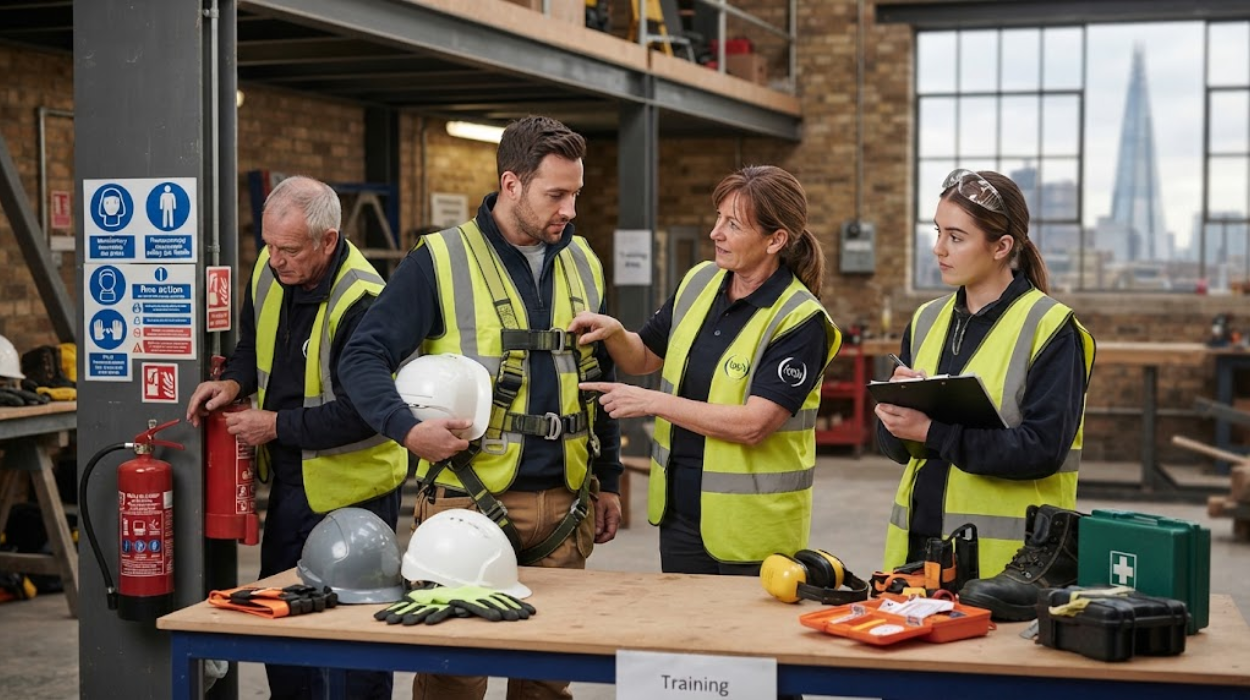
Health and safety courses in London differ by learning objective, occupational risk, delivery method, assessment approach and accreditation route. Employers and HR teams should compare course content with workforce responsibilities, regulatory requirements, practical competence, assessment evidence and measurable workplace outcomes before selecting training.
Workplace health and safety training sits within a wider employer responsibility to identify hazards, control risks, provide competent people and maintain suitable arrangements. Understanding these obligations gives HR professionals and managers the foundation for evaluating different learning routes. For a broader explanation of the legal framework, see workplace health and safety legal duties.
What types of health and safety courses in London are available?
London training options range from general workplace safety and risk assessment to specialist programmes covering facilities management, construction, fire safety, occupational risks, environmental controls and managerial responsibilities, allowing organisations to match learning depth with specific roles and operational exposure.
General health and safety courses establish foundational knowledge. Typical subjects include hazard identification, risk assessment, accident prevention, emergency procedures, safe working practices and employee responsibilities. These programmes suit employees who require a broad understanding of workplace safety.
Managerial courses address a wider responsibility. They examine safety leadership, policy implementation, risk governance, incident investigation, contractor management and performance monitoring. They are relevant to supervisors, managers, HR professionals and operational leaders.
Specialist programmes focus on defined workplace risks. Facilities teams, for example, require knowledge of building systems, maintenance activities, contractors and statutory controls. Construction teams require training aligned with site risks and project responsibilities.
The correct option depends on the competency gap rather than the course label. An organisation should identify the job function, risk exposure, current capability and required workplace outcome before selecting a programme.
How should organisations compare health and safety training formats?
Training formats should be compared according to the competency being developed, workforce availability, practical requirements, geographical distribution and assessment needs, with classroom, online, blended and corporate delivery each supporting different organisational learning conditions.
Classroom training provides direct interaction between trainers and participants. It supports discussions, case studies, group exercises and scenario-based learning. This format works well when participants need to analyse workplace situations collectively.
Online learning provides greater scheduling flexibility. It supports geographically distributed employees and self-paced learning structures. It also reduces the need for participants to travel to a training venue.
Blended learning combines digital preparation with structured instructor-led sessions. Employees can complete foundational material before attending practical activities. This approach separates knowledge acquisition from application.
Corporate delivery supports organisation-specific learning. HR teams can incorporate internal procedures, risk registers, incident examples and operational scenarios into the learning process.
The delivery decision should therefore follow the learning objective. A programme focused on practical risk evaluation requires application exercises. A programme focused on regulatory awareness can place greater emphasis on structured knowledge development.
Which accreditations matter when selecting a health and safety course?
Accreditation matters because it provides evidence about the status and recognition of a learning programme, but organisations should also examine syllabus relevance, assessment standards, trainer competence and workplace application rather than treating accreditation as the sole measure of quality.
Accreditation describes formal recognition associated with a course, qualification or awarding organisation. Certification describes evidence that a learner completed specified requirements. These terms should not be treated as interchangeable.
Employers should first establish what recognition their workforce actually requires. Some roles need a recognised qualification. Others require internal competence development supported by a course certificate and workplace assessment.
The awarding body also matters. HR teams should verify who issues the credential, what assessment process applies, how competence is evaluated and whether the qualification aligns with the employee's professional responsibilities.
Course content remains equally important. A formally recognised programme that does not address the organisation's risks provides limited operational value.
For facilities professionals, accreditation should therefore be assessed alongside technical content covering maintenance, engineering, risk management, contractor controls and operational safety.
What should a health and safety course include for managers?
Managerial health and safety training should cover legal responsibilities, risk assessment, control measures, incident management, workforce competence, contractor oversight, safety communication, documentation and performance indicators that enable managers to translate policy into operational controls.
Managers do not simply follow safety procedures. They help establish the systems through which those procedures operate.
A suitable managerial programme therefore addresses governance and implementation. Participants need to understand how responsibilities are allocated, how risks are assessed and how preventive measures are monitored.
Risk assessment is central. Managers should understand hazard identification, likelihood and consequence, control selection, review requirements and documentation.
Incident management is another important component. Managers need processes for reporting, investigation, corrective action and trend analysis.
Contractor management also requires attention where external suppliers perform maintenance, engineering, cleaning, construction or other operational services.
Training should connect these responsibilities with measurable indicators. Useful KPIs include training completion, overdue corrective actions, inspection completion, audit findings, incident reporting and risk assessment reviews.
How do specialist facilities management courses differ from general safety courses?
Facilities management courses integrate safety with buildings, maintenance, engineering systems, contractors, asset performance and operational continuity, making them more suitable for professionals whose safety responsibilities arise from managing physical assets and technical workplace services.
General safety training establishes broad workplace awareness. Facilities management training operates at a more specialised level.
Facilities professionals manage systems that directly affect workplace safety. These include electrical installations, mechanical equipment, fire protection, ventilation, access systems, plant rooms and building infrastructure.
Maintenance also has a direct safety relationship. Preventive maintenance reduces equipment deterioration. Corrective maintenance addresses identified defects. Predictive maintenance uses condition information to identify developing failures.
Contractor management adds another dimension. Facilities managers need to evaluate contractor competence, work methods, risk controls, permits and performance.
This makes facilities-oriented learning particularly relevant for organisations where health and safety is embedded in property, maintenance and engineering responsibilities.
The Facilities Management, Maintenance & Engineering training area connects facilities operations, maintenance, engineering, tender evaluation, contractor assessment, workplace safety and operational control.
How can HR teams evaluate course content against workforce skill gaps?
HR teams should begin with a competency gap analysis that maps employee roles, current knowledge, operational risks and required performance outcomes against course objectives, ensuring training addresses an identifiable business requirement rather than simply providing attendance-based development.
A skills-gap analysis starts with job responsibilities. HR teams identify what employees currently perform and what additional competence their roles require.
The next step is risk mapping. Employees working with machinery, contractors, building services or hazardous activities require different competencies from administrative employees.
Training objectives should then be mapped against these gaps. Each learning objective needs a clear connection to a workplace responsibility.
Assessment provides another comparison point. HR teams should establish whether participants will complete knowledge tests, case studies, practical exercises, written assessments or other forms of evaluation.
Post-training measurement completes the process. Managers can compare workplace indicators before and after training.
For example, an FM department can monitor statutory inspection completion, overdue corrective actions, contractor audit findings and maintenance compliance. These measures provide stronger evidence than attendance records alone.
What accreditation and assessment evidence should employers examine?
Employers should examine the awarding organisation, credential type, assessment method, learning hours, syllabus coverage, trainer requirements and evidence of competence, then determine whether the resulting credential supports the specific professional and organisational objective.
The credential should have a clearly defined purpose. Employers need to know whether it represents attendance, successful assessment, professional qualification or another recognised form of achievement.
Assessment depth is particularly important. A multiple-choice test measures knowledge differently from a practical scenario or workplace assignment.
Learning hours also provide useful context. A short awareness course and an extended professional programme cannot be evaluated using identical expectations.
The syllabus should show exactly what participants learn. Relevant content includes legal duties, risk assessment, safe systems of work, emergency planning, contractor controls and workplace monitoring.
Trainer competence also influences learning quality. Trainers should understand both the subject and its workplace application.
HR teams should record the credential alongside post-course performance evidence. This creates a more complete competency record for employees and managers.
Which health and safety course is appropriate for facilities and engineering professionals?
Facilities and engineering professionals need training that connects safety requirements with maintenance planning, asset management, technical systems, contractor activities, risk controls and operational performance rather than relying solely on broad workplace safety awareness.
A facilities manager works across multiple risk areas. Responsibilities can include planned maintenance, statutory inspections, contractor supervision, building services and emergency arrangements.
An engineering professional requires sufficient safety awareness to recognise hazards associated with technical systems and maintenance work. The role also requires understanding of when specialist competence is necessary.
Maintenance managers need to connect asset condition with safety performance. Equipment deterioration can create operational and compliance risks.
Procurement and contract professionals need another set of competencies. Their responsibilities include defining requirements, evaluating supplier capability and incorporating safety expectations into service specifications.
A course therefore becomes more relevant when its learning outcomes correspond directly with these responsibilities.
The Facilities Management, Maintenance & Engineering programme is particularly relevant where an organisation wants facilities, maintenance, engineering and safety capabilities considered as interconnected professional functions. The Academy's related training content covers tender evaluation, contractor competence, risk control and operational decision-making.
How can organisations measure the effectiveness of health and safety training?
Training effectiveness should be measured through a sequence of learning, competence, behaviour and operational indicators, linking course assessment with workplace evidence such as audit results, compliance rates, corrective actions, contractor performance and risk-control quality.
The first measurement level is learning. Tests and assessments establish whether participants understood the course material.
The second level is competence. Scenario exercises and practical assessments establish whether participants can apply knowledge to realistic workplace situations.
The third level is behaviour. Managers should observe whether employees apply risk controls, follow procedures and identify hazards consistently.
The fourth level is operational performance. Organisations can track indicators such as audit findings, corrective-action closure, inspection completion and contractor performance.
A six- or twelve-month trend provides stronger evidence than a single measurement point. Recurring improvements demonstrate whether learning has transferred into workplace activity.
HR teams can combine these measures with employee development records. This creates an evidence-based approach to workforce capability rather than relying only on course completion.
What decision criteria should HR teams use when choosing between courses?
The strongest selection framework considers role relevance, legal and technical coverage, accreditation, delivery format, assessment, trainer expertise, practical application and measurable outcomes, allowing HR teams to compare courses against organisational priorities rather than course names alone.
Role relevance should be the first criterion. The course must match the employee's responsibilities.
Curriculum coverage should follow. Organisations should check whether the programme addresses the risks, regulations and technical requirements relevant to the workplace.
Accreditation and certification should then be reviewed according to the credential required by the organisation or profession.
Delivery format determines how easily the programme fits workforce schedules and geographical requirements.
Assessment determines how competence is evidenced. Stronger assessment methods measure application as well as knowledge.
Practical relevance determines whether participants can transfer learning into workplace activities.
Measurement determines whether HR teams can demonstrate organisational value.
This framework prevents accreditation, duration or delivery format from becoming the only selection criteria. It places workforce competence and business outcomes at the centre of the decision.
How should organisations connect health and safety training with business performance?
Health and safety training creates stronger business value when learning objectives connect with operational risks, workforce capability, compliance performance, maintenance reliability and management KPIs, allowing organisations to evaluate training as part of continuous performance improvement.
Safety training influences more than individual knowledge. It supports the systems through which organisations manage workplace risk.
For facilities departments, this connection is particularly direct. Better competence supports maintenance planning, contractor oversight, inspection processes and risk controls.
For HR teams, training data supports workforce planning. Skills gaps can be identified, development pathways can be structured, and competency evidence can be incorporated into professional development records.
For managers, performance indicators provide operational evidence. A reduction in overdue actions, stronger audit results or improved inspection completion demonstrates changes in workplace control.
Explore More Expert Insights:
How General Contractors Use BIM to Cut Project Costs
What Is BIM? Building Information Modelling for Non-Engineers
Training should therefore be integrated into the organisation's wider management system. Risk registers, maintenance systems, audit programmes and performance dashboards provide useful evidence.
The decision to select a health and safety course should ultimately reflect the organisation's risk profile, workforce responsibilities, required credentials and measurable performance objectives.