
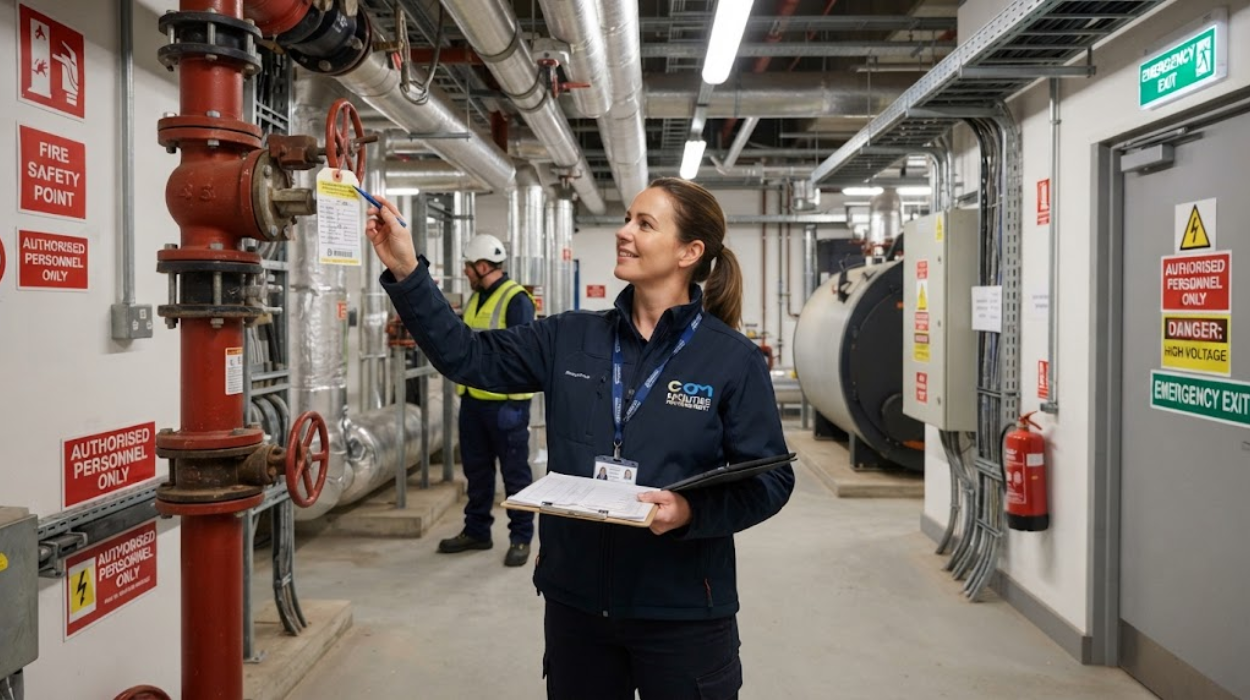
Health and safety in facilities management is a structured responsibility covering people, buildings, equipment, contractors, maintenance activities and workplace conditions. Effective FM controls connect legal duties, risk management, competent staff, planned maintenance and continuous monitoring into one operational system.
Facilities management decisions also depend on how responsibilities, competencies and evaluation criteria are defined across service delivery. Understanding the wider procurement context through FM Tender Review: Roles, Competencies and Evaluation Criteria helps connect safety requirements with contractor selection, tender evaluation and operational accountability.
What are the main health and safety duties in facilities management?
Facilities managers are responsible for establishing practical controls that protect employees, contractors, visitors and other people affected by facility operations, while ensuring risks are assessed, responsibilities are assigned, maintenance is controlled, and legal requirements are continuously monitored.
Health and safety in facilities management begins with clear ownership. The facilities manager does not necessarily perform every technical safety task, but must ensure that suitable arrangements exist and that competent people manage specialist risks.
In the UK, employers have general duties under the Health and Safety at Work etc. Act 1974. People controlling non-domestic premises also have duties towards people who use those premises. The Workplace (Health, Safety and Welfare) Regulations 1992 address fundamental workplace conditions including ventilation, temperature, lighting, cleanliness, space, traffic routes and welfare facilities.
The Management of Health and Safety at Work Regulations 1999 establish additional management requirements. These include suitable and sufficient risk assessments and arrangements for planning, organising, controlling, monitoring and reviewing preventive and protective measures.
For an FM department, these duties translate into operational controls. The department needs defined responsibilities, documented procedures, competent personnel, inspection schedules, maintenance programmes, contractor controls and incident reporting.
How does risk assessment support health and safety in facilities management?
Risk assessment provides the decision-making process for identifying hazards, evaluating risk, selecting controls and reviewing their effectiveness across buildings, assets, maintenance work, contractors, emergency arrangements and everyday workplace activities.
A facilities management risk assessment starts by identifying hazards. These include electrical systems, fire, asbestos, legionella, work at height, confined spaces, hazardous substances, machinery, slips and trips, manual handling and inadequate workplace conditions.
The next step evaluates who can be harmed and how. Employees, contractors, visitors, customers and members of the public can have different exposure levels.
Controls are then selected according to the level and nature of the risk. Engineering controls, physical safeguards, maintenance procedures, restricted access, training, supervision and personal protective equipment each have different roles.
Risk assessments also need review. A new building system, contractor, maintenance method, workplace layout or operational activity can change the risk profile.
HSE's management framework identifies leadership, management, worker involvement, competence, legal compliance and risk profiling as connected elements of effective health and safety management. Its Plan, Do, Check, Act approach provides a practical structure for continuous improvement.
Which standards and regulations influence facilities management safety?
Facilities management safety is governed by a combination of legislation, approved guidance, technical standards, organisational procedures and industry practices, with the applicable requirements depending on the building, activities, workforce, assets and specific risks being managed.
There is no single standard that covers every FM safety responsibility. Facilities managers work across multiple regulatory and technical areas.
The Workplace (Health, Safety and Welfare) Regulations 1992 provide requirements covering fundamental workplace conditions. These include ventilation, temperature, lighting, cleanliness, floor conditions, traffic routes, sanitary facilities and washing facilities.
Other requirements apply to particular activities. Work at height, fire safety, hazardous substances, asbestos, electrical work, lifting equipment and construction activities each involve specific legal or technical requirements.
Technical standards also support consistent maintenance and building management. HSE guidance identifies BS 8210 as a guide to facilities maintenance management, while other standards address areas such as access equipment, structures and workplace systems.
Facilities managers therefore need a compliance register that identifies the requirement, responsible person, inspection frequency, evidence required and corrective action process.
How should facilities managers manage contractors and maintenance teams?
Contractor safety depends on defined responsibilities, competence checks, risk controls, method statements, communication, supervision, permit systems and performance monitoring that continue from contractor selection through completion and review of the work.
Contractors introduce additional risks because facilities managers often do not directly control their workforce. The FM function must therefore establish requirements before work begins.
Prequalification checks should consider competence, relevant experience, insurance, training, safety performance and technical capability. The exact requirements should reflect the risk associated with the contracted activity.
Work planning then converts these requirements into operational controls. Higher-risk work requires stronger controls, clearer communication and appropriate authorisation.
Permit-to-work systems are particularly relevant for activities such as hot work, confined-space entry and certain electrical or maintenance operations. They create a controlled process for authorising specific work under defined conditions.
Contract performance should also be monitored. Useful measures include completed inspections, overdue corrective actions, incident frequency, repeat defects, planned maintenance completion and contractor audit findings.
This approach connects safety with procurement. Contractor evaluation is not only a commercial exercise. Competence and safety capability influence whether a supplier can deliver the required FM service reliably.
What competencies should facilities management professionals have?
Competent FM professionals need a combination of technical knowledge, risk-management capability, communication skills, contractor-management expertise, regulatory awareness, maintenance understanding and the ability to translate safety requirements into measurable operational controls.
Competence means more than completing a training course. It involves the knowledge, skills, experience and behaviours required to perform responsibilities effectively.
Facilities managers need sufficient technical understanding to recognise risks in building services and maintenance activities. They do not need to perform every specialist engineering task themselves, but they need to recognise when specialist competence is required.
Risk assessment is another core competency. Managers need to identify hazards, understand control measures and challenge weak or incomplete assessments.
Contract management is equally important. FM professionals need to establish scopes of work, service requirements, performance measures and safety expectations.
Communication also has a direct safety function. Instructions need to be understood by employees, contractors and other stakeholders.
For HR teams, this creates a workforce development question. Training should address the specific competence gaps identified through risk assessments, audits, incidents, performance reviews and operational changes.
How should organisations evaluate health and safety performance in facilities management?
FM safety performance should be evaluated through measurable indicators covering compliance, risk controls, maintenance, incidents, corrective actions, contractor performance, workforce competence and workplace conditions rather than relying on training attendance or incident counts alone.
A strong measurement system combines leading and lagging indicators.
Lagging indicators measure events that have already happened. These include accidents, injuries, property damage, enforcement actions and reportable incidents.
Leading indicators measure preventive activity. Examples include risk assessments completed, safety inspections conducted, planned maintenance completed, corrective actions closed and staff competence assessments completed.
A practical FM dashboard can include:
The value of these indicators comes from trend analysis. A single monthly result provides limited information. A 6- or 12-month trend shows whether controls are improving or deteriorating.
HSE's approach emphasises that effective management is systematic rather than dependent on one-off interventions.
How does maintenance affect health and safety in facilities management?
Maintenance protects health and safety by keeping critical building systems, equipment and infrastructure in a suitable operating condition while reducing failure risks, supporting compliance and providing evidence that assets receive appropriate inspection and servicing.
Maintenance is directly connected to safety. A poorly maintained ventilation system can affect indoor conditions. Defective electrical equipment can create electrical hazards. Failed fire protection systems can compromise emergency protection.
FM teams generally manage several maintenance approaches. Preventive maintenance follows planned intervals. Predictive maintenance uses condition information to identify developing failures. Corrective maintenance addresses identified defects, while reactive maintenance responds after failure.
The correct approach depends on asset criticality, failure consequences, operating conditions and regulatory requirements.
Asset criticality assessment helps facilities managers prioritise resources. A critical fire protection system receives a different maintenance strategy from a low-consequence non-critical asset.
Lifecycle thinking also matters. Building maintenance programmes need to consider asset condition, performance, renewal requirements and whole-life risk. Facilities management training programmes commonly connect maintenance planning with asset management, lifecycle decisions and operational performance.
How should organisations choose training for facilities management health and safety responsibilities?
Training should be selected according to identified competence gaps, job responsibilities, operational risks and required performance outcomes, with delivery methods evaluated by practical application, knowledge retention, workplace behaviour and measurable improvements in FM performance.
Training selection starts with a skills-gap analysis. HR teams and FM leaders should identify where current capability falls short of operational requirements.
A facilities manager may require broader knowledge of risk, compliance, contractor management and asset performance. An engineer needs stronger technical competence. A supervisor may need practical skills in safe work control and workforce communication.
Learning delivery should match the competency being developed. Classroom training supports structured discussion and case analysis. Practical exercises support application. Workshops can address organisation-specific procedures and risk scenarios.
The assessment method also matters. A completion certificate demonstrates participation, not workplace competence. Better evaluation examines knowledge, application and operational outcomes.
Relevant measures include improved audit scores, fewer overdue corrective actions, stronger maintenance compliance, better contractor performance and faster closure of identified risks.
The Facilities Management, Maintenance & Engineering training area provides a relevant learning context where facilities operations, maintenance, asset management and workplace safety can be considered as connected professional capabilities.
What should an organisation evaluate before selecting an FM health and safety training programme?
Organisations should evaluate curriculum relevance, trainer expertise, practical application, competency coverage, assessment methods, delivery format, alignment with operational risks and the ability to measure post-training changes in workplace performance.
The first criterion is relevance. A programme should address the actual responsibilities of the target workforce rather than presenting generic safety information.
The second is practical application. Participants should work with realistic facility scenarios involving risk assessments, maintenance activities, contractor controls, compliance decisions and incident management.
The third is competency coverage. The programme should address the combination of technical, managerial and behavioural capabilities required by the role.
The fourth is measurement. HR teams should determine how learning outcomes will be assessed after delivery.
The fifth is organisational integration. Training should connect with existing risk registers, maintenance systems, contractor procedures, audit programmes and performance dashboards.
At this decision stage, organisations evaluating a dedicated programme can review what participants learn in FM tendering and health and safety training against their own competency requirements, compliance responsibilities and operational priorities.
How can HR teams measure the business impact of facilities management safety training?
HR teams can measure training impact by connecting learning outcomes with workplace indicators such as competence assessments, audit findings, maintenance compliance, corrective-action closure, contractor performance, incident trends and operational reliability.
Training ROI should not be measured only through attendance or satisfaction scores.
A stronger model begins with baseline data. Before training, HR and FM leaders record relevant performance indicators. After training, the same indicators are reviewed at defined intervals.
For example, an organisation can measure statutory maintenance completion before and after training. It can also compare overdue corrective actions, audit findings and risk assessment quality.
Competence assessments provide another layer. Participants can complete knowledge assessments, scenario exercises or practical evaluations.
Operational managers should then review whether participants apply the learning. This creates a connection between learning and workplace performance.
The final measure is organisational impact. Improvements in compliance, reliability, risk control and resource utilisation demonstrate whether the learning intervention contributed to business objectives.
What does an effective facilities management health and safety framework look like?
An effective framework connects legal compliance, risk assessment, competent people, safe maintenance, contractor management, workplace conditions, emergency preparedness, performance measurement and continuous improvement into one accountable facilities management operating system.
The strongest frameworks do not treat health and safety as a separate administrative function. Safety is integrated into procurement, maintenance, asset management, workforce planning and daily operations.
Responsibilities are defined at each level. Managers establish arrangements. Competent specialists manage technical requirements. Supervisors control work activities. Employees and contractors follow procedures and report hazards.
Evidence supports the system. Risk assessments, inspection records, maintenance logs, training records, contractor audits, incident reports and corrective-action registers demonstrate whether controls are operating.
Performance data then supports management decisions. Recurring defects indicate maintenance problems. Repeated contractor findings indicate supplier-control issues. Persistent training gaps indicate workforce-development requirements.
Explore More Expert Insights:
Social Media Targeting and Marketing Communication That Converts
Behavioral Economics in Marketing: 9 Biases That Drive Buying
This creates a continuous cycle of Plan, Do, Check and Act, consistent with the management approach promoted by HSE.
For organisations comparing FM capabilities, the central consideration is not simply whether a safety procedure exists. The stronger question is whether people, processes, assets and suppliers consistently operate within defined controls and whether management can prove that those controls work.