
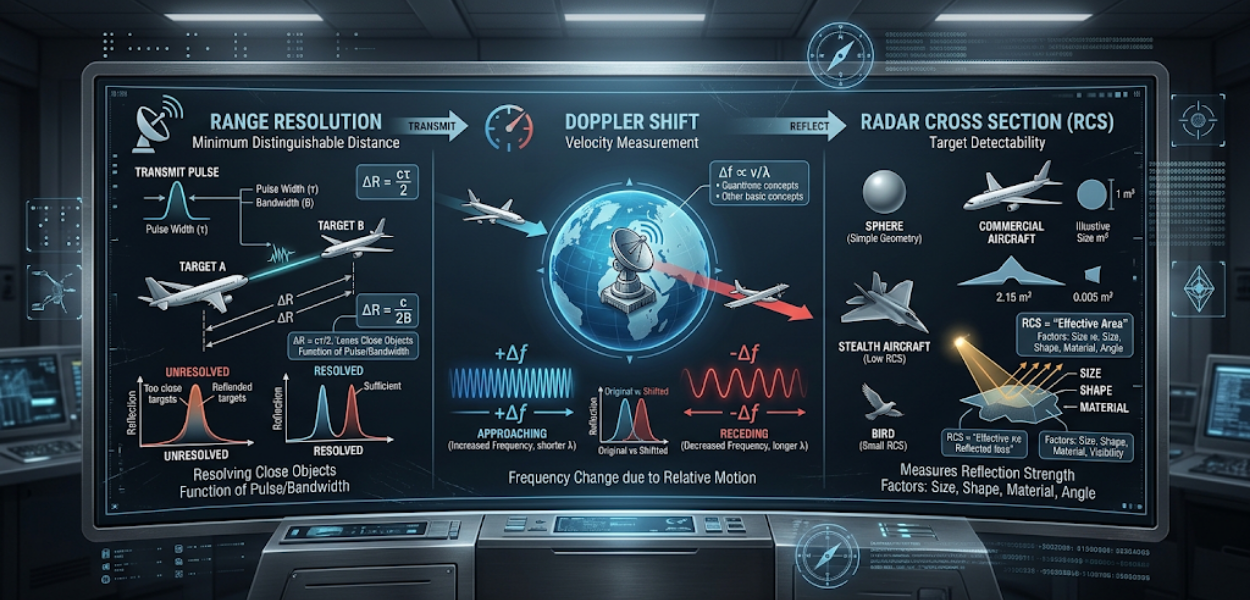
Radar performance depends on how accurately a system detects objects, separates targets, identifies movement, and maintains reliable measurements in complex environments. Range resolution, Doppler shift, and radar cross section are three core concepts that determine how radar signals behave and how effectively systems interpret returned energy.
Understanding these concepts provides the technical foundation for evaluating Radar Systems and Signal Processing approaches, especially when organisations need engineers and technical teams to improve detection performance, signal interpretation, and operational reliability. A broader overview of radar capabilities, signal processing methods, and professional development approaches is available through the Radar Systems and Signal Processing Training Courses.
What determines radar range resolution?
Range resolution determines how closely two objects can be positioned along the radar line of sight while still being detected as separate targets, with bandwidth, pulse duration, waveform design, and signal processing directly controlling achievable separation.
Range resolution is primarily associated with the bandwidth of the transmitted radar signal. For a basic pulse radar, range resolution is approximately determined by the relationship between pulse duration and the propagation speed of electromagnetic energy. Shorter pulses produce finer resolution because the returned signals occupy a smaller time interval.
For a radar signal with effective bandwidth (B), range resolution is commonly expressed as:
[
\Delta R \approx \frac{c}{2B}
]
where (c) represents the speed of light and (B) represents the signal bandwidth.
A bandwidth of 10 MHz produces a theoretical range resolution of approximately 15 metres, while 100 MHz produces approximately 1.5 metres under ideal conditions. This difference becomes important when radar operators need to distinguish closely spaced vehicles, aircraft, maritime objects, or other targets.
Pulse duration also affects basic radar resolution. A long transmitted pulse contains more energy and supports detection under challenging conditions, but its duration creates a larger minimum separation between two targets. This produces an engineering trade-off between transmitted energy and resolution.
Modern systems address this trade-off through waveform design and signal processing. Pulse compression allows a radar to transmit a longer coded or frequency-modulated pulse while processing the received signal to achieve a much narrower effective response.
This approach separates transmission energy requirements from final range resolution. Engineers therefore evaluate both waveform bandwidth and processing performance rather than considering pulse duration alone.
How does pulse compression improve radar performance?
Pulse compression improves radar performance by transmitting energy over a relatively long waveform while using signal processing to create a narrow compressed response, improving range resolution without requiring the same limitations as an extremely short transmitted pulse.
Pulse compression is particularly valuable in systems that require both detection range and target separation. A longer pulse delivers greater energy to the target, increasing the energy available for detection. Processing then compresses the received waveform to obtain a narrower response.
Linear frequency modulation is one established pulse-compression technique. The transmitted signal changes frequency across the pulse bandwidth. When the received signal passes through an appropriate processing stage, the frequency components align to produce a concentrated output peak.
The compression ratio relates to the product of pulse duration and bandwidth. Increasing this time-bandwidth product generally increases the processing gain available from pulse compression.
A matched filter is central to this process. It is designed to maximise the signal-to-noise ratio for a known transmitted waveform. In radar processing, the matched filter correlates the received signal with the expected waveform and produces a strong response when the waveform is present.
The result is a sharper detection peak that supports improved range estimation.
For organisations managing radar engineering teams, pulse compression is therefore not simply a transmission technique. It requires coordinated understanding of waveform generation, receiver architecture, digital signal processing, sampling, filtering, and detection algorithms.
Training decisions should reflect this system-level relationship. Engineers who understand only individual processing stages have less visibility into how changes in bandwidth, sampling rate, filter design, and waveform selection affect complete radar performance.
What is Doppler shift and why does it matter in radar?
Doppler shift is the frequency change produced when there is relative motion between a radar and a target, allowing radar systems to estimate radial velocity and distinguish moving objects from stationary returns and background clutter.
When a radar transmits a signal toward a moving target, the frequency of the reflected signal differs from the transmitted frequency. This difference is known as Doppler shift.
For monostatic radar systems, where the transmitter and receiver are located together, Doppler frequency is commonly represented as:
[
f_D = \frac{2v}{\lambda}
]
where (v) is the target's radial velocity and (\lambda) is the radar wavelength.
The factor of two exists because the radar signal travels from the transmitter to the target and then returns to the receiver.
A target moving toward the radar produces a different frequency response from one moving away. The measured Doppler frequency therefore provides information about radial motion.
Doppler processing becomes especially important when radar systems operate in environments containing stationary objects, terrain, buildings, vegetation, sea surfaces, or other sources of unwanted returns.
A radar system can analyse frequency changes across multiple received pulses to identify moving targets. This process often involves coherent processing, pulse-to-pulse comparison, Doppler filtering, and detection algorithms.
Doppler information also introduces design considerations. Pulse repetition frequency affects the unambiguous velocity range, while coherent processing intervals influence Doppler resolution.
This creates a relationship between radar waveform design and signal-processing architecture. Engineers evaluating system performance therefore need to consider range and velocity measurements together rather than treating them as completely independent parameters.
How does Doppler processing support clutter rejection?
Doppler processing supports clutter rejection by separating radar returns according to their frequency or velocity characteristics, allowing processing systems to suppress unwanted stationary or slowly changing reflections while retaining relevant moving-target information.
Clutter refers to unwanted radar returns that do not represent the target of interest. Ground surfaces, buildings, vegetation, weather phenomena, and sea conditions generate different forms of clutter depending on the radar environment.
Clutter rejection is therefore a central part of radar signal processing.
Moving Target Indication and Moving Target Detection techniques use differences between successive radar returns to identify motion. Doppler filters separate signals according to frequency, creating a mechanism for reducing returns that occupy undesirable velocity regions.
The effectiveness of clutter rejection depends on the environment and radar architecture. A stationary ground return has a very different Doppler characteristic from a rapidly moving aircraft. However, wind-driven vegetation, rotating machinery, waves, and weather produce more complex Doppler behaviour.
This is why engineers need to evaluate clutter characteristics alongside target characteristics.
Poor clutter rejection increases false detections and reduces the ability of operators or automated systems to identify meaningful targets. Excessive filtering creates the opposite problem by suppressing legitimate targets.
A balanced processing strategy therefore requires knowledge of the expected operating environment, target velocity distribution, radar waveform, antenna characteristics, receiver performance, and detection thresholds.
For B2B training decisions, these relationships matter because radar engineers often work across several technical disciplines. Effective development programmes need to connect theoretical signal processing with practical system-level performance analysis.
What is radar cross section and how does it affect detection?
Radar cross section describes how strongly an object reflects electromagnetic energy toward a radar, with target shape, material, wavelength, aspect angle, and surface characteristics influencing the strength of the returned signal.
Radar cross section, commonly abbreviated as RCS, is expressed in square metres. It does not simply represent the physical size of an object.
A relatively large object can have a smaller radar return from one aspect angle, while a smaller structure with an efficient reflecting geometry can produce a stronger return.
Several characteristics influence radar cross section. These include the object's shape, electrical properties, surface structure, radar wavelength, polarisation, and angle relative to the radar.
Aspect angle is particularly important. An object can present different reflective characteristics as it changes orientation relative to the radar.
RCS also influences radar detection range because the returned signal strength affects the signal-to-noise ratio available to the receiver. The radar range equation incorporates radar cross section as one of the factors influencing received power.
This makes RCS important when engineers evaluate detection performance, target signatures, radar coverage, and system sensitivity.
RCS should not be interpreted as a fixed universal property of an object. It changes with operating conditions and measurement geometry.
For training and workforce development, this distinction is important. Technical teams need to understand why a target's observed radar signature changes instead of assuming that physical dimensions alone determine detectability.
How are range resolution, Doppler shift and radar cross section connected?
Range resolution, Doppler shift, and radar cross section describe different aspects of radar detection, but they interact within the same processing chain by determining where a target appears, how it moves, and how strongly its return is detected.
Range resolution primarily describes separation along the radar's line of sight. Doppler shift provides information about radial motion. Radar cross section influences the strength of the reflected signal.
Together, these characteristics contribute to the target's observable radar signature.
A radar processor can therefore represent detections across multiple dimensions. A target can have a particular range, Doppler frequency, amplitude, and angular position.
Signal processing systems combine these measurements to distinguish meaningful targets from noise and clutter.
The relationship becomes particularly important when targets are close together. Two objects can occupy similar ranges but have different velocities. Doppler processing then provides an additional method of separation.
Similarly, two targets can have similar Doppler characteristics while appearing at different ranges. Improved range resolution helps distinguish them.
RCS introduces another dimension because targets with different reflective properties generate different signal strengths.
This multi-dimensional view explains why radar performance cannot be evaluated using one metric alone. A system with excellent range resolution still requires effective Doppler processing and adequate detection sensitivity.
Which radar signal-processing methods should organisations evaluate?
Organisations should evaluate radar processing methods according to their operational requirements, waveform architecture, target environment, processing constraints, and measurable performance objectives rather than selecting techniques independently from the wider radar system.
The first consideration is the operational requirement. Air surveillance, maritime monitoring, automotive sensing, weather observation, industrial sensing, and defence applications impose different requirements on range, velocity, accuracy, latency, and target density.
The second consideration is waveform architecture. Engineers need to understand how bandwidth, pulse duration, pulse repetition frequency, modulation, and coherent processing influence final performance.
The third consideration is computational capability. Modern radar systems increasingly depend on digital processing platforms capable of handling large volumes of sampled data.
Processing architecture affects latency, throughput, memory requirements, and algorithm implementation.
The fourth consideration is environmental complexity. A technique that performs effectively in a controlled environment requires different validation when exposed to dense clutter, interference, multipath, rapidly changing targets, or multiple simultaneous returns.
Professional development should therefore address the complete processing workflow. A structured programme can cover waveform generation, receiver processing, matched filtering, pulse compression, Doppler analysis, clutter rejection, target detection, and performance measurement.
For organisations addressing technical workforce gaps, Information Technology and Programming Courses can support broader technical development where radar processing increasingly intersects with programming, computational methods, data processing, and software-based implementation.
How should radar training effectiveness be measured?
Radar training effectiveness should be measured through technical competency, processing accuracy, practical implementation, problem-solving performance, and measurable improvements in system analysis rather than attendance or course completion alone.
Training managers can establish measurable learning outcomes before selecting a delivery model.
Technical assessments can measure understanding of range resolution, Doppler shift, radar cross section, pulse compression, matched filtering, and clutter rejection.
Practical exercises can evaluate whether engineers can analyse radar returns, interpret signal-processing outputs, identify processing limitations, and explain performance changes.
Workplace assessments provide another measurement layer. Engineers can be evaluated on their ability to troubleshoot processing chains, compare waveform configurations, interpret detection results, and document technical findings.
For HR and learning teams, these outcomes create a clearer connection between training investment and workforce capability.
Training delivery can also be assessed according to the technical requirements of the workforce. Instructor-led programmes provide direct technical interaction and structured problem-solving. Virtual delivery supports distributed engineering teams. Blended learning combines structured instruction with practical technical exercises and post-training application.
The appropriate model depends on workforce location, existing competency, technical complexity, available equipment, and the amount of practical work required.
What should engineers consider before selecting a radar training approach?
Engineers and training managers should evaluate curriculum depth, practical signal-processing work, instructor expertise, technical relevance, delivery format, assessment methods, and workplace application to ensure learning aligns with actual radar engineering responsibilities.
Curriculum depth should match the team's responsibilities. Engineers working with radar receivers require different development priorities from managers overseeing radar programmes or software specialists implementing processing algorithms.
Technical relevance is equally important. Training should address the radar architectures and processing environments used by the organisation.
Practical application provides another selection criterion. Engineers should have opportunities to work through realistic signal-processing problems rather than relying exclusively on theoretical explanations.
Assessment should also reflect workplace requirements. Knowledge tests measure conceptual understanding, while practical exercises reveal whether participants can apply concepts to technical scenarios.
The final consideration is business application. HR teams and technical managers need to connect learning objectives with measurable workforce outcomes such as improved troubleshooting capability, faster technical analysis, stronger documentation, reduced processing errors, or more consistent engineering decisions.
When training selection moves from general awareness toward a specific professional development solution, the decision becomes more focused on curriculum design, delivery methodology, practical depth, and technical relevance. At this stage, organisations can examine advanced radar systems and signal processing expertise delivered by engineers with system-building experience as a decision-stage reference for evaluating specialist learning approaches.
How can organisations connect radar expertise with wider technical capability?
Radar engineering increasingly requires combined expertise across electromagnetic principles, signal processing, programming, data analysis, digital systems, and technical decision-making, making cross-functional capability an important consideration in workforce development planning.
Radar processing is no longer isolated from software and computational engineering.
Modern systems depend on algorithms that transform raw sampled signals into useful detection information. This creates demand for engineers who understand both radar principles and the computational environments used to implement them.
Programming capability supports algorithm development, simulation, data analysis, testing, and automation. Signal-processing knowledge enables engineers to understand what the algorithms are expected to achieve.
This combination becomes particularly relevant when organisations modernise legacy radar architectures or introduce software-defined processing environments.
Workforce planning should therefore identify individual skill gaps and team-level capability gaps separately.
An engineer can understand radar fundamentals but require stronger programming skills. Another engineer can have strong software experience but require deeper knowledge of Doppler processing and radar signatures.
A structured development plan can address these gaps through targeted technical learning rather than treating radar competence as a single skill.
Explore More Expert Insights:
Digital Signal Processing: Sampling, Aliasing and Quantisation in Communication Receivers
Antenna Design and Measurement: Gain, Directivity and Radiation Pattern Fundamentals
The result is a more measurable approach to workforce development. Organisations can map required competencies to roles, identify existing capabilities, select appropriate learning interventions, and evaluate performance after training.
Radar systems ultimately depend on the interaction between electromagnetic energy, target characteristics, receiver architecture, and signal-processing decisions. Understanding range resolution, Doppler shift, and radar cross section provides the technical foundation for evaluating how these systems detect and interpret targets.